For years, sales and RevOps teams have treated the 35% qualified-to-booked benchmark as gospel. Hit that number, and you're doing fine. Fall below it, and something's broken. The problem? That benchmark emerged from a different era of B2B sales, one defined by manual lead review queues, 48-hour email response times, and buyers who actually waited for your SDR to call them back.
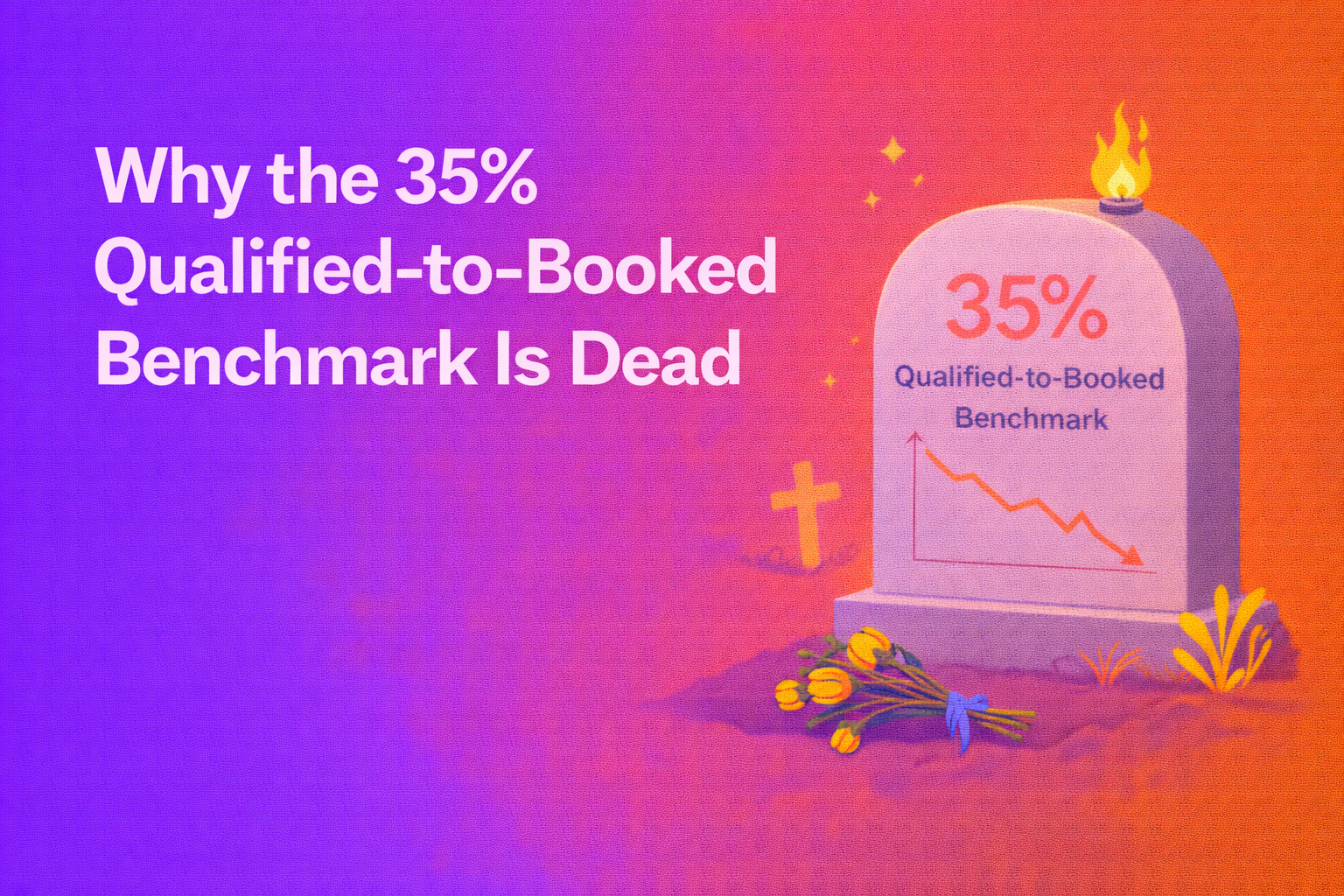
The 35% qualified-to-booked benchmark is dead because the conditions that created it no longer exist. Modern buyers self-educate before ever filling out a form. They expect instant responses. And when they don't get one, they move on to a competitor who delivers. Recent data from over one million inbound form submissions tells a different story: the median qualified-to-booked rate among companies using instant scheduling is 62%. The top 10% hit 78% or higher. If your team is still treating 35% as acceptable, you're leaving significant pipeline on the table with the same traffic, same spend, and same leads you already have.
The gap between 35% and 78% isn't about lead quality or product-market fit. It's about what happens in the 30 seconds after someone clicks "Book a Demo."
The Erosion of the Traditional 35% Conversion Standard
The 35% benchmark didn't appear from nowhere. It reflected the reality of how most B2B companies operated their inbound funnels for the better part of a decade. Understanding why it existed helps explain why it no longer applies.
Historical Context: Why 35% Was Once the Golden Rule
The traditional inbound process looked like this: a lead fills out a form, the form goes to a queue, someone manually reviews it, routes it to the right rep, and eventually sends an email asking to schedule a call. Days pass. Intent decays. The meeting that should have happened doesn't.
In that world, 35% was actually reasonable. You were fighting against time delays, manual handoffs, and the simple reality that leads go cold. Sales teams accepted this number because they didn't know any better, and because the technology to do things differently didn't exist at scale.
The Shift from Quantity to High-Intent Pipeline
The shift away from this benchmark coincides with a fundamental change in how go-to-market teams measure success. Volume metrics like MQLs and form fills have given way to pipeline quality and conversion efficiency. RevOps leaders now care less about how many leads entered the funnel and more about how many actually became revenue.
This shift exposes the 35% benchmark for what it always was: a symptom of broken process, not a standard to aspire to.
How Modern Buyer Behavior Has Broken the Funnel
Your prospects have changed. The funnel you built five years ago was designed for a different type of buyer, and it's now actively working against you.
The Rise of the Self-Educated Buyer
By the time someone fills out your demo request form, they've already done their homework. They've read reviews, compared alternatives, and likely watched a product video or two. They're not looking for education. They're looking for validation and a conversation with someone who can answer their specific questions.
This means the window for engagement has shrunk dramatically. A buyer who's ready to talk today may have moved on by tomorrow. The old assumption that leads would patiently wait for your follow-up no longer holds.
Friction Points: Why Qualified Leads Abandon the Booking Flow
Every step between form submission and confirmed meeting is a potential exit point. The "thanks, we'll be in touch" confirmation page. The 24-hour wait for an SDR email. The back-and-forth to find a mutually available time. Each of these moments gives your qualified lead a chance to reconsider, get distracted, or book a meeting with your competitor instead.
Data shows that companies putting a calendar in front of qualified leads immediately, not after manual review, convert at nearly double the rate of those who don't.
The Hidden Costs of Chasing Arbitrary Benchmarks
When teams anchor to outdated benchmarks, they make decisions that feel reasonable but actually harm pipeline quality and sales efficiency.
Incentivizing Sales Development Reps for the Wrong Outcomes
If your SDR team is measured against a 35% qualified-to-booked target, they'll optimize for that number. This often means loosening qualification criteria to inflate the numerator or spending excessive time chasing leads who were never going to book. Neither behavior produces better pipeline.
The real cost isn't just wasted SDR time. It's the opportunity cost of not focusing on the leads who were genuinely ready to buy and needed immediate attention.
The Lead Quality vs. Volume Paradox
Teams chasing arbitrary conversion benchmarks often fall into a trap: they prioritize volume over quality to make their numbers look better. A 35% conversion rate on 100 leads sounds worse than 35% on 150 leads, even if the additional 50 leads were never going to close.
Top performers take the opposite approach. They're pickier about who qualifies for sales conversations, which means their qualified-to-booked rates are higher and their sales cycles are shorter. The disqualification rate among top-performing companies runs around 71%, compared to 22% for SMB-focused teams. Being selective pays off.
New Metrics for Success: Beyond the Qualified-to-Booked Ratio
If the 35% benchmark is dead, what should you measure instead? The answer lies in metrics that capture the full picture of conversion efficiency.
Measuring Speed-to-Meeting and No-Show Rates
Speed to lead has always mattered, but speed to meeting matters more. The time between form submission and confirmed calendar slot is your new critical metric. Companies booking meetings within minutes of form submission consistently outperform those with multi-day response times.
No-show rates tell you whether your booking process is creating genuine commitment. If leads are booking but not showing up, your qualification or scheduling process may be too frictionless in the wrong places.
Pipeline Velocity and Customer Acquisition Cost Efficiency
The ultimate test of your conversion process is how efficiently it turns demand into revenue. Pipeline velocity, the speed at which opportunities move through your funnel, reveals whether your booking process is creating momentum or stalling deals.
Customer acquisition cost efficiency connects your conversion rate to actual business outcomes. A 78% qualified-to-booked rate means you're extracting more pipeline from the same marketing spend. That's not just a better number. It's a better business.
Optimizing the Modern Conversion Path
Knowing that the old benchmark is obsolete is one thing. Building a process that achieves modern conversion rates is another.
Implementing Instant Scheduling for Inbound Leads
The companies hitting 78%+ qualified-to-booked rates share one characteristic: they put a calendar in front of qualified leads immediately. Not after manual review. Not after an SDR email. Right then, in the moment of highest intent.
This requires real-time qualification using form responses, enrichment data, and CRM history. Platforms like RevenueHero enable this by qualifying and routing leads instantly, so the moment someone submits a form, they know if they qualify and can book time with the right rep.
The gap between 35% and 78% often comes down to this single decision: do they see a calendar, or do they see a "thanks, we'll be in touch" message?
Leveraging Intent Data to Redefine 'Qualified'
Static qualification criteria based on company size and title miss the point. Intent signals, including what pages they visited, how they found you, and what they said in the form, tell you far more about readiness to buy.
Top performers use this data to route leads dynamically. A prospect who visited your pricing page three times and filled out a demo form gets immediate access to a calendar. A first-time visitor requesting general information might get a different path. The definition of "qualified" becomes contextual rather than binary.
Future-Proofing Your Sales Development Strategy
The death of the 35% benchmark isn't a one-time event. Buyer expectations will continue to rise, and the bar for conversion efficiency will keep moving higher. Teams that treat their conversion process as a static system will fall behind.
The companies that win aren't doing anything complicated. They use "Book" instead of "Request" in their CTAs. They cut form fields that don't help routing or personalization. They're pickier about who gets through to sales. And when someone qualifies, they put a calendar in front of them immediately.
None of this requires a bigger budget or better leads. You already have the traffic. You already have people raising their hands. The only question is how many of them actually end up talking to your team.
If you're at 40% today and you get to 62%, that's 22 more meetings for every 100 qualified leads. Get to 78%, and you've nearly doubled your output from the same demand. The 35% benchmark served its purpose in a different era. It's time to leave it there.
Let RevenueHero help your team turn high-intent users into booked meeting without slowing down your funnel.