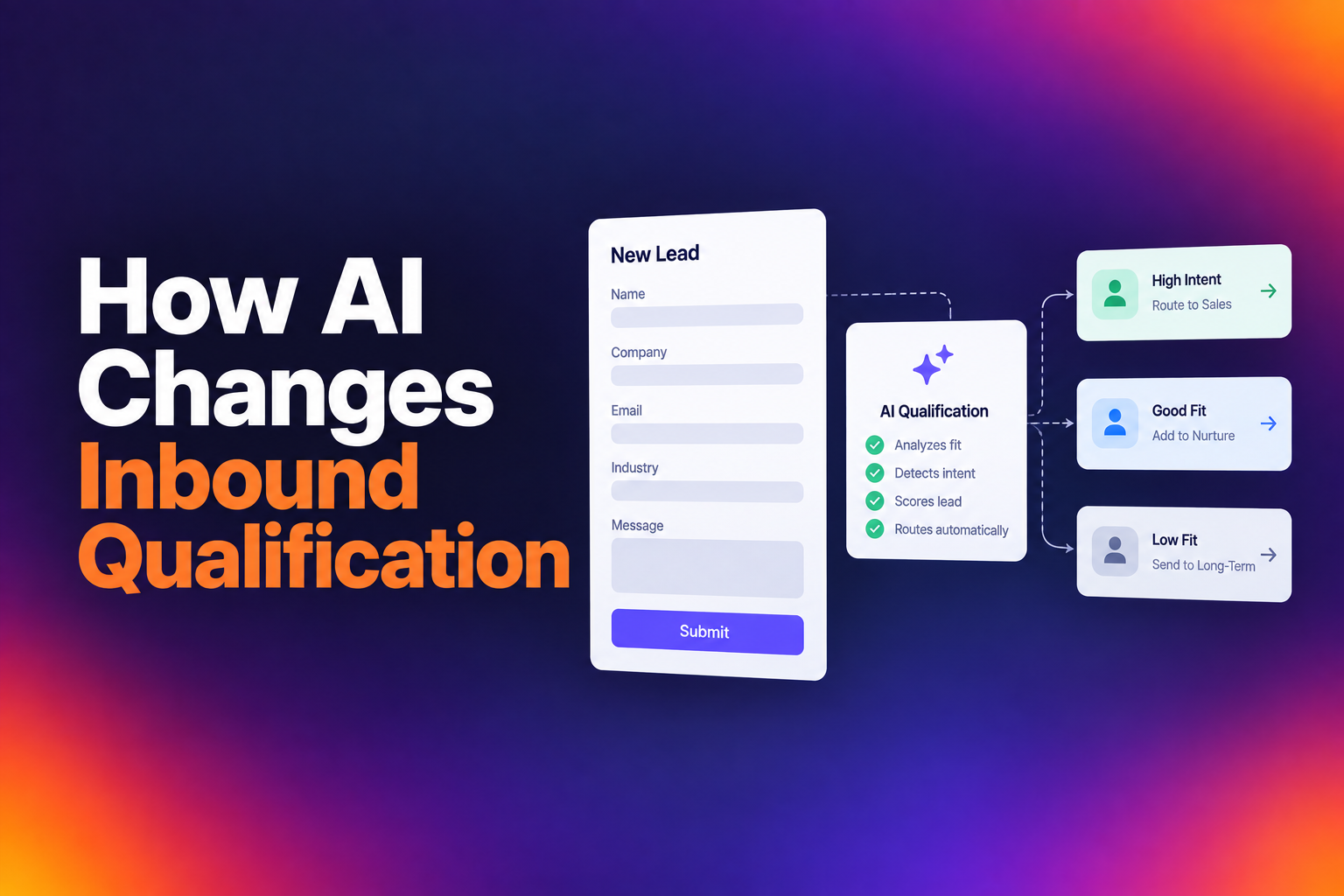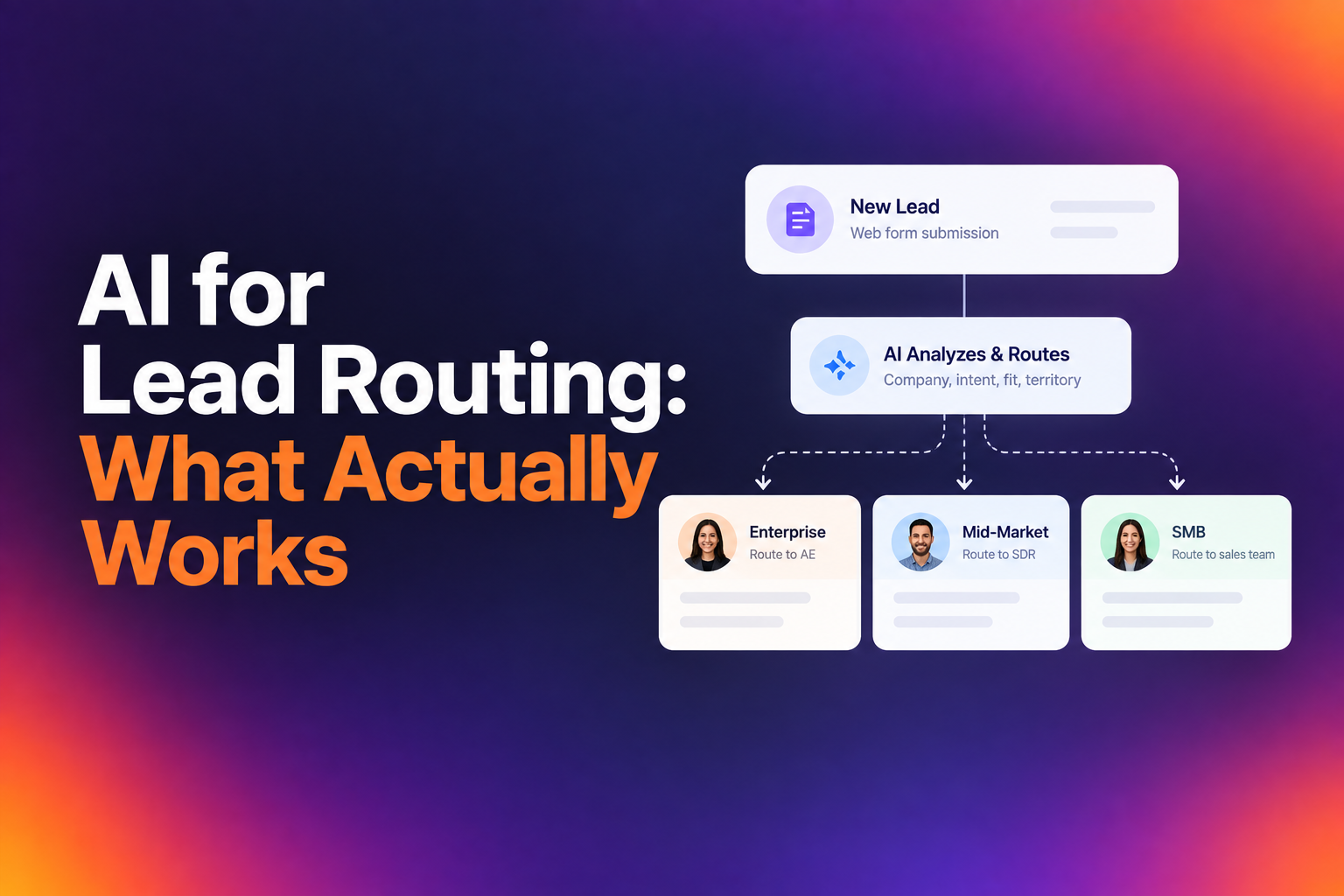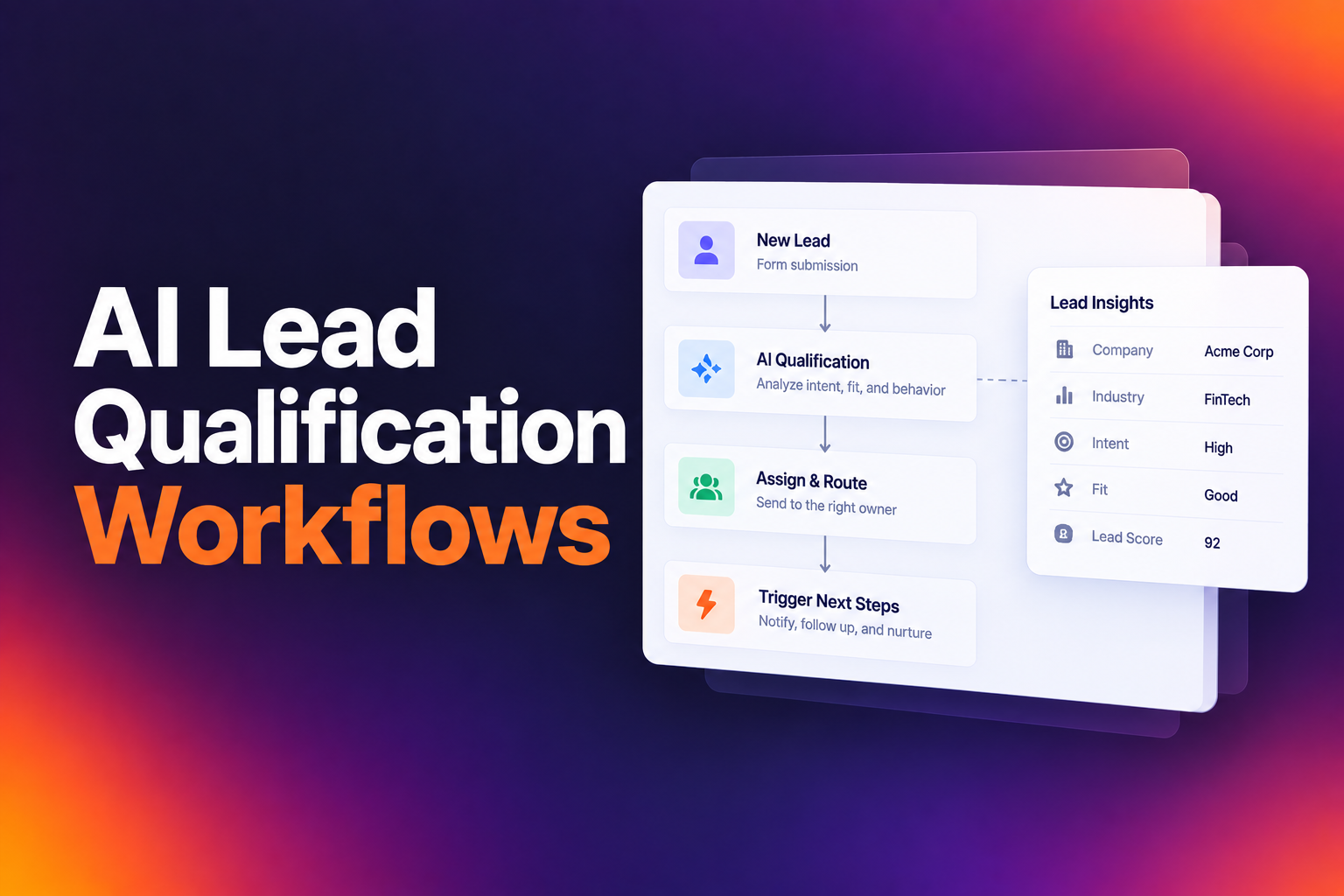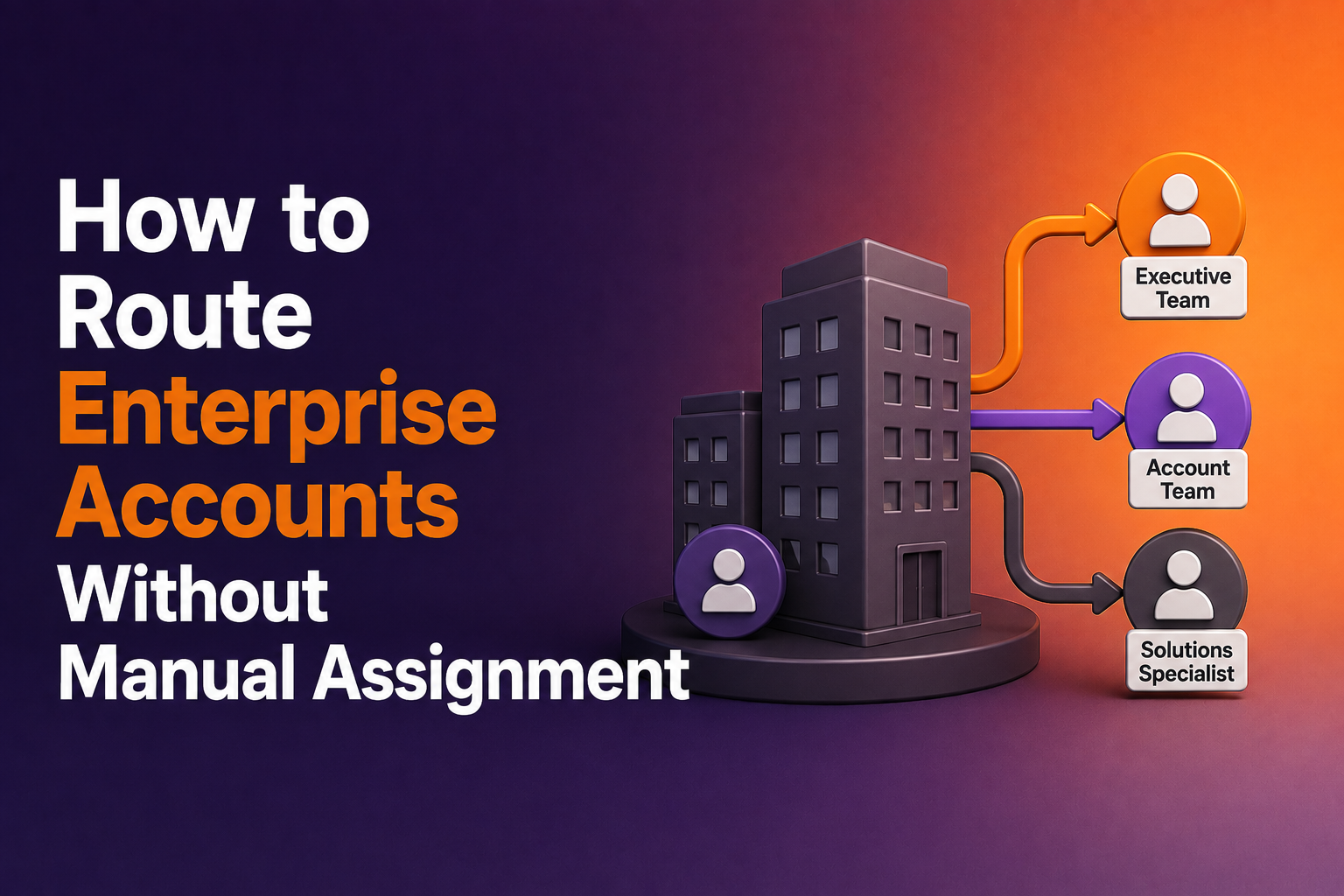
Every enterprise deal starts with a moment of intent: someone fills out a form, clicks a button, and signals they're ready to talk. What happens in the next 30 seconds determines whether that signal becomes a meeting or a missed opportunity. For most B2B companies, the answer is disappointing: the form goes to a queue, someone manually reviews it, maybe they route it, maybe they email the lead back. Days pass. Intent decays. The meeting that should have happened doesn't. The gap between a 35% qualified-to-booked rate and a 78% rate isn't about having better leads or a better product. It's about eliminating the manual steps that sit between a buyer's intent and a calendar invite. If you're trying to figure out how to route enterprise accounts without relying on manual assignment, you're asking the right question at the right time.
The Hidden Cost of Manual Lead Assignment in Enterprise Sales
Manual assignment feels safe. A human reviews each lead, decides who should own it, and sends it along. But that sense of control comes at a steep cost: speed. In enterprise sales, where deal cycles are long and buying committees are large, the first conversation often sets the trajectory. Delaying that conversation by even a few hours introduces risk that compounds throughout the pipeline.
The real damage isn't just slower response times. It's the invisible friction that erodes conversion rates, burns rep capacity on low-fit leads, and creates data gaps in your CRM that haunt pipeline reviews for months.
Why Manual Review Queues Kill Inbound Intent
A lead that fills out a form at 2 PM on a Tuesday has an intent window measured in minutes, not days. The old "five-minute rule" for lead response is already obsolete in 2026: buyers evaluating multiple solutions simultaneously expect sub-minute engagement. When that lead hits a manual review queue instead of a calendar, you're asking them to wait while their attention shifts to a competitor.
Manual queues also create uneven distribution. The rep who checks the queue most frequently gets the most leads, not the most qualified rep for that account. Territory mismatches, overlooked CRM ownership, and timezone conflicts all compound when a human is eyeballing each assignment.
The Drop-off: Analyzing the Gap Between 35% and 78% Conversion Rates
Data from RevenueHero's 2025 benchmark analysis of 12 months of inbound conversion data tells a clear story. The median qualified-to-booked rate across all customers sits at 62%. The bottom quartile hovers around 58%. The top 10% book 78% or more of their qualified leads.
The difference isn't traffic quality or product strength. Companies in the top tier made a structural choice: they stopped treating inbound scheduling as an afterthought and started treating it as a conversion event. They put a calendar in front of qualified leads immediately, not after an SDR reviews the submission. If your team is at 40% today and you move to 62%, that's 22 more meetings for every 100 qualified leads, with zero increase in spend.
Leveraging Real-Time Data for Instant Qualification
Routing enterprise accounts without manual assignment requires real-time data to replace human judgment. The goal isn't to remove intelligence from the process; it's to encode that intelligence into rules that execute instantly.
Combining Form Responses with Enrichment Data
A two-field form can tell you surprisingly little about whether a lead is a good fit. But a two-field form combined with firmographic enrichment from third-party data sources can tell you company size, industry, funding stage, tech stack, and employee count before the page even finishes loading. This is the foundation of automated qualification.
The key is choosing form fields that serve routing, not just data collection. Each field should either get the lead to the right rep or help the rep tailor the demo. Company size, region, and use case are high-value fields. "How did you hear about us?" is not, unless you're actually actioning that data downstream. Top performers convert at 77% with 2 fields and at 76% with 13 fields. The number of fields doesn't matter; whether each field does something useful does.
Using CRM Ownership to Honor Existing Account Relationships
Enterprise accounts rarely arrive as net-new. A VP of Engineering at a company your AE has been working for six months fills out a demo form, and if your routing logic doesn't check CRM ownership, that lead lands with a random rep. The AE loses context. The prospect gets a cold introduction from someone who doesn't know their history. Trust erodes before the conversation starts.
Automated routing that respects existing CRM relationships solves this. The system checks whether the account or parent company already has an owner in Salesforce or HubSpot. If it does, the meeting routes directly to that owner. If the owner is on PTO or has left the company, fallback rules kick in based on territory or product line. This kind of nested routing logic is essential for enterprise motions where account relationships span years.
Architecting an Automated Routing Engine
Building an automated routing engine isn't a weekend project, but it's far less complex than most teams assume. The core architecture involves three layers: qualification rules, routing logic, and scheduling execution. Each layer needs to fire in sequence, in real time, without human intervention.
Defining High-Value Criteria: Industry, Use Case, and Territory
Your routing criteria should mirror your sales team's actual segmentation. If your enterprise team is organized by vertical, route by industry. If they're organized by geography, route by territory. If you have specialists for specific use cases, route by the use case field on your form.
The benchmark data shows that vertical positioning wins consistently. Construction Tech converts at 69.1%, Ecommerce at 68.8%, and Travel Tech at 68.3%, all outperforming generic horizontal SaaS at 62.8%. When your routing engine sends a construction-focused lead to a rep who speaks that language, the downstream conversion impact is measurable.
Territory-based routing also needs to account for edge cases: what happens when a lead's IP-based location conflicts with their form-submitted headquarters? Which takes priority? These decisions need to be made once and encoded into your rules, not adjudicated by a human on every submission.
Setting Up Disqualification Rules to Protect Rep Time
Selectivity pays off. Enterprise accounts with higher disqualification rates actually see better conversion outcomes. The benchmark data shows enterprise segments running a 71.2% DQ rate alongside a 70.1% meeting rate. Companies that are picky about who gets through to sales end up with higher-quality conversations, better show rates, and stronger pipeline.
Your DQ rules should filter on criteria that genuinely predict poor fit: company size below your minimum, industries you don't serve, geographies outside your coverage. But review these rules quarterly. If your DQ rate is under 20% and your meeting rate is struggling, you're likely letting through leads that waste rep time. If your DQ rate is above 70%, make sure you're not filtering out viable opportunities with overly aggressive criteria.
Replacing Permission Language with Commitment Actions
The words on your buttons matter more than most teams realize. Among top performers, 29% use "Book a Demo," 21% use "Get a Demo," and 12% use "Schedule a Demo." Only 12% use "Request a Demo." The pattern is consistent: commitment language outperforms permission language.
"Request" implies uncertainty. The visitor doesn't know if they'll actually get what they're asking for. "Book" implies commitment. They're making a decision, picking a time, and mentally crossing the threshold from considering to doing while they're still on the page.
Auditing Your Site for 'Request' vs. 'Book' CTAs
This is a five-minute fix with measurable impact. Search your site for every instance of "Request," "Submit," "Contact Sales," and "Get in Touch." Replace them with "Book," "Schedule," "Reserve Your Spot," or "Pick a Time." Check your buttons, headers, meta descriptions, and email templates.
The psychological shift is real. "Request a Demo" tells the visitor they're entering a process. "Book Your Demo" tells them they're completing an action. When paired with an automated routing engine that actually shows a calendar on submission, the visitor's experience matches the promise. No "thanks, we'll be in touch" page. No waiting. Just a time slot and a confirmation.
Measuring Success in the Post-Manual Era
Once you've removed manual assignment from your inbound flow, you need new benchmarks. The old metrics, like "time to first touch" or "leads assigned per day," become irrelevant. What matters now is the conversion efficiency of your entire form-to-meeting pipeline.
Benchmarking Your Qualified-to-Booked Rates
Your qualified-to-booked rate is the single most important metric for evaluating routing performance. If you're below 58%, you're in the bottom quartile. At 62%, you're at the median. At 76% or above, you're outperforming most of your peers. Track this metric monthly and segment it by source, industry, and rep to identify where friction still exists.
Seasonal patterns also matter. Q2 consistently outperforms other quarters, with April, May, and June all exceeding 60% meeting rates. Q3 dips, driven almost entirely by August (53.4%) and September (53.7%). Plan your biggest inbound campaigns for Q2, and don't panic if late-summer numbers soften: the pattern is consistent across the broader market.
Automating Post-Booking Workflows and Rescheduling
Booking the meeting is only half the battle. No-shows, cancellations, and reschedules can erode your booked-to-held rate if you're handling them manually. Automated workflows that send reschedule links for canceled meetings and no-shows keep the pipeline moving without requiring rep intervention.
Every meeting and its status should sync back to your CRM instantly. This eliminates the manual logging that eats rep time and gives RevOps real-time visibility into pipeline health. When your CRM reflects what's actually happening, not what reps remember to update, your forecasts get sharper and your funnel audits get faster.
Making the Shift Stick
Routing enterprise accounts automatically isn't a technology problem. It's an operational decision. The companies booking 78% of their qualified leads aren't using magic: they use commitment-driven CTAs, real-time qualification with enrichment data, routing logic that respects CRM ownership, and immediate calendar presentation. None of this requires a bigger budget or better leads. You already have the traffic. You already have people raising their hands.
The only question is whether those people end up talking to your team or drifting to a competitor while someone reviews a queue. If you're ready to close that gap, start with the highest-impact change: replace your "thank you, we'll be in touch" page with a live calendar, and build your routing rules from there. The data says it pays off.
Let RevenueHero help your team turn high-intent users into booked meeting without slowing down your funnel.