Most B2B SaaS teams spend heavily to drive inbound traffic, then squander the results with slow follow-up. A lead fills out a form, enters a queue, and waits. Hours pass. Sometimes days. By the time a rep reaches out, the buyer has already booked a call with a competitor. The gap between a 40% qualified-to-booked rate and a 78%+ rate isn't about better leads or bigger budgets. It's about what happens in the 30 seconds after someone clicks "Book a Demo." AI-driven lead qualification workflows have become the infrastructure that closes this gap, turning every form fill into a real-time conversion event rather than a task in someone's inbox. The companies winning pipeline in 2026 aren't doing anything complicated. They're just faster, more intentional, and more automated than everyone else.
The Decay of Intent: Why Traditional Lead Qualification Fails
The traditional inbound process has a fundamental flaw baked into it. A lead submits a form, that form enters a review queue, and someone manually evaluates whether the lead is worth pursuing. Maybe they route it. Maybe they send an email. Maybe the lead responds. Each of these steps introduces delay, and delay kills conversion.
Intent isn't static. It peaks at the moment someone fills out your form and decays rapidly from there. The old "five-minute rule" for lead response is already obsolete. Buyers evaluating three or four solutions simultaneously don't wait five minutes: they move on in seconds.
The 30-Second Window Between Submission and Conversion
Data from over one million B2B SaaS form submissions shows that the top 10% of performers book nearly 8 out of 10 qualified leads into meetings. The median sits at 62%. That difference isn't explained by product quality or market positioning. It's explained by speed.
The conversion probability in the first minute after a form fill can sit around 80%. By the next day, it drops to roughly 40%. The companies hitting 78%+ meeting rates treat the form submission itself as the conversion event. The moment someone submits, they see a calendar, not a "thanks, we'll be in touch" message.
How Manual Review Queues Drain Sales Pipeline
Manual review queues are where pipeline goes to die. A lead sits in a spreadsheet or CRM queue until an SDR gets to it. That SDR checks firmographic data, decides if it's worth pursuing, and maybe sends a follow-up email. The lead, who was ready to talk 45 minutes ago, has moved on.
This isn't a people problem. It's a process problem. Even the fastest SDR team can't match the speed of a system that qualifies, routes, and schedules in real time. If your median response time is measured in hours rather than seconds, you're losing meetings you already earned.
Architecting the Instant AI Qualification Workflow
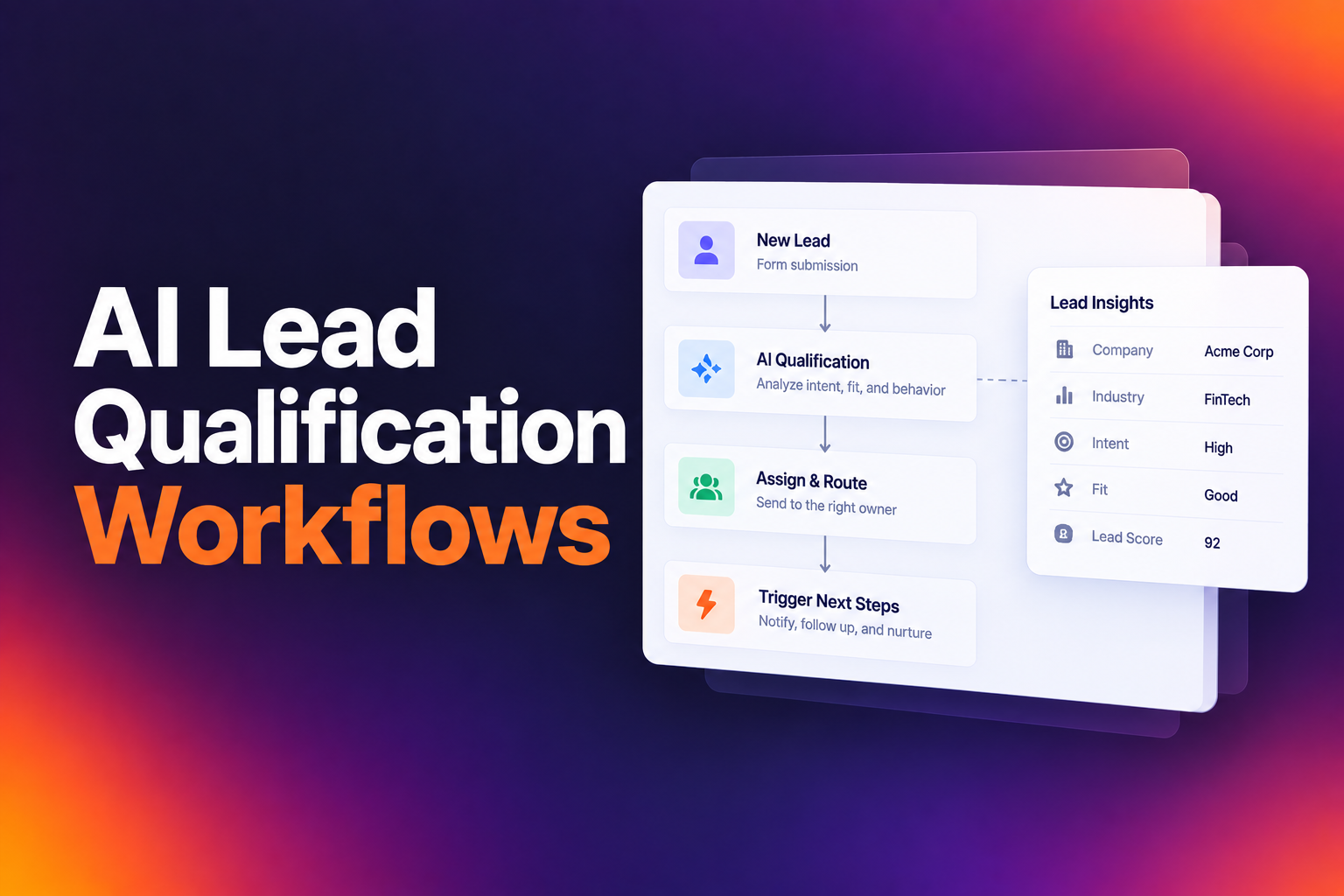
Building an effective AI qualification workflow means collapsing multiple steps into a single moment. Instead of form fill, then queue, then manual review, then routing, then outreach, then scheduling, the entire sequence happens instantly and automatically.
The core logic is straightforward. A lead submits a form. The system enriches the submission with firmographic data and CRM history. Qualification rules fire immediately. If the lead qualifies, they see a calendar for the right rep. If they don't, they're routed to an appropriate nurture path. No human touches the process until the meeting itself.
Leveraging Enrichment Data and CRM History for Real-Time Routing
Smart routing goes well beyond simple round-robin assignment. The best AI qualification workflows use form responses, enrichment data, and CRM ownership to determine exactly which rep should take the meeting. If the lead's company already has an account owner in Salesforce or HubSpot, the meeting goes to that rep. If the lead matches a specific territory or product interest, routing respects those rules.
This matters because routing accuracy directly affects show rates and deal velocity. A lead who books with the wrong rep gets rescheduled, creating friction and delay. RevenueHero's routing engine, for example, uses this combination of form data, enrichment, and CRM ownership to get every lead to the right rep instantly, with no manual assignment required. Edge cases like rep PTO or territory mismatches are handled through nested routing rules rather than manual intervention.
Replacing Permission Language with Commitment-Driven CTAs
CTA language has a measurable impact on conversion. Among top-performing teams, 29% use "Book a Demo," 21% use "Get a Demo," and only 12% use "Request a Demo." The pattern is clear: commitment language outperforms permission language.
"Request a Demo" creates uncertainty. The visitor doesn't know if they'll actually get what they're asking for. "Book Your Demo" or "Schedule a Call" creates commitment. The visitor mentally crosses from considering to doing while still on your page. This is a five-minute fix. Search your site for every instance of "Request," "Submit," "Contact Sales," or "Get in Touch." Replace them with "Book," "Schedule," or "Reserve." Then watch your numbers.
Optimizing Form Strategy for Higher Conversion
Form strategy is one of the most debated topics in demand generation. How many fields is too many? What information actually matters? The data tells a more nuanced story than most teams expect.
The Friction Myth: Balancing Field Count with Utility
The conventional wisdom says fewer form fields always means higher conversion. The data says otherwise. Top performers convert at 77% with 2 fields and at 76% with 13 fields. The number of fields doesn't matter nearly as much as whether each field does something useful.
A field that enables routing or personalization earns its place. Company size, region, and use case help get the lead to the right rep and help that rep tailor the conversation. A field like "How did you hear about us?" that nobody ever actions on just adds friction without value. Audit every field on your forms and ask a simple question: does this field change what happens next? If it doesn't, cut it.
Vertical Positioning and Industry-Specific Qualification
Generic positioning underperforms vertical positioning consistently. Construction Tech converts at 69.1%. Ecommerce at 68.8%. Travel Tech at 68.3%. Generic Sales Tech sits at 62.8%. The pattern holds across segments: industry-specific messaging wins.
If you have a vertical that performs well, build a dedicated landing page for that segment. Use industry-specific headlines, customer logos, testimonials, and even form fields tailored to that buyer's context ("How many locations?" for multi-site businesses, "Current ATS?" for HR buyers). Run traffic to it for 30 days and compare against your generic page. The lift is real and repeatable.
Benchmarking Success: From 40% to 78%+ Meeting Rates
Knowing your numbers is the starting point. But knowing how those numbers compare to peers is what drives real improvement. If you're converting at 58%, you're in the bottom quartile. At 76%+, you're outperforming most of the market.
The gap between 40% and 78% represents, on the same traffic and the same spend, 38 more meetings per 100 qualified leads. That's not incremental improvement. That's a fundamentally different pipeline outcome.
Analyzing the 2025 Inbound Conversion Metrics
Twelve months of aggregate data from B2B SaaS companies reveal clear seasonal patterns. Q2 is the best time to push inbound campaigns, with April, May, and June all exceeding 60% qualified-to-booked rates. Q3 drags, driven almost entirely by August at 53.4% and September at 53.7%. July actually performs well at 61.1%.
If your late-summer numbers drop, the pattern is consistent with the broader market. Plan your biggest launches and campaign pushes for Q2. Use Q3 for experimentation and process refinement rather than expecting peak performance.
Quarterly Audits of Disqualification (DQ) Criteria
Your disqualification criteria deserve as much attention as your qualification criteria. Companies with higher DQ rates actually tend to have higher meeting-to-opportunity conversion because reps aren't wasting time on poor fits.
But there's a balance. If your DQ rate is under 20% and your meeting rate is struggling, you're likely letting through leads that waste rep time. Consider tightening criteria on company size, industry, or use case fit. If you're running an enterprise motion where a single bad meeting costs hours of expensive rep time, a higher DQ rate makes sense. For high-velocity SMB motions where demos are fast and cheap, you can afford to be more inclusive. Review and update these criteria quarterly, not annually.
Automating Post-Qualification Engagement
Qualification and scheduling are only half the equation. What happens between the booking and the actual meeting determines whether your pipeline is real or inflated.
Instant Scheduling vs. 'Thanks, We'll Be In Touch'
The difference between showing a calendar immediately and displaying a confirmation message is the difference between a 40% meeting rate and a 78%+ one. Teams that present a scheduling interface the moment someone qualifies eliminate the single biggest drop-off point in the inbound funnel.
"Thanks, we'll be in touch" is a promise that creates uncertainty. The lead doesn't know when they'll hear back, from whom, or whether their request was even received. A calendar eliminates all of that. The lead picks a time, gets a confirmation, and the meeting syncs to the CRM automatically. No manual work, no delays, no ambiguity.
Automated Workflows for Reschedules and No-Shows
Even with instant scheduling, no-shows and cancellations happen. The difference between high-performing teams and everyone else is what happens next. Automated workflows that send reschedule links for canceled meetings and no-shows recover meetings that would otherwise be lost.
One GTM operations leader reported booking meetings with 75%+ of qualified inbounds the same day, up from around 40%, specifically because automation rules handled reschedule links for cancellations and no-shows without any manual follow-up. These workflows run in the background, recovering pipeline that most teams simply write off.
Building Your Qualification Engine for 2026
The companies outperforming their peers aren't using a secret playbook. They use commitment language instead of permission language. They cut form fields that don't inform routing or personalization. They're intentional about who gets through to sales. And when someone qualifies, they put a calendar in front of them right then, not after an SDR reviews the lead tomorrow morning.
You already have the traffic. You already have people raising their hands. The only variable is how many of them actually end up talking to your team. If you're at 40% today and you get to 62%, that's 22 more meetings for every 100 qualified leads. Get to 78%, and you've nearly doubled your pipeline output without spending another dollar on acquisition. Start by auditing your current form-to-meeting workflow, measuring your median response time, and identifying every point where a human touch adds delay without adding value.
Let RevenueHero help your team turn high-intent users into booked meeting without slowing down your funnel.