Most GTM teams already know their inbound funnel is leaking. The harder question is where, and why the fixes they've tried haven't worked. The gap between a qualified lead and a booked meeting should be measured in seconds, not days. Yet the median qualified-to-booked rate across B2B SaaS still sits around 62%, while the top 10% of teams are booking 78% or more. That 16-point gap isn't explained by better leads or bigger budgets. It's explained by what happens in the 30 seconds after someone clicks a CTA. AI-powered lead routing that actually works isn't about adding intelligence to a broken process. It's about eliminating the process entirely: the manual review, the delayed email, the intent decay that turns a hot lead into a ghost. Here's what separates teams that convert from teams that wonder why they don't.
The Decay of Intent: Why Traditional Lead Routing Fails Modern GTM Teams
The standard inbound motion at most companies still follows a pattern built for 2015. A lead fills out a form. That form enters a queue. Someone reviews it manually, maybe routes it, maybe sends a follow-up email. The lead might respond. Days pass. By the time a rep reaches out, the buyer has already moved on to a competitor's calendar.
This isn't a minor inefficiency. It's a structural flaw in how GTM teams convert demand into pipeline. The old benchmark of 35% qualified-to-booked was a product of this exact workflow, and many teams are still stuck there.
The 48-Hour Lag and the 35% Conversion Trap
Intent has a half-life. A buyer who fills out a demo form is at peak motivation in that exact moment. Conversion probability sits around 80% in the first minute. By the next day, it drops to roughly 40%. After 48 hours, you're chasing someone who's already evaluating two other vendors.
The 35% conversion rate that many teams treat as normal isn't a reflection of lead quality. It's a reflection of response time. Every hour of delay is revenue left on the table, and the old "five-minute rule" for lead response is already obsolete. Buyers evaluating multiple solutions simultaneously expect sub-minute engagement, not a promise that someone will be in touch.
Why Manual Review Queues are Revenue Killers
Manual review queues exist because teams don't trust their qualification criteria enough to automate them. An SDR eyeballs the lead, checks firmographic data, decides if it's worth routing. This adds hours or days to the handoff, and it introduces human error and inconsistency.
The companies booking 78%+ of their qualified leads have removed this step entirely. When someone submits a form, they know immediately whether they qualify, and if they do, they see a calendar. No "thanks, we'll be in touch" confirmation page. No waiting for a human to make a judgment call that a well-configured system can make in milliseconds.
AI-Driven Real-Time Qualification Over Static Forms
Static forms collect data. Intelligent routing systems act on it. The difference between these two approaches is the difference between a 62% median and the 88% conversion rate achieved by the best-performing teams in recent benchmarks.
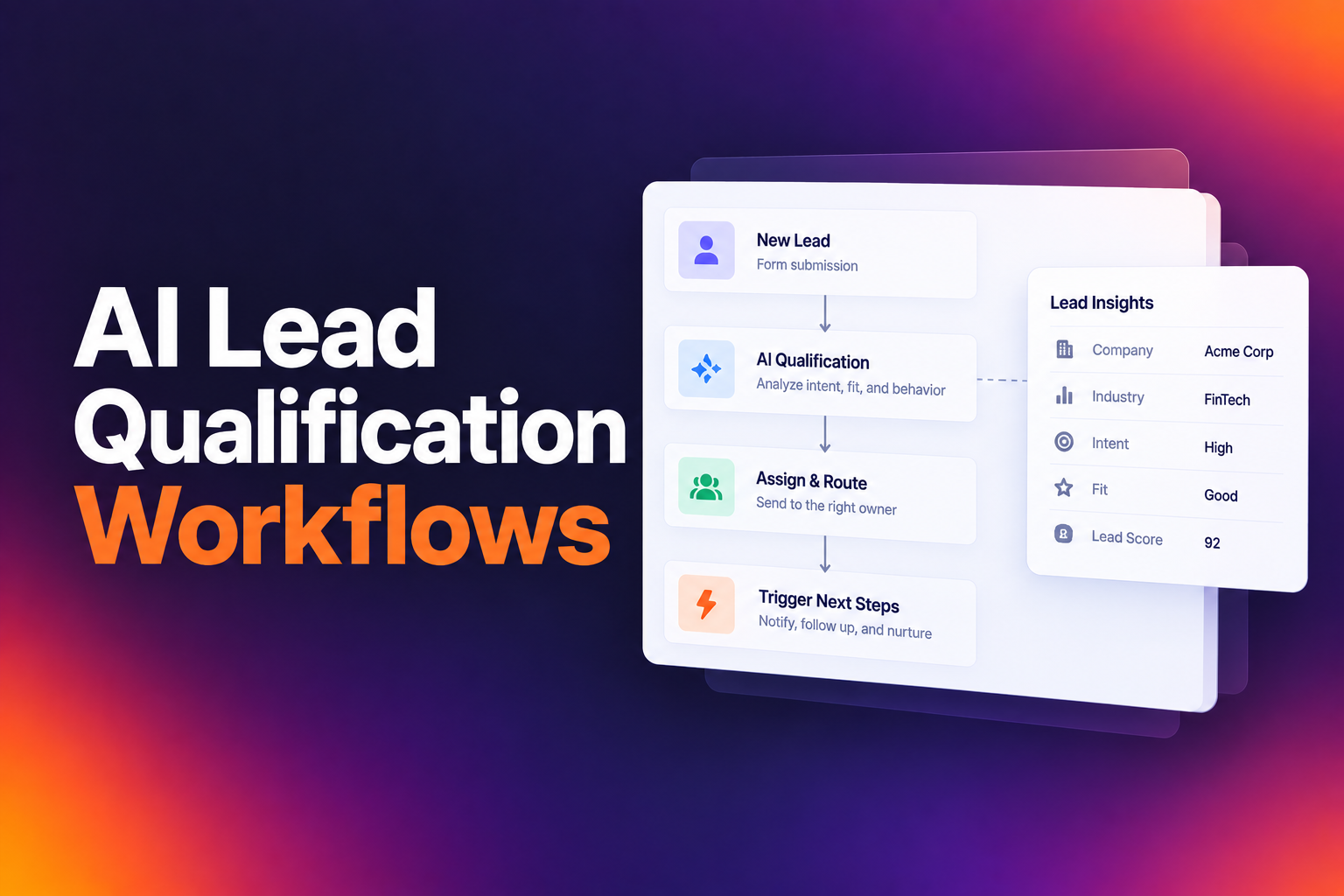
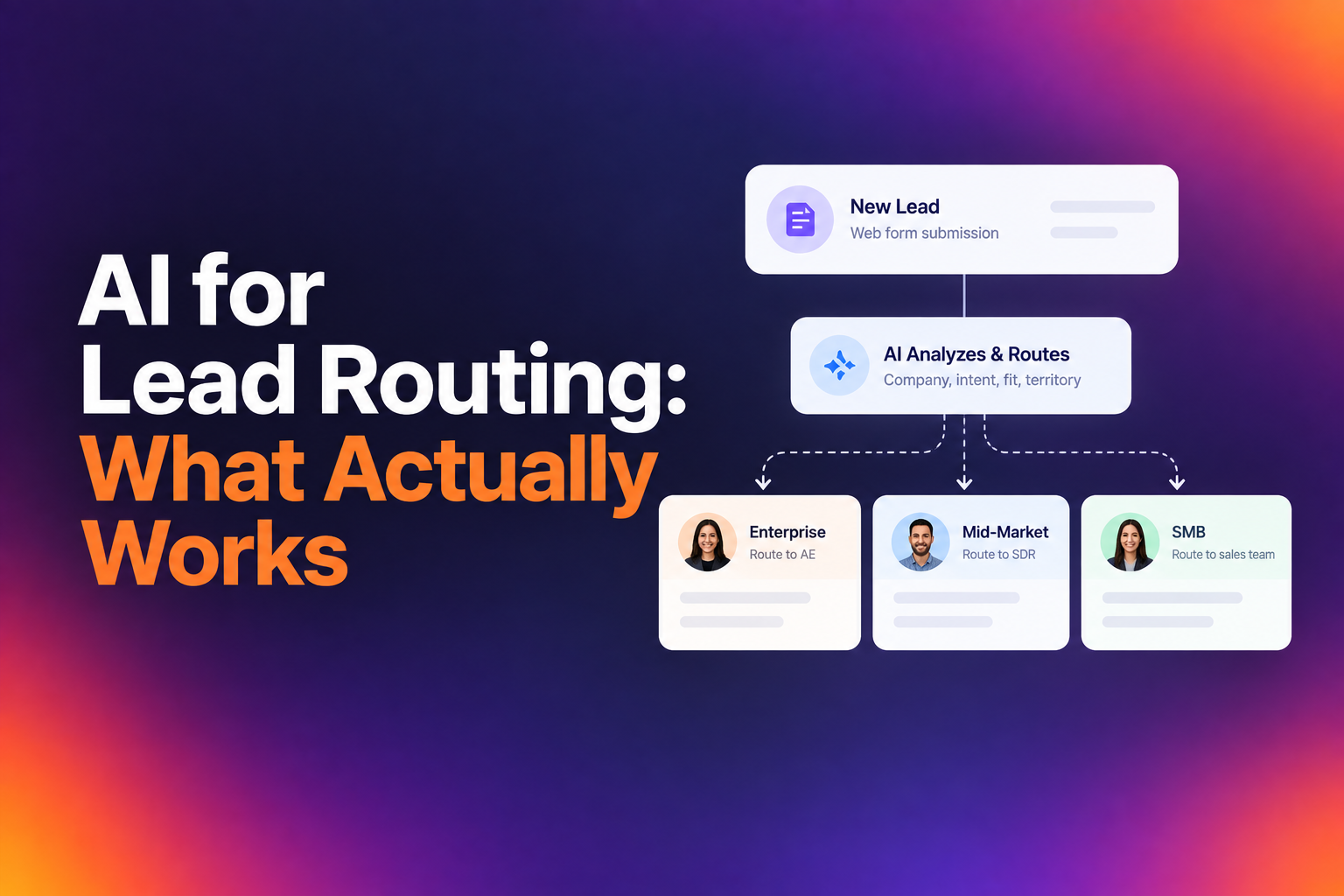
Real-time qualification means the moment a form is submitted, enrichment data, CRM history, and form responses are evaluated together to determine fit, route the lead to the right rep, and present a calendar. No queue. No lag. No manual step.
Moving Beyond Field Count: Purpose-Driven Data Collection
There's a persistent myth that fewer form fields always convert better. The data tells a different story. Top performers convert at 77% with 2 fields and at 76% with 13 fields. The number of fields doesn't matter. What matters is whether each field does something useful.
A field that determines routing (company size, region, use case) earns its place. A field that sits in a CRM and never gets actioned ("How did you hear about us?") is costing you conversions without delivering value. The right question to ask about your form isn't "how many fields?" but "what does each field enable?" If it doesn't change who gets the lead or how the rep opens the call, cut it.
Leveraging Enrichment Data and CRM History for Instant Routing
Smart routing goes beyond what the lead tells you on the form. Enrichment data fills in firmographic gaps: company size, industry, tech stack, funding stage. CRM history reveals whether this lead belongs to an existing account, whether there's an open opportunity, or whether a specific rep already owns the relationship.
RevenueHero's routing engine, for example, uses form responses, enrichment data, and CRM ownership together to get every lead to the right rep instantly. This matters because routing isn't just about speed. It's about accuracy. Sending a lead to the wrong rep because your system doesn't respect existing account ownership creates friction for the buyer and internal conflict for your team. Advanced routing logic should handle territory rules, product interest, account matching, and rep availability (including PTO coverage) without human intervention.
The Psychology of Commitment: Replacing 'Request' with 'Book'
Language on your conversion pages shapes buyer behavior more than most teams realize. The words you use on buttons, headers, and CTAs create either uncertainty or commitment in the visitor's mind.
Among top-performing teams, 29% use "Book a Demo," 21% use "Get a Demo," and 12% use "Schedule a Demo." Only 12% use "Request a Demo." The pattern is clear: commitment language outperforms permission language consistently.
How Language Shifts Drive the 78% Elite Threshold
"Request a Demo" puts the buyer in a passive position. They're asking for something and hoping someone responds. "Book Your Demo" puts them in control. They're taking action. The visitor mentally crosses from "considering" to "doing" while still on your page.
This is a five-minute fix with measurable impact. Search your site for every instance of "Request," "Submit," "Contact Sales," or "Get in Touch." Replace them with "Book," "Schedule," "Reserve Your Spot," or "Pick a Time." The shift from permission language to commitment language is one of the simplest changes that separates median performers from the elite 78%+ threshold. It costs nothing and compounds across every page and email template on your site.
Vertical Positioning and Segment-Specific Routing Logic
Generic positioning produces generic results. The data on vertical-specific conversion rates makes this painfully clear: Construction Tech converts at 69.1%, Ecommerce at 68.8%, Travel Tech at 68.3%, while generic Sales Tech sits at 62.8%.
The pattern holds across segments. Teams that position for a specific vertical or use case outperform those running horizontal messaging, even when the underlying product is the same.
The Impact of Industry-Specific Headlines and Testimonials
Building a dedicated landing page for your best-performing vertical with industry-specific headlines, customer logos, testimonials, and even tailored form fields ("How many locations?" for multi-site businesses, "Current ATS?" for HR buyers) consistently lifts conversion rates.
Run traffic to a vertical-specific page for 30 days and compare against your generic page. The routing logic behind that page should also be segment-specific: different qualification criteria, different rep assignments, different follow-up sequences. A Construction Tech lead and an Ecommerce lead may both qualify, but they should reach reps who understand their context. This is where AI-driven routing earns its keep, matching leads not just to available reps but to the right reps based on segment expertise and account fit.
Optimizing the DQ Rate: Balancing Friction and Rep Efficiency
Disqualification rates are counterintuitive. Teams with higher DQ rates often have better overall conversion numbers. Companies that are selective about who gets through to sales end up with higher-quality conversations. Reps aren't wasting time on poor fits. The leads who make it through are more likely to show up, more engaged, and more likely to convert.
This doesn't mean you should disqualify everyone. It means your qualification criteria should be intentional and aligned with your sales motion.
Identifying and Filtering 'Genuinely Poor Fits' Quarterly
If your DQ rate is under 20% and your meeting rate is struggling, you're likely letting through leads that waste rep time. Tighten criteria on company size, industry, or use case fit. If you're selling enterprise deals where a single bad meeting costs hours of expensive rep time, a higher DQ rate makes sense. If you're running a high-velocity SMB motion where demos are fast and low-cost, you can afford to be more inclusive.
The key discipline is reviewing DQ criteria quarterly. Ask yourself: "Is this filtering out genuinely poor fits, or just adding friction?" Markets shift. Your ICP evolves. Qualification rules that made sense six months ago may be blocking good leads today. Build this review into your RevOps cadence, and make sure your routing system can adjust criteria without requiring engineering support.
Closing the Gap: Achieving 80%+ Qualified-to-Booked Rates
The teams booking 80% or more of their qualified leads aren't doing anything exotic. They use "Book" instead of "Request." They cut form fields that don't help routing or personalization. They're pickier about who gets through to sales. And when someone qualifies, they put a calendar in front of them immediately. Not tomorrow. Not after an SDR reviews the lead. Right then.
None of this requires a bigger budget or better leads. You already have the traffic. You already have people raising their hands. The only variable is how many of them actually end up talking to your team. If you're at 40% today and you get to 62%, that's 22 more meetings for every 100 qualified leads. Get to 78%, and you've nearly doubled your pipeline from the same traffic.
The path from AI lead routing that sounds good in theory to routing that actually works comes down to three things: eliminating manual handoffs, respecting CRM relationships in every routing decision, and treating the moment after form submission as your most important conversion event. The teams that get this right don't just book more meetings. They build pipeline that closes.
Let RevenueHero help your team turn high-intent users into booked meeting without slowing down your funnel.