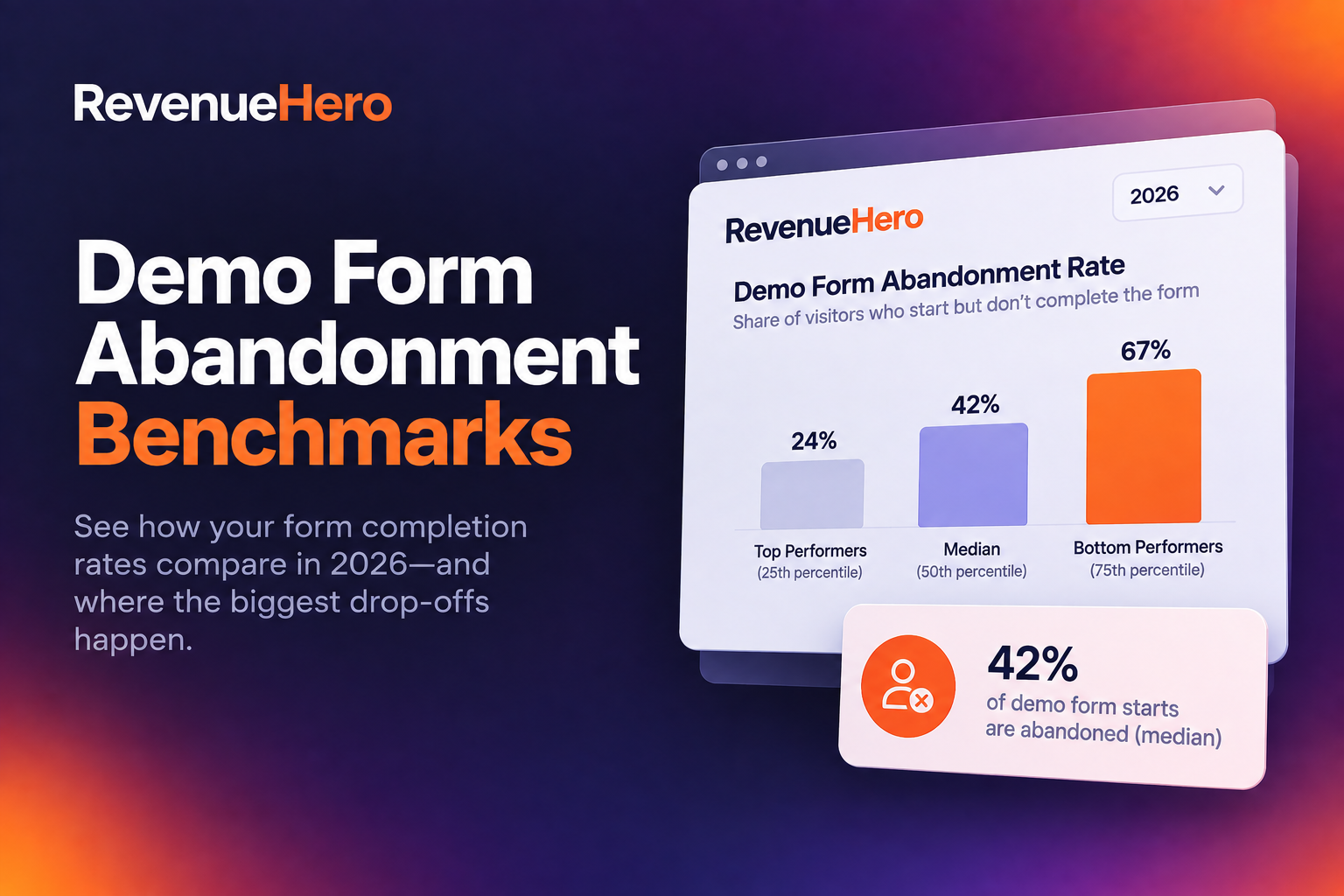
Most B2B SaaS teams obsess over driving traffic and generating form fills, but the real pipeline leak happens after someone hits "submit." The gap between a qualified form fill and a booked meeting is where intent goes to die, and most teams don't even measure it properly. Based on 12 months of data across over one million inbound form submissions, the median qualified-to-booked rate sits at 62%. The top 10% of companies hit 78% or higher. The best performer in the dataset books 88% of qualified leads into meetings. If your team is converting at 30-40% and treating that as normal, you're leaving significant pipeline on the table. Understanding demo form abandonment benchmarks isn't about vanity metrics: it's about identifying exactly where your process bleeds revenue and fixing it with precision.
The Invisible Pipeline Leak: Why Intent Decays After the Form Fill
The traditional inbound funnel treats the form fill as the conversion event. Marketing celebrates the MQL, passes it to sales, and moves on. But the actual conversion that matters, a booked meeting with the right rep, often happens hours or days later. That delay is where your pipeline quietly collapses.
The real problem isn't that leads go cold. It's that they go elsewhere. A buyer who fills out your demo form has likely filled out two or three competitor forms in the same session. The company that books first wins. Intent doesn't decay gradually: it falls off a cliff.
The Fallacy of Manual Review Queues
Many teams still route inbound leads through manual review queues. An SDR eyeballs the submission, checks it against some loose criteria, then sends a follow-up email or makes a call. This process introduces a minimum delay of 30 minutes and often stretches to several hours.
The old benchmark of 35% qualified-to-booked came from exactly this kind of workflow. Companies using manual review queues are measuring themselves against a standard that was set by broken processes. If your SDR team is triaging leads in a shared inbox, you're competing with one hand tied behind your back.
Why 48-Hour Response Times Kill Conversion
Conversion probability drops dramatically with every passing hour. An 80% booking probability in the first minute can fall to 40% by the next day. By the time a 48-hour response window closes, you're essentially cold-calling someone who already chose a competitor.
The "we'll be in touch" confirmation page is a relic. Buyers don't wait. They book with whoever makes it easy to book right now. Every hour of delay is a compounding tax on your pipeline.
2025 Demo Conversion Benchmarks: Median vs. Elite Performers
Data from the 2025 Inbound Conversion Benchmark report, drawn from RevenueHero's customer base, provides a clear picture of where teams actually stand. These aren't theoretical numbers or self-reported surveys. They're aggregate conversion rates weighted by volume across a full calendar year.
The 62% Median and the 78% Elite Threshold
The distribution tells a stark story. The median qualified-to-booked rate across all customers is 62%. The top 25% convert at 72%. The top 10% hit 78% or higher. And the single best performer books 88% of qualified leads. On the other end, the bottom 25% sit at 53%.
That 16-point gap between median and elite performance happens on the same traffic, the same spend, and the same leads. The difference is determined by what happens in the 30 seconds after the form fill, not by marketing strategy or lead quality.
Industry Variations: Vertical SaaS vs. Horizontal SaaS
One of the clearest patterns across the dataset is that vertical SaaS consistently outperforms horizontal SaaS. Construction Tech converts at 69.1%. Ecommerce Tech hits 68.8%. Travel Tech comes in at 68.3%. Generic Sales Tech, by contrast, sits at 62.8%.
The reason is straightforward. Vertical buyers have higher intent because they're solving a specific, well-defined problem. Their forms can ask more detailed questions without creating friction because the audience expects that level of specificity. A "How many locations?" field on a construction software form isn't friction: it's relevance.
Seasonal Trends: The Q2 Peak and Q3 Lull
Conversion rates aren't flat across the year. Q2 is the peak quarter at 61.0%, with April, May, and June all exceeding 60%. Q1 comes in at 58.5%, Q4 at 58.0%, and Q3 drags at 55.9%.
The Q3 dip is driven almost entirely by August (53.4%) and September (53.7%). July actually performs well at 61.1%. If your late-summer numbers drop, you're not alone: this is a market-wide pattern. Plan your biggest inbound campaigns for Q2, and don't panic when August feels slow.
Optimizing Form Friction for Quality and Volume
The knee-jerk response to high form abandonment is to strip fields. Fewer fields, more conversions, right? The data tells a more nuanced story.
Debunking the 'Short Form' Myth
Top performers in the dataset convert at 77% with 2-field forms and at 76% with 13-field forms. The number of fields doesn't determine your conversion rate. What matters is whether each field serves a clear purpose.
A 13-field form works brilliantly when each field changes who gets the lead or how the rep opens the call. Medical software buyers, for instance, expect credentialing and detailed intake. A 2-field form works when your ICP is broad and any additional friction would cost more than the data is worth. The question to ask about your form isn't "how many fields?" but "what does each field enable?"
Aligning Field Purpose with Sales Enablement
Every field on your form should pass a simple test: does it change routing, qualification, or how the rep prepares for the conversation? Company size and region help route the lead. Current tools or use case help the rep tailor the demo. Job title, when it's actually used in routing logic, earns its place.
Fields that fail this test, like "How did you hear about us?" when nobody actions the response, are costing you conversions without delivering value. Audit your form quarterly. If a field doesn't change a downstream decision, remove it.
Psychological Triggers: Commitment vs. Permission Language
Small copy changes on your demo form can produce measurable shifts in conversion. The words on your CTA button and surrounding your form shape how buyers perceive the action they're taking.
Replacing 'Request' and 'Submit' with Action
Among top performers in the benchmark data, 29% use "Book a Demo," 21% use "Get a Demo," and 12% use "Schedule a Demo." Only 12% use "Request a Demo." The pattern is clear: commitment language outperforms permission language.
"Request" implies uncertainty. The buyer doesn't know if they'll actually get what they're asking for. "Book" implies certainty. The buyer is making a decision and taking an action. Search your site for every instance of "Request," "Submit," "Contact Sales," or "Get in Touch." Replace them with "Book," "Schedule," or "Reserve." This is a five-minute fix with measurable impact.
The Impact of Specific Social Proof Near the Form
Generic testimonials ("Great product, love it!") do almost nothing near a form. Specific testimonials with numbers change behavior. "We saw a 57% increase in bookings within 90 days" gives prospects a concrete expectation and implies you have customers willing to share real results.
If you're going to invest in social proof near your demo form, invest in getting specific metrics from your best customers. Call them this week. Ask for one sentence with a number. Put the best one above the fold, near the form. One testimonial with a metric is worth ten without.
Closing the Gap with Automated Inbound Scheduling
The companies hitting 78%+ aren't doing anything magical with their marketing. They've eliminated the gap between form fill and meeting booking by treating the scheduling step as the conversion event, not the form submission.
Moving from Form Fills to Meeting Bookings as the Primary Metric
When your primary metric is form fills, you build processes that celebrate the wrong moment. Marketing reports MQLs. Sales complains about lead quality. Nobody owns the gap in between.
Shifting your primary metric to booked meetings changes everything. Marketing is accountable for leads that actually convert to pipeline. Sales gets meetings, not lists. RevOps can measure the real conversion rate and identify exactly where leads drop off. The teams hitting elite demo form abandonment benchmarks have made this shift already.
Leveraging Routing Engines for Instant Qualification
The highest-converting teams use routing engines that qualify, route, and book meetings in one step. The form fill triggers real-time enrichment with firmographic data, applies qualification logic, respects existing CRM ownership, and presents a calendar for instant booking. No SDR review. No email follow-up. No lag.
This is where tools like RevenueHero's routing engine fit: form responses, enrichment data, and CRM ownership combine to get every lead to the right rep instantly. The result isn't just speed. It's accuracy. Territory rules, account matching, and product interest all factor into routing, so the buyer meets the rep who can actually help them.
The companies booking 78% or more of their qualified leads aren't working harder. They've removed the manual steps between intent and action. Your form abandonment rate isn't a traffic problem or a messaging problem. It's a process problem, and the fix is measured in seconds, not strategies. Audit your current qualified-to-booked rate this week. If you're below the 62% median, the gap is almost certainly in what happens after the form fill, not before it.
Let RevenueHero help your team turn high-intent users into booked meeting without slowing down your funnel.