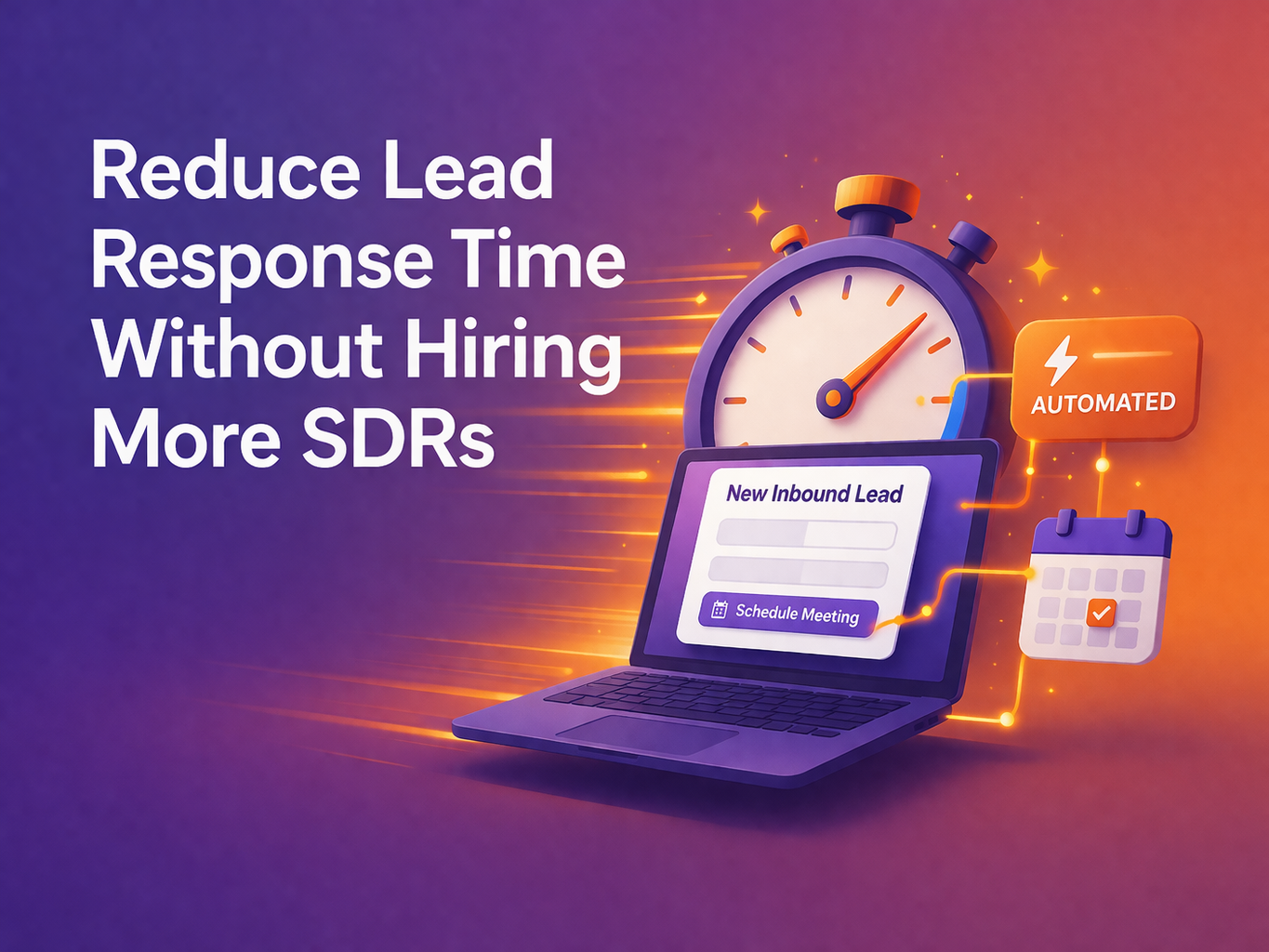
A qualified lead fills out your demo form at 2:47 PM. Your SDR sees the notification at 4:15 PM, between back-to-back calls. By the time they dial at 4:32 PM, the lead has already booked a call with your competitor. This scenario plays out thousands of times daily across B2B sales teams, and it's costing companies pipeline they've already paid to generate.
The challenge of reducing lead response time without hiring more SDRs isn't just about speed. It's about rethinking what happens in the critical seconds after someone raises their hand. Most sales teams operate with processes built for a different era: manual lead review, queue-based assignment, and SDR-dependent follow-up. These workflows create delays that compound into lost revenue. The companies converting at 78% or higher aren't working with bigger teams. They're working with smarter systems that eliminate the gap between qualification and conversation. According to recent benchmark data, the median qualified-to-booked rate sits at 62%, while top performers reach 88%. That 26-point gap represents real revenue, and closing it doesn't require adding headcount.
The Revenue Impact of the Five-Minute Response Window
Speed matters more than most sales leaders realize. The first vendor to respond captures a disproportionate share of deals, not because they're necessarily better, but because they're present when intent peaks.
The Science of Lead Decay
Lead intent isn't static. It decays rapidly from the moment someone submits a form. A prospect researching solutions has multiple tabs open, multiple vendors under consideration, and limited attention. Within five minutes of form submission, that prospect is still mentally engaged with your brand. Within an hour, they've moved on to other tasks. Within a day, they may not remember why they reached out at all.
Research consistently shows that response within five minutes dramatically increases contact rates and conversion likelihood. The companies booking 78% of their qualified leads understand this. They've eliminated the manual review queue, the delayed follow-up, and the 48-hour lag while intent decays. Their prospects see a calendar immediately after qualification, not a "thanks, we'll be in touch" message.
Calculating the ROI of Speed vs. Headcount
Before hiring another SDR at $60,000-80,000 annually, calculate what faster response times could deliver. If your current team handles 200 qualified leads monthly at a 40% booking rate, that's 80 meetings. Improving to 62% (the median) yields 124 meetings. Reaching 78% produces 156 meetings. That's nearly double the pipeline from identical lead volume.
The math favors process improvement over headcount expansion. A new SDR might add incremental capacity, but they won't fix the fundamental delay between form fill and first touch. The gap between 35% and 78% isn't about having better leads or more reps. It's about what happens in the 30 seconds after someone clicks submit.
Automating Lead Qualification and Routing
Manual lead review creates bottlenecks that no amount of SDR hustle can overcome. When qualification happens in real-time, response time becomes measured in seconds rather than hours.
Implementing Real-Time Lead Scoring
Effective lead scoring happens at the moment of form submission, not in a batch process overnight. Modern qualification systems use form responses, enrichment data, and CRM history to determine fit instantly. A prospect submits their information and immediately knows whether they qualify for a conversation.
The key is building scoring criteria that reflect genuine fit without creating unnecessary friction. Top performers maintain qualification standards while streamlining the process. They ask questions that matter: company size, use case, current solutions. They skip vanity fields that don't change routing or personalization. Every field should either help route the lead to the right rep or help that rep tailor the conversation.
Automated Round-Robin and Territory Logic
Once a lead qualifies, routing should happen automatically based on predefined logic. Territory assignments, account ownership, product interest, and rep availability all factor into instant distribution. No manual assignment means no delays.
The best routing systems respect existing CRM relationships. If a prospect works at a company already owned by a specific AE, the meeting routes there automatically. If territory rules apply, they're honored without human intervention. This keeps existing ownership intact while ensuring every qualified lead reaches the right rep within seconds of submission.
Leveraging AI Chatbots for Instant Engagement
Chatbots have evolved beyond simple FAQ responders. When properly configured, they serve as always-on qualification and scheduling engines that engage leads the moment they arrive.
24/7 Availability Without Human Intervention
Your website receives traffic around the clock, but your SDRs work finite hours. A prospect researching solutions at 10 PM shouldn't wait until 9 AM for engagement. AI chatbots fill this gap by qualifying visitors, answering initial questions, and offering immediate scheduling options.
The goal isn't replacing human conversation. It's ensuring no qualified lead waits for one. A well-designed chatbot captures intent at its peak, qualifies based on your criteria, and presents a calendar before the prospect navigates away. This converts after-hours traffic that would otherwise require next-day follow-up.
Seamless Hand-offs from Bot to Live Agent
The transition from bot to human should feel natural, not jarring. When a conversation requires human expertise, the handoff includes full context: what the prospect asked, how they qualified, and what they're trying to accomplish. The rep enters the conversation informed rather than starting from scratch.
Effective handoffs also respect timing. If a rep is available, the transfer happens live. If not, the bot schedules the meeting and provides confirmation. Either path keeps the prospect moving forward without friction or delay.
Optimizing SDR Workflows with Sales Enablement Tools
Even with automation handling qualification and routing, SDRs need tools that maximize their effectiveness during working hours. The right enablement stack turns good reps into great ones.
Using SMS and Push Notifications for Instant Alerts
Email notifications create delays. A lead submits a form, an email lands in a crowded inbox, and minutes pass before anyone notices. SMS and push notifications solve this by reaching reps on their phones immediately.
The best alert systems include lead context in the notification itself. Rep sees the company name, qualification score, and one-click options to call or view details. This eliminates the need to log into a system before taking action. Hot leads get immediate attention because the alert demands it.
Templated Responses and Multi-Channel Sequences
When human follow-up is required, templates accelerate response without sacrificing personalization. Pre-built messages for common scenarios let SDRs respond in seconds rather than minutes. The template handles structure while the rep adds relevant details.
Multi-channel sequences ensure no lead falls through cracks. If a call goes unanswered, an SMS follows automatically. If email gets no response, LinkedIn outreach triggers. These sequences run without manual intervention, keeping leads warm while SDRs focus on live conversations.
Enabling Self-Service Scheduling for High-Intent Leads
The highest-intent leads don't want to wait for a callback. They want to book a meeting and move on with their day. Self-service scheduling removes friction for these motivated prospects.
Embedding Calendars Directly in Lead Forms
The most effective approach presents a calendar immediately after qualification. A prospect fills out a form, confirms they meet your criteria, and sees available time slots on the same page. No email exchange. No phone tag. No waiting.
RevenueHero customers skip the traditional handoff entirely. The moment someone submits and qualifies, they're booking directly onto a rep's calendar. This treats inbound scheduling as a conversion event rather than an afterthought. Companies using this approach book 78% or more of their qualified leads because they've eliminated every delay between intent and action.
Measuring Success Through Response Time Analytics
What gets measured gets improved. Response time analytics reveal where delays occur and whether process changes deliver results.
Track time-to-first-touch across all lead sources and segments. Identify which leads receive fast response and which languish in queues. Compare booking rates between leads contacted within five minutes versus those contacted later. The data will confirm what the benchmarks suggest: speed drives conversion.
Build dashboards that surface response time metrics alongside pipeline outcomes. When leadership sees the correlation between faster response and higher booking rates, investment in automation becomes easier to justify. The companies converting at 78% didn't get there by accident. They measured relentlessly, identified bottlenecks, and eliminated them systematically.
Reducing lead response time without hiring more SDRs requires rethinking the entire journey from form fill to booked meeting. Automation handles qualification and routing. Chatbots engage around the clock. Enablement tools accelerate human follow-up. Self-service scheduling captures high-intent leads instantly. Together, these systems close the gap between 40% and 78%, turning existing traffic into dramatically more pipeline. The leads are already there. The only question is how many actually end up talking to your team.
Let RevenueHero help your team turn high-intent users into booked meeting without slowing down your funnel.