Eliminating the 30-Minute Follow-Up Gap
You see it every day. A prospect fills out your demo form. They’re engaged. They’re ready. Your job should be easy now. But then-nothing happens. The lead sits in your CRM longer than necessary. That pause, that 30-minute gap, is silently killing your conversion rate.
With inbound conversion, speed to lead, and navigating routing complexity, every minute counts. If your team can't respond fast enough, you risk turning interest into lost opportunity.
Understanding the Follow-Up Gap
The follow-up gap is more than just a delay. It represents the moment when your operational workflows fail your prospect. Every second lost is a missed opportunity.
When prospects fill out a form, there's an expectation of immediate action. But what happens when internal processes slow that down? Let's dig into why this delay exists and what it means for your business.
Defining the Gap
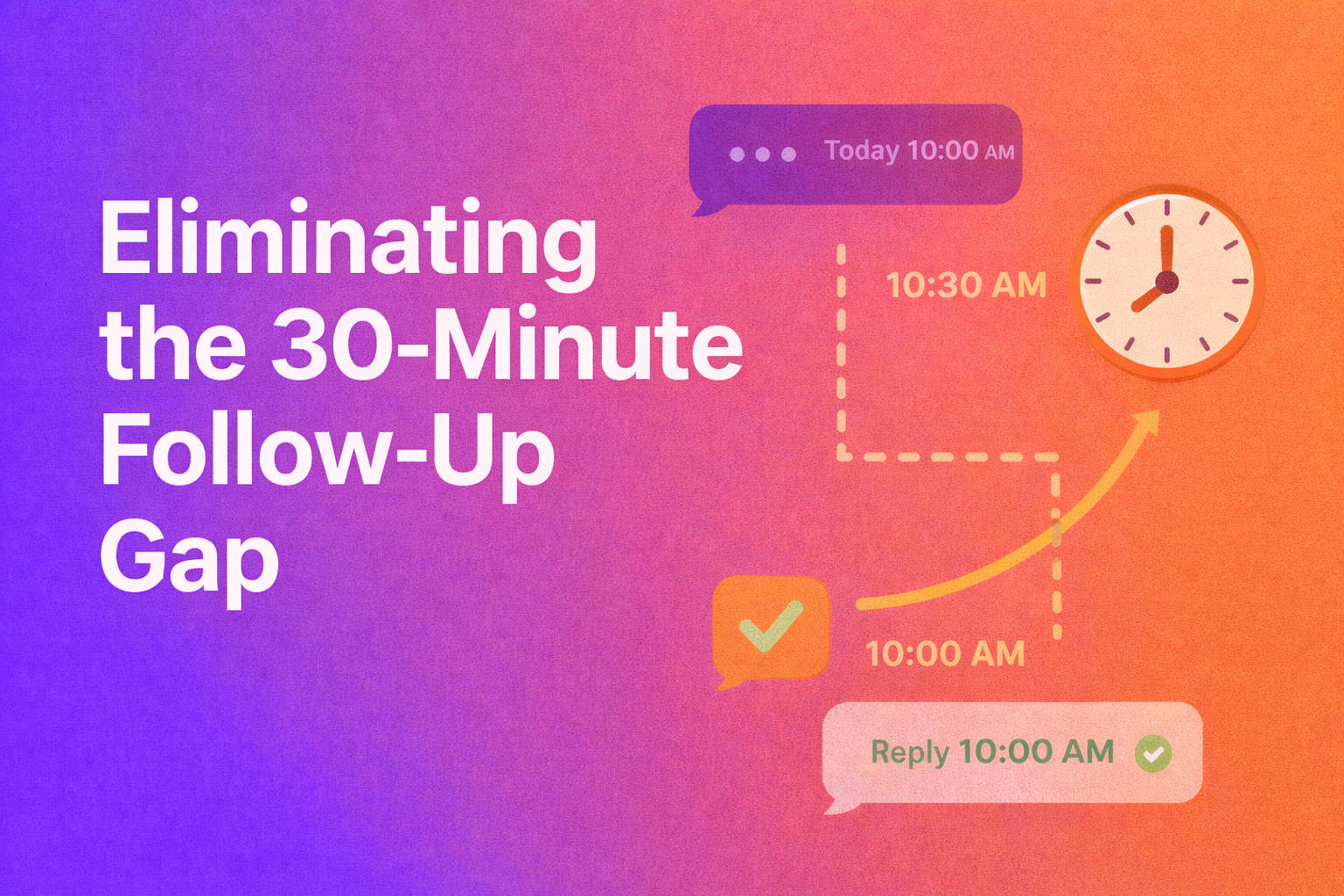
The follow-up gap is the time window between when a prospect submits a form and when a sales rep reaches out. This delay may be short or extend to frustrating 30 minutes or more. In many cases, it’s even longer.
When prospect interest is high and attention spans are short, every minute becomes a critical point of failure. A recent study found that 73% of consumers expect a response within five minutes (ZipDo), and if your response time lags, you risk losing the moment entirely.
Why the Gap Exists
Most delays are operational, not intentional. The wait between form submission and rep contact is often due to internal system workflows that rely on asynchronous processes. The gap is created by several factors:
- Manual routing workflows that delay assignment
- Generic thank-you pages with no immediate call-to-action
- CRM enrichment processes that take longer than expected
- Lags between assignment notifications and rep follow-ups
Every time your system dithers, the prospect's behavior changes. They may seek out competitors, or worse, become completely disengaged.
Operational Roots of the Problem
The operational complexity behind the gap is not a mystery. Many GTM leaders still rely on outdated manual workflows. The moment a lead is captured, it goes through several checks and possible delays:
- CRM Enrichment: Data is checked against internal records and updated asynchronously.
- Routing Rules: Rules are applied to determine which rep or team the lead gets assigned to.
- Assignment Notification: Alerts via Slack, email, or other channels are sent without immediate action.
Each step adds friction. Even useful processes like data enrichment become hindrances if they delay proactive engagement. Operational inefficiencies directly impact conversion.
The Cost of Delay
Every minute a prospect is left waiting, the likelihood of a sale decreases. The risk of losing a qualified lead increases dramatically due to impatience and shifting priorities.
Understanding the cost of the follow-up gap is the first step toward eliminating it.
Impact on Conversion Rates
Consider this: companies that respond to inquiries within an hour are seven times more likely to qualify the lead (ZipDo). But many prospects are so impatient that waiting beyond 1 minute means losing their interest. The statistics speak for themselves:
- A third of callers are too impatient to wait more than one minute (Contact Centre Helper).
- Lead qualification probability drops significantly if not contacted within 5 minutes (ZipDo).
This gap doesn't just affect conversion rates. It hurts seller confidence, creates inefficiencies in the sales process, and ultimately leads to missed revenue opportunities. A delay of 30 minutes can be the difference between booking a meeting and losing an opportunity forever.
Effect on Customer Experience
The prospect experience is paramount. The first interaction post-form submission is a critical touchpoint. If that experience is marred by delays, the impact is two-fold:
- Prospects lose confidence in your ability to manage their needs.
- They begin to question whether your processes are equipped to address their urgency.
This delay leaves a memorable mark on the buyer experience. Research shows that 95% of consumers become frustrated after waiting more than an hour. Even if the system eventually responds, the damage to the experience is already done (Hyken).
The Ripple Effect on Sales Pipelines
The longer the gap, the fewer meetings booked and the slower the pipeline moves. When prospects are forced into a waiting game, they often find alternative methods to satisfy their needs. A quick call or a scheduling solution can make all the difference.
Friction in the booking process can result in a slower sales cycle, lower meeting attendance, and a missed opportunity for granular reporting on buyer behavior, which is critical for refining demo processes and conversion strategies.
The Old Way vs. the New Way
Traditional follow-up methods rely on reactive outreach. This is the old way where leads are collected and then later engaged by a rep. Time passes while the prospect’s interest cools. This method fosters uncertainty both for the buyer and the internal team.
In contrast, high-velocity teams automate and embed scheduling experiences immediately after the lead is captured. They operate on the principle that immediate engagement creates a smoother buyer journey and superior outcomes.
Manual Follow-Up: The Traditional Approach
Under conventional practices, a demo request enters your CRM, followed by manual routing. Reps are alerted, but the notifications often come too late. Here’s a common scenario:
- A prospect fills out the demo form.
- The form is recorded in the system, triggering a generic thank-you page.
- The backend process kicks in, but a manual lookup or round-robin assignment creates a delay.
- Finally, the rep follows up, sometimes 30 minutes or more after the submission.
By that time, the prospect has already been engaged elsewhere or lost interest entirely. Operational bottlenecks and manual workflows are to blame.
Automated Booking: Embracing a New Standard
Mature sales teams no longer rely on manual processes. They remove the need to chase unresponsive leads by automating the scheduling process. Here’s how they do it:
- Real-Time Routing: Using predefined rules, leads are assigned at the moment of form submission. By eliminating delays, prospects are immediately directed to the appropriate sales rep.
- Instant Calendar Display: Instead of a basic thank-you page, prospects are shown the availability of the assigned rep. This lets them book a meeting immediately if they are ready.
- Automated Notifications: Sales reps receive alerts the moment a prospect books a meeting. This parallel process means no chasing needed.
- Fallback Mechanisms: In cases where the assigned rep is unavailable, backup pools and asynchronous options ensure the process continues unimpeded.
This approach drastically reduces operational friction. When prospects book meetings in real time, the conversion rate naturally ramps up. RevenueHero uses these principles to streamline inbound revenue acceleration, ensuring no opportunity is left waiting.
Implementing the New Flow in Operational Workflows
Integrating an automated scheduling experience into your workflow may sound daunting. Yet, the benefits far outweigh the effort. Mature teams optimize every step to reduce the follow-up gap.
Let’s look at how you can implement these changes operationally, ensuring your team captures every qualified lead as soon as it appears.
Instant Routing in Action
Immediate routing is at the heart of a frictionless booking process. Combine rule-based assignments with real-time data to connect the lead with the most appropriate rep swiftly.
This means setting up rules that do not wait for CRM enrichment or manual lookups. Instead, lead attributes such as industry type, geographic region, or prior engagement history drive instant assignment.
Embedding Scheduling Experiences
Your thank-you page should do more than just acknowledge form submission. When integrated with calendar API connections, it can display the rep’s real-time availability. This is a direct invitation for the prospect to take the next step.
By offering flexible time slots, you cater to each prospect’s specific needs. This not only ensures that no lead is left waiting, but also builds a stronger initial relationship by offering control immediately.
Automated Reminders and Follow-Ups
After the booking is made, automated reminders and follow-up emails ensure that the prospect remains engaged. These alerts, delivered via Slack or email to the rep, keep the momentum going.
This process minimizes manual intervention while boosting accountability. When all communications are aligned, there’s little room for prospects to disengage due to administrative delays.
Integrating Granular Reporting
Every interaction becomes a data point. Granular reporting helps identify where delays occur, which parts of the messaging are most effective, and how the conversion pipeline can be further optimized.
Analytics become the guiding force behind continuous improvement. By monitoring buyer behavior and conversion patterns, teams can fine-tune their processes, making improvements that directly influence conversion rates.
Real-World Scenarios and Tactical Improvements
The theory behind automation is sound. But real-world scenarios drive the point home. Let’s examine concrete examples that demonstrate how high-velocity teams have successfully closed the follow-up gap.
These scenarios emphasize why operational efficiency, automation, and rapid routing are critical for every RevOps or GTM leader to understand.
Scenario One: The Quick Win
A prospect fills out a demo form, and thanks to a well-integrated system, is immediately presented with a calendar showing the assigned AE’s availability. The prospect selects a time slot and books a meeting before even leaving the page.
The sales team receives a real-time alert. By the time the prospect’s email lands in the rep’s inbox, the meeting is on the calendar. Conversion increases dramatically because the window for doubt was completely eliminated.
In this scenario, operational maturity is visible through immediate lead acknowledgment. There’s no waiting, no follow-up chasing-just an instant connection that feels personal and driven by the prospect’s own pace.
Scenario Two: Handling High Volumes
Consider a situation with a high volume of requests. Traditionally, teams would be overwhelmed by the manual workload. Now, intelligent automation sorts leads, assigns them to the right rep, and presents tailored booking options to each prospect.
Even if one rep is unavailable, fallback logic quickly reroutes the lead to a backup team or presents an asynchronous option such as a video meeting, all without the prospect noticing any delay.
This streamlined process not only enhances efficiency but also allows the sales team to focus on high-value engagement. It’s not about working harder; it’s about building systems that inherently drive conversion.
Scenario Three: Turning Data into Action
The power of granular reporting comes to the fore when analyzing buyer behavior during the follow-up gap. A mature GTM team routinely reviews reports that show how quickly prospects book meetings, which timeslots get the most traction, and where delays occur in the handoff process.
Based on these insights, the team refines its automated workflows. For example, if data shows that prospects prefer morning slots, the system can prioritize showing these timeslots first. The result? An even more engaging and personalized booking experience.
Data-driven improvements like these create a feedback loop. Every booked meeting serves as both an immediate win and a valuable datapoint for future refinements.
The Human Element in High-Speed Workflows
While automation is pivotal, the human touch remains essential. It’s not just about technology-it’s about the way teams interact with prospects. Even with automated scheduling, the eventual outcome still depends on the sales team’s engagement.
Modern workflows blend intelligent automation with personalized follow-up, ensuring that the connection feels natural and customer-centric. It’s about leveraging technology to enhance human interaction rather than replace it.
Balancing Automation and Personalization
Automated scheduling minimizes friction, but personalized follow-up cements the relationship. The moment a prospect books a meeting, they should feel valued. This is achieved by tailoring internal notifications and follow-up scripts to the individual lead.
High-velocity teams typically use dynamic data points to shape the follow-up conversation. They know the prospect’s industry, role, and previous interactions, and they tailor their messaging accordingly.
Training Reps for the New Normal
It’s essential for reps to understand that while technology facilitates immediate engagement, their role in nurturing the relationship is still vital. Training sessions emphasize that speed alone is not enough; quality contact matters just as much.
Rep training often involves scenario-based exercises that help them adopt a proactive approach. When they receive an alert about a booked meeting, they’re equipped to respond with a tailored, message that both thanks the prospect and moves the conversation forward.
Creating a Culture of Urgency
The shift in processes also necessitates a cultural change within the sales organization. Mature teams build a culture where immediate engagement is the norm. Every team member understands that a prompt response sets the tone for the entire buyer journey.
This sense of urgency is fostered by clear metrics, feedback loops, and accountability. When every team member is aligned with the goal of eliminating the follow-up gap, improved conversion and a better customer experience follow naturally.
Measuring Success and Continuous Improvement
Implementing an automated and personalized scheduling process is not a set-it-and-forget-it endeavor. It requires constant monitoring and iterative improvements. Success is measured through both qualitative and quantitative data points.
Mature GTM teams continually assess the performance of their systems against benchmarks like meeting booking rates, average response times, and overall conversion rates. This iterative approach ensures that the process adapts to evolving buyer expectations.
Key Performance Metrics
The metrics that truly matter span different operational areas. RevenueHero’s platform, for example, offers granular reporting that gives actionable insights into the booking process. Here are some critical metrics to track:
- Speed to Lead: The time between form submission and rep contact. Studies show that even a few minutes delay can have significant negative consequences.
- Conversion Rates: The percentage of booked meetings relative to form submissions. A high conversion rate is a clear indicator of process efficiency.
- No-show Rates: Lower no-show numbers suggest that the prospect was truly engaged and motivated at the time of booking.
- Engagement Quality: Feedback on the follow-up call or meeting, capturing how personalized and timely the response felt to the prospect.
Monitoring these metrics helps teams understand where delays still exist and where additional automation or training might be necessary.
Iterative Process Improvements
Even after establishing an automated workflow, the process should never remain static. Teams need to gather feedback continuously and make adjustments. Perhaps the fallback logic isn’t triggering frequently enough, or the calendar display needs further customization to boost booking rates.
This iterative approach ensures the scheduling experience remains aligned with evolving buyer behavior, turning initial wins into long-term success.
Feedback Loops and Team Collaboration
Regular reviews and team meetings are critical. High-velocity teams compare data from booked meetings, response times, and buyer feedback to refine the process constantly.
Collaboration is key. When every stakeholder-from marketing to sales-understands the impact of the follow-up gap, they can work together to optimize the system. This collaborative approach ensures that insights are shared, bottlenecks are identified, and improvements are enacted quickly.
Integrating RevenueHero’s Core Solutions
At the heart of this transformation is the right technology. RevenueHero’s platform is designed to bridge the gap between lead capture and meeting scheduling.
By focusing on inbound conversion, rapid lead response, and sophisticated routing, RevenueHero provides a solution that minimizes delays and enhances the overall buyer experience.
Instant Scheduling and Smart Meeting Distribution
RevenueHero’s instant scheduling feature means that prospects can book meetings immediately after form submission. No waiting, no intermediate steps-just a frictionless experience where the prospect's time is respected.
Coupled with smart meeting distribution, the platform ensures that leads are automatically routed based on predefined criteria. This allows sales teams to connect with the right prospects without the hassle of manual assignments.
Campaign Router and Seamless Handoffs
The Campaign Router transforms email CTAs into one-click scheduling experiences. When paired with seamless handoffs between Sales Development Representatives (SDRs) and Account Executives (AEs), the process becomes virtually invisible to the prospect.
This integration minimizes the follow-up gap and builds a consistent, reassuring buyer journey. It’s a practical application of automation that works in tandem with the human element to drive engagement and conversion.
Data-Driven Insights for Continuous Growth
A key component of the RevenueHero approach is granular reporting. By examining buyer behavior, meeting outcomes, and conversion patterns, teams can fine-tune their strategies. Analytics inform where operational tweaks are necessary and validate the impact of process improvements.
This data-driven approach ensures that every change made to the system is based on solid evidence. It eliminates guesswork and empowers RevOps leaders to drive meaningful improvements in conversion rates.
Looking Ahead: The Future of Follow-Up
The path forward is clear. As buyer expectations continue to shift, the need for immediate engagement will only grow. The moment you capture a lead, that window of opportunity begins closing.
Future advancements in automation and AI will further optimize the scheduling experience, but the principles remain the same: eliminate friction, reduce delays, and deliver a personalized, immediate experience.
Technological Evolution and Buyer Expectations
There is no denying that consumers expect rapid responses-73% of consumers expect contact within five minutes (ZipDo). As technology evolves, the systems built around the lead capture process must evolve as well.
The challenge is to maintain operational efficiency even as volumes increase and customer expectations scale. That will be achieved by continuously fine-tuning automation workflows, leveraging AI to predict best engagement times, and cementing a culture of rapid response.
The Role of Analytics and AI
Data and analytics will increasingly dictate how follow-up processes evolve. With machine learning, teams can predict which leads are most likely to book meetings and adjust the scheduling process accordingly.
AI-driven insights can identify bottlenecks and recommend when to intervene manually, ensuring that the system remains agile and responsive. This marriage of automation and AI is integral to future-ready sales operations.
Adapting to New Buyer Behaviors
As buyer behaviors change, so too must inbound conversion strategies. For instance, the rise in self-service booking options is a willingness to take control of the scheduling process-a change that RevenueHero’s platform is designed to facilitate.
Understanding these shifts not only helps in designing better experiences but also positions your team to be more competitive in an increasingly fast-paced, data-driven market.
Final Thought
If you’re optimizing your funnel for leads but not optimizing what happens in those crucial minutes after a submission, you’re leaving money on the table. This isn’t about working harder. It’s about building a system that doesn’t drop the ball.
By eliminating the follow-up gap with the right blend of automation and personalized engagement, you accelerate conversion rates, enhance the buyer experience, and enable your sales teams to focus on what matters most-closing deals.
Adopting a streamlined, real-time follow-up approach is critical for every RevOps and GTM leader who understands that inbound conversion hinges on speed and efficiency. RevenueHero is built around this philosophy, transforming how you connect with prospects from the very first click.
The opportunity is clear. Eliminate the gap, and the path to increased conversion and operational efficiency unfolds before you. The time to act is now.
For deeper insights on speeding up your lead response process and enhancing operational efficiency, check out our blog articles on inbound conversion and GTM best practices.
Let RevenueHero help your team turn high-intent users into booked meeting without slowing down your funnel.