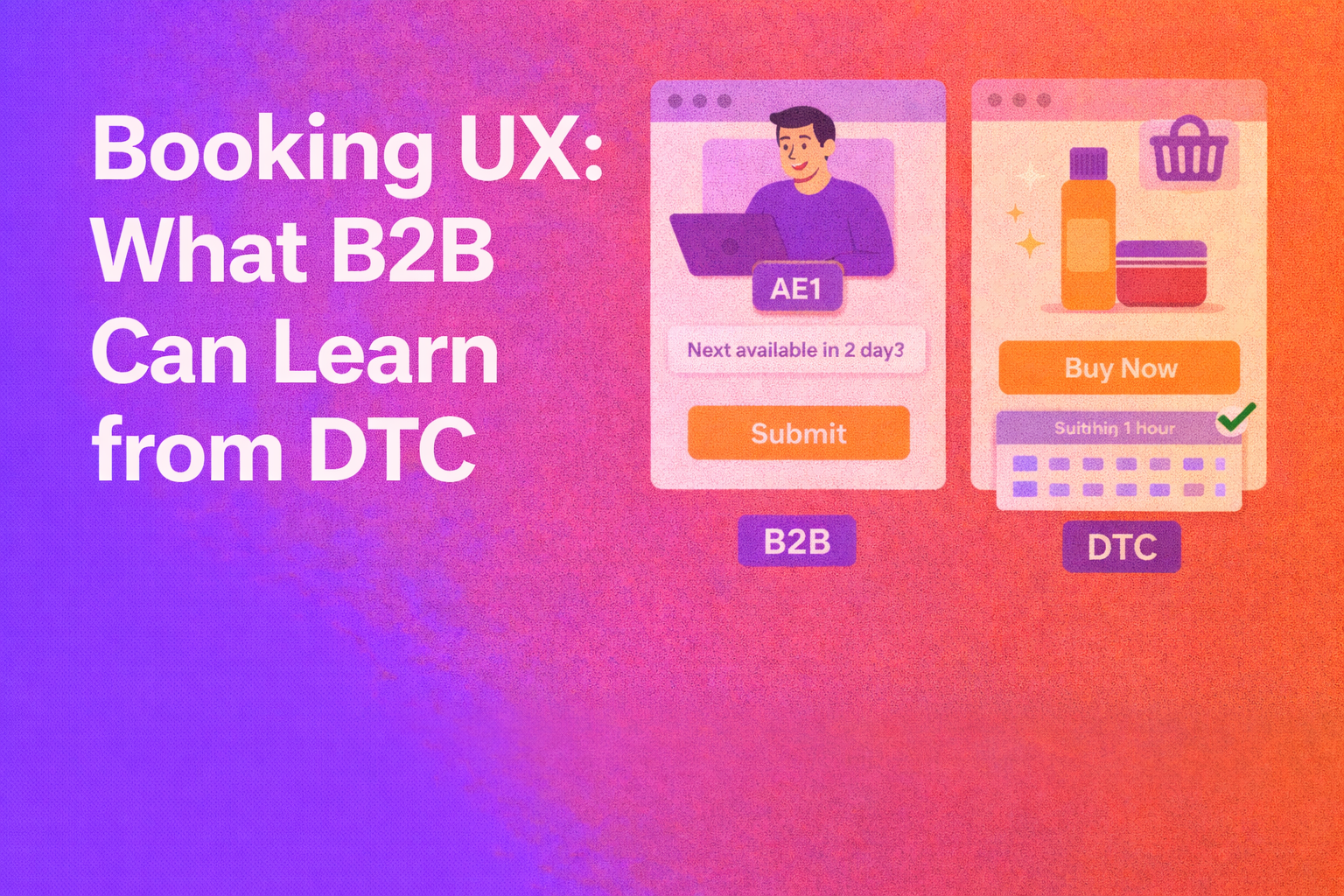
Booking UX: What B2B Can Learn from DTC
Picture this. A prospect fills out your demo form. They’re engaged and ready to see what you offer. But then, nothing happens. Instead of experiencing an instant, smooth booking process, they’re left waiting while internal workflows catch up. This gap is where B2B falls short compared to the streamlined experiences that direct-to-consumer (DTC) brands have perfected.
This article dives deep into why a frictionless booking experience matters and how B2B teams can learn from DTC UX principles to boost inbound conversion, speed to lead, and overall operational efficiency. We’ll discuss what’s broken about the current process, operational challenges, and roles revenue acceleration platforms like RevenueHero play in bridging these gaps.
Understanding the Old Booking Process
The traditional B2B booking process is riddled with delays and inefficiencies. Sales teams often wait for routing rules to fire and for alerts to land in their inboxes before engaging with a lead. Meanwhile, prospects are evaluating multiple vendors online. When 90% of B2B buyers research between two and seven different sites before making a decision (DesignRush), every minute counts.
This lag is more than just a technical hiccup; it’s the difference between a secured lead and a missed opportunity. B2B buyers expect efficiency, and the traditional approach is built on outdated methods that leave too much to chance.
Why the Delay Happens
Most follow-up delays have operational causes. They are not a sign that your team doesn’t care; rather, your system is built around manual steps that slow the process.
Key reasons for delays include:
- Manual routing workflows that wait for round-robins or owner lookups to complete
- Generic thank-you pages that lack an immediate call-to-action
- Lag in CRM enrichment leading to delayed alert notifications
- No reset of priorities after the prospect submits their form
Impact on Buyer Behavior
While your internal process stumbles, your prospect is actively researching. Some might switch to another vendor or even fill out a competitor’s form, all because your follow-up wasn’t immediate.
Recent research shows that 77% of B2B buyers state that their latest purchase was very complex or difficult (Gartner). Complexity paired with long wait times creates a discouraging first impression that can cost your company valuable opportunities.
DTC’s Instant Gratification Model
DTC brands have tapped into the expectation of immediate service. When a potential customer interacts with a DTC website, the response is nearly instantaneous. This expectation is beginning to redefine how buyers perceive service in every industry, including B2B.
With browsers primed for quick results, it’s time to align B2B lead capture with the speed and simplicity of DTC experiences.
Key Aspects of the DTC UX Model
DTC companies offer immediate feedback. They reduce friction by automating the follow-through process from the moment a lead interacts with their digital interface.
- Instant actions upon form submissions
- Clear, real-time availability and booking options integrated directly into the website
- Seamless transitions from browsing to booking without unnecessary delays
These practices have proven their worth. For instance, 80% of B2B buyers indicate that the user experience (UX) is a key factor in their purchasing decision (DesignRush). Thus, the lessons from DTC are not just relevant; they’re essential for survival in a competitive B2B environment.
How the Instant Response Impacts Conversion
The moment a prospect is allowed to schedule a meeting immediately after form submission, the momentum is preserved. Leads are more likely to convert when they are given direct control over their next step.
For example, teams that incorporate instant scheduling experience increased demo conversion rates and dramatically reduced no-shows. Providing immediate booking options creates a sense of engagement and responsiveness that resonates with modern buyers.
The Evolution: Speed to Lead in B2B
The concept of speed to lead is transforming how B2B teams interact with prospects. It’s not enough to simply capture a lead; how fast your team responds directly influences the conversion rate.
RevenueHero’s platform, with its mastery of routing complexity, was built to address these issues head-on. The focus is on eliminating any friction that slows down the buyer's journey.
Defining Speed to Lead
Speed to lead refers to the time elapsed between a prospect submitting their information and receiving a personalized, relevant response. This metric is more than just a number; it’s a reflection of your operational agility.
When leads aren’t handed off instantly, prospects lose interest. Research has shown that even a minute's delay can have a dramatic impact, as buyers continue their research and reallocate their attention. This operational lag is where many B2B organizations lose potential business.
How Mature Teams Get It Right
Mature teams understand that in the fast-paced realm of digital inquiries, speed isn’t optional. They incorporate systems that automatically route leads, display next available time slots in real time, and trigger notifications to reps without delay.
- Real-time routing based on predefined criteria like domain and region
- Dynamic scheduling tools that display the booked calendar instantly
- Automated notifications sent via Slack or email ensuring the team is always in the loop
This level of automation ensures that every prospect receives attention in less than five minutes, preserving the initial enthusiasm manifested during form submission.
Personalization at Scale
In today’s digital age, buyers expect experiences that are tailored to their unique needs. The era of generic experiences is over, and personalization has become a key differentiator in both B2B and DTC landscapes.
Customizing the booking experience based on a prospect’s industry, company size, or previous interactions can significantly increase engagement. RevenueHero’s platform leverages data-driven insights to streamline these interactions.
The Role of Data in Personalization
Personalization relies on collecting relevant data and then acting upon it immediately. Granular reporting allows teams to see buyer behavior, meeting outcomes, and conversion patterns. In doing so, they refine strategies in near real-time.
A typical example involves tailoring the booking journey. When a lead submits a form, the system can identify their company size or industry and automatically assign them to the rep best equipped to handle their needs. This targeted approach significantly increases conversion likelihood.
Implementing Tailored Booking Experiences
A few tactical steps for implementing personalization at scale include:
- Real-time segmentation: Understand the buyer’s characteristics immediately upon form submission. This segmentation allows the system to determine which salesperson or demo should be highlighted, matching the prospect’s unique requirements with the rep’s expertise.
- Dynamic calendar displays: Integrate the representative’s calendar seamlessly into the booking interface. Instead of a generic confirmation message, show available time slots that align with the prospect’s profile, making it easier to choose a suitable time.
- Automated personalized alerts: Notify the assigned team member instantly. These alerts ensure that there is minimal delay between form submission and the prospect receiving a call-to-action, thereby maintaining their initial interest.
This personalization transforms the booking process from a generic task into a finely tuned extension of your brand’s promise to deliver value quickly.
Streamlining Booking Processes: The New Operational Standard
Today’s B2B teams cannot afford inefficiencies. Every second of delay represents a potential lost opportunity. A smooth, automated booking process not only enhances conversion rates but also boosts the overall buyer experience.
RevenueHero brings operational simplicity to the forefront by removing the follow-up gap entirely. Instead of waiting for a rep to chase a lead, the process is built to allow prospects to take control immediately.
The Automated Routing Promise
Imagine a system that understands the nuances of your buyer’s requirements and routes them to the right rep or demo session instantly. This is what RevenueHero offers. By automating the capture-to-conversion process, the system dramatically reduces the friction inherent in traditional scheduling.
Key elements in this automated routing include:
- Instant lead-to-rep matching using real-time data
- Rules that direct qualified leads to reps who are ready and available
- Fallback mechanisms to handle overflow scenarios, ensuring no lead is left unaddressed
This kind of operational maturity is not just an upgrade; it is the new standard for booking UX.
Examples from the Field
Consider a scenario where a buyer fills out a demo request expecting immediate confirmation. In the old system, they might see a bland thank-you page and wait. With an integrated solution, the buyer instantly sees the available slots of the dedicated account executive, can book at their convenience, and receives a confirmation email with next steps right away.
This immediate response not only keeps the buyer engaged but also prevents attrition that is common when prospects are left sitting in a queue. In many operational workflows, this results in higher booked meeting rates and fewer no-shows, proving that seamless UX directly impacts the bottom line.
Data-Driven Insights: The Secret Behind High Conversion Rates
The transformation from a laggy, manual process to an automated, seamless booking system isn’t simply about tech upgrades. Data plays an integral role in refining the system, guiding routing rules, and pinpointing exactly where improvements can be made.
When teams have access to granular data, they can make informed decisions that drive performance. It allows for continuous testing and refinement until the process optimally converts prospects into meetings.
How Analytics Influence Booking Decisions
Analytics provide insights into every step of the buyer’s journey. You can determine which touchpoints are effective at preserving momentum and which ones contribute to drop-offs. For example, data might show that once a prospect is offered a live calendar integration, the booking rate increases by a significant percentage.
Moreover, data reveals operational pain zones-be it delays in routing, incomplete form data, or gaps in follow-up. This information is critical for adjusting the process and ensuring that every lead receives timely attention.
Operational Benefits of the Data-Driven Approach
Beyond improving conversion, a data-centric approach optimizes internal workflows. Automation and granular reporting work in tandem to streamline internal operations:
- Actionable insights: Teams receive real-time data on performance, identifying which time slots attract more bookings.
- Performance feedback: The system shows how changes in the booking process correlate with conversion rates, offering clear guidance on where tweaks are needed.
- Customer journey mapping: Detailed analytics allow teams to track how prospects navigate the booking process, providing feedback for further personalization.
This level of detail converts user behavior data into tangible improvements, reducing the friction in the buyer journey and establishing a smoother path to conversion.
Implementing Change: Operational Steps for Mature Teams
The transition from traditional, manual booking processes to an automated, data-driven approach is transformative. Operationally mature teams take concrete steps to close the follow-up gap and meet buyer expectations.
These teams understand that eliminating delays isn’t just about tweaking a few processes; it’s about rethinking the entire buyer-scheduling dynamic.
Step 1: Instant Lead Routing
Operational excellence begins the moment a lead is captured. The routing process must be instantaneous. Instead of waiting for manual enrichment or round-robin selection, mature teams use rules that immediately assign a prospect to a rep whose calendar reflects real-time availability.
This eliminates the risk of a missed connection, ensuring that prospects are greeted instantly. The system prioritizes efficiency, reducing operational friction significantly.
Step 2: Dynamic Calendar Integration
Displaying a live calendar at the moment of form submission transforms the prospect’s experience from vague anticipation into immediate action. Instead of filler text and generic thank-you pages, prospects see available slots and can actively decide on a meeting time that suits both parties.
This shift from “we’ll get back to you soon” to “book your meeting now” leverages the buyer’s current enthusiasm, keeping the conversion momentum intact.
Step 3: Automated Alerts and Follow-Ups
Once a booking is completed, automated alerts create a seamless handoff. Using tools that integrate with internal communication platforms like Slack and email ensures reps are notified instantly. This minimizes any risk of further delays.
In essence, the system works in parallel-guaranteeing that as soon as a lead books a meeting, the corresponding account executive is ready to take the call without any manual intervention.
Step 4: Continuous Data Feedback and Optimization
Building operational maturity isn’t a one-off project. Mature teams continuously analyze data on booking behaviors, conversion rates, and no-show statistics. This feedback loop informs regular tweaks to the process.
Most notably, if data reveals that a booking form is causing friction-perhaps due to too many fields or unclear instructions-the team can quickly iterate. Continuous improvement is crucial, and data remains the cornerstone of this refinement.
Overcoming Common Resistance Points
Even as teams understand the benefits of an automated, seamless booking process, there is often resistance to change. Old workflows die hard, and shifting organizational behavior can be challenging. However, the operational benefits far outweigh the transitional hurdles.
Resistance frequently comes from deeply ingrained processes that have been in use for years. Overcoming these requires clear communication about the operational improvements and outcomes that new systems like RevenueHero enable.
Addressing Internal Challenges
When teams are reluctant to adopt new workflows, it helps to highlight the specifics:
- Faster lead response times that preserve the prospect’s interest
- Reduced manual steps allowing smaller teams to manage higher volumes efficiently
- Data-backed improvements that clearly display enhanced conversion metrics
By focusing on concrete operational advantages and real results, mature teams can overcome resistance and transform their booking UX.
Real-World Scenarios and Success Stories
Consider a GTM team that transitioned from a manual follow-up process to an automated system. Previously, leads were waiting nearly 30 minutes for a follow-up email or call. After integration, the response time dropped to under five minutes, leading to a surge in confirmed meetings and a significant reduction in no-shows.
This example mirrors the experience of many teams that have shifted to a streamlined system where every interaction is optimized for speed and personalization. In these scenarios, the competition is essentially nullified as the buyer experiences no delay. They’re engaged, and they’re more likely to complete the booking effortlessly.
The RevenueHero Perspective
At RevenueHero, we believe that the future of B2B conversion lies in eliminating every operational barrier. Our platform is designed with the understanding that inbound leads deserve a frictionless, immediate response. We merge the precision of data-driven routing with the intuitive simplicity of DTC experiences.
This integrated approach isn’t just about faster response times-it’s about building systems that guarantee prospect engagement remains high from form submission to confirmed meeting.
How Our Platform Addresses the Follow-Up Gap
RevenueHero’s solution is built around eliminating the follow-up gap. We’ve engineered the system so that instants after form submission, the prospect’s experience transforms into a dynamic booking interface. Here’s our approach:
- Immediate Validation:
- The moment a user submits a form, our platform validates the input and triggers a routing algorithm that assigns the lead to the most appropriate available rep. This is done without manual intervention, ensuring no time is wasted.
- Live Calendar Integration:
- Prospects aren’t met with a generic confirmation page. Instead, they are presented with the real-time availability of their assigned account executive. This immediacy is critical in preserving the buyer's momentum.
- Automated Notifications:
- Simultaneously, automated alerts are sent to the designated rep. This coordination means when a booking occurs, the rep knows exactly when to prepare, significantly reducing idle waiting time.
- Fallback Solutions:
- If no rep is immediately available, our system offers backup options such as asynchronous offerings (like recorded demos) or routes leads to a secondary pool, ensuring no prospect falls through the cracks.
This workflow not only simplifies the operational process but also aligns perfectly with the modern expectations set by DTC brands. The result is a system that leaves no room for missed opportunities.
Operational Efficiency and Revenue Impact
By eliminating delays and optimizing the booking experience, you see enhanced conversion rates and a healthier pipeline. In fact, studies show that every $1 invested in UX improvements can bring up to $100 in returns, emphasizing the massive potential of streamlined booking processes (DesignRush).
This efficiency isn’t just cost-effective-it’s a competitive necessity. When teams reduce booking friction, prospects convert faster, meetings are scheduled more reliably, and overall sales cycles shorten dramatically.
Future-Proofing Your Inbound Conversion Strategy
The digital buyer landscape is continually evolving. B2B teams must be agile, ready to adapt, and always one step ahead of buyer expectations. Emulating the DTC instantaneous booking model is not just a trend; it’s a strategic imperative.
Future-proofing your strategy means continuously refining your processes based on robust data, evolving buyer behavior, and advances in automation technology.
Staying Agile with Continuous Improvement
Operational maturity is not achieved overnight. It requires constant iteration based on feedback loops ingrained within your analytics. Regularly review which parts of the booking process engage the buyer and which parts lag. This proactive approach helps you refine and optimize your routing, scheduling interface, and notification systems.
By staying agile and data-focused, your team can quickly pivot when insights indicate that slight adjustments could make a big difference in conversion rates.
Leveraging New Technologies for Enhanced UX
The technology landscape is rife with solutions that can further streamline the buyer journey. AI-powered tools are beginning to analyze lead behavior, predicting the best times to schedule meetings and further personalizing the booking experience. Integrating these tools with robust platforms like RevenueHero can create a seamless, almost intuitive, experience for each prospect.
This forward-thinking attitude not only enhances current operations but also positions your team at the forefront of B2B conversion tactics.
Operational Workflow Deep Dive: A Real-World Scenario
Let’s drill into a typical workflow that illustrates both the old and the new ways. Consider the following scenario:
A prospect visits your website, fills out a demo form, and expects a prompt confirmation. In the traditional model, the form is captured and sits unaddressed for 30 minutes or more while manual routing tests and alerts occur. By the time the rep gets on the call, the buyer’s interest has diminished and they might be exploring another solution.
Now, imagine a modernized process:
Stage 1: Immediate Capture and Data Enrichment
The moment a lead submits their contact info, the system immediately enriches the data using available algorithms, categorizing the lead by industry, company size, and prior engagement.
This step happens in real time, ensuring that the lead is segmented accurately based on predefined criteria. There is no waiting-everything happens instantly. The enriched data allows for precise, real-time decisions about routing.
Stage 2: Real-Time Routing and Calendar Integration
The enriched lead is instantly routed to the appropriate sales representative whose calendar is synced with the system. Rather than a generic thank-you message, the lead receives a custom interface showing the rep’s live calendar.
This interface is dynamic, meaning if the rep’s availability changes, the options update accordingly. The prospect can immediately book a slot that works for them, without needing to wait for an email or a confirmation call.
Stage 3: Automated Rep Notification and Follow-Up
At the time of booking, both the prospect and the rep are notified with an automated alert. The rep’s agenda is updated in real time, ensuring they are aware and prepared before the meeting.
If any issue arises-such as a conflict in scheduling-the system offers fallback options like a backup representative or an alternate meeting format. The follow-up is not an afterthought but part of the carefully orchestrated operational workflow.
Stage 4: Data-Driven Performance Review
Post-meeting, the system collects data about the process-from booking speed to engagement metrics. This data is consolidated in granular reports that help the team identify performance gaps and areas in need of improvement.
This continuous improvement loop is what separates operationally mature teams from those stuck in legacy processes. Data informs each tweak, ensuring that performance continually improves.
Wrapping It Up
The difference between B2B and DTC booking experiences isn’t rooted in the complexity of the product but in the operational design of the buyer’s journey. When you provide a frictionless, automated booking experience, you not only meet your prospect’s expectations-you surpass them.
This transformation is fundamental for inbound conversion. Buyers deserve immediate, personal, and efficient interactions that reflect their digital-first mindset. With platforms like RevenueHero, the transition is clear: the follow-up gap vanishes, and operational efficiency becomes the norm.
Making the Strategic Shift
Moving away from laggy, manual follow-ups means rethinking internal workflows, embracing automation, and always keeping the buyer’s experience front and center. Mature teams recognize that each delayed minute can, and often does, lead to a lost opportunity.
Leveraging data, real-time routing, and dynamic calendar integrations are not just operational tweaks-they represent a strategic reevaluation that aligns your entire process with modern buyer behavior. This shift is not merely tactical but transformational, embedding responsiveness into the DNA of your sales process.
The Road Ahead
As the digital landscape continues to evolve, B2B companies must remain agile, continually investing in systems that enhance the buyer experience. The techniques discussed reflect a future where immediate action, personalized interactions, and data-driven strategies ensure your lead capture process is as smart as it is fast.
Your goal should be clear: eliminate every friction point. When every interaction in the booking journey is streamlined, the conversion mountains transform into smooth pathways leading to rapid, effective sales outcomes.
Final Thoughts
Ultimately, bridging the gap between the old manual processes and the streamlined, automated experiences of DTC brands is not just about technology-it’s about understanding the buyer’s journey and removing every obstacle between form submission and meeting booking.
The evidence is compelling. With 80% of B2B buyers prioritizing UX over price or product (DesignRush) and 93% preferring to buy online once they’ve decided what to purchase (Gitnux), the call to action is clear. The future of booking UX lies in eliminating operational delays, personalizing the experience at scale, and harnessing the power of real-time data.
Today’s mature teams are setting the standard. They rout instantly, engage immediately, and let technology do the heavy lifting so that every prospect feels valued from the first click. This is the RevenueHero approach-where inbound conversion is accelerated, the follow-up gap is eliminated, and complexity is replaced by clarity.
If you’re serious about improving your inbound conversion and operational efficiency, it’s time to rethink your booking process. Integrate dynamic scheduling, prioritize speed to lead, and let data guide your next steps. It’s not about working harder; it’s about building a system that simply never drops the ball.
In the end, the DTC principles of instant gratification have a place in every B2B environment. Embrace the change, invest in seamless automation, and transform the way you connect with your prospects. The path to a frictionless buyer experience is clear-and the rewards are substantial.
Let RevenueHero help your team turn high-intent users into booked meeting without slowing down your funnel.