When a named account visits your website, fills out a form, or triggers an intent signal, the clock starts. Every minute that passes without the right rep engaging that account is a minute where interest decays and competitors gain ground. For account-based marketing programs, this timing problem becomes even more acute: these aren't random leads but strategically selected companies your entire go-to-market team has agreed to prioritize.
The challenge isn't identifying these accounts. Most ABM teams have their target lists defined. The problem is what happens after a contact from one of those accounts raises their hand. Manual routing creates delays. Ownership disputes cause friction. Reps miss signals because alerts get buried in email. The result? Your highest-value prospects receive the same slow, generic treatment as everyone else.
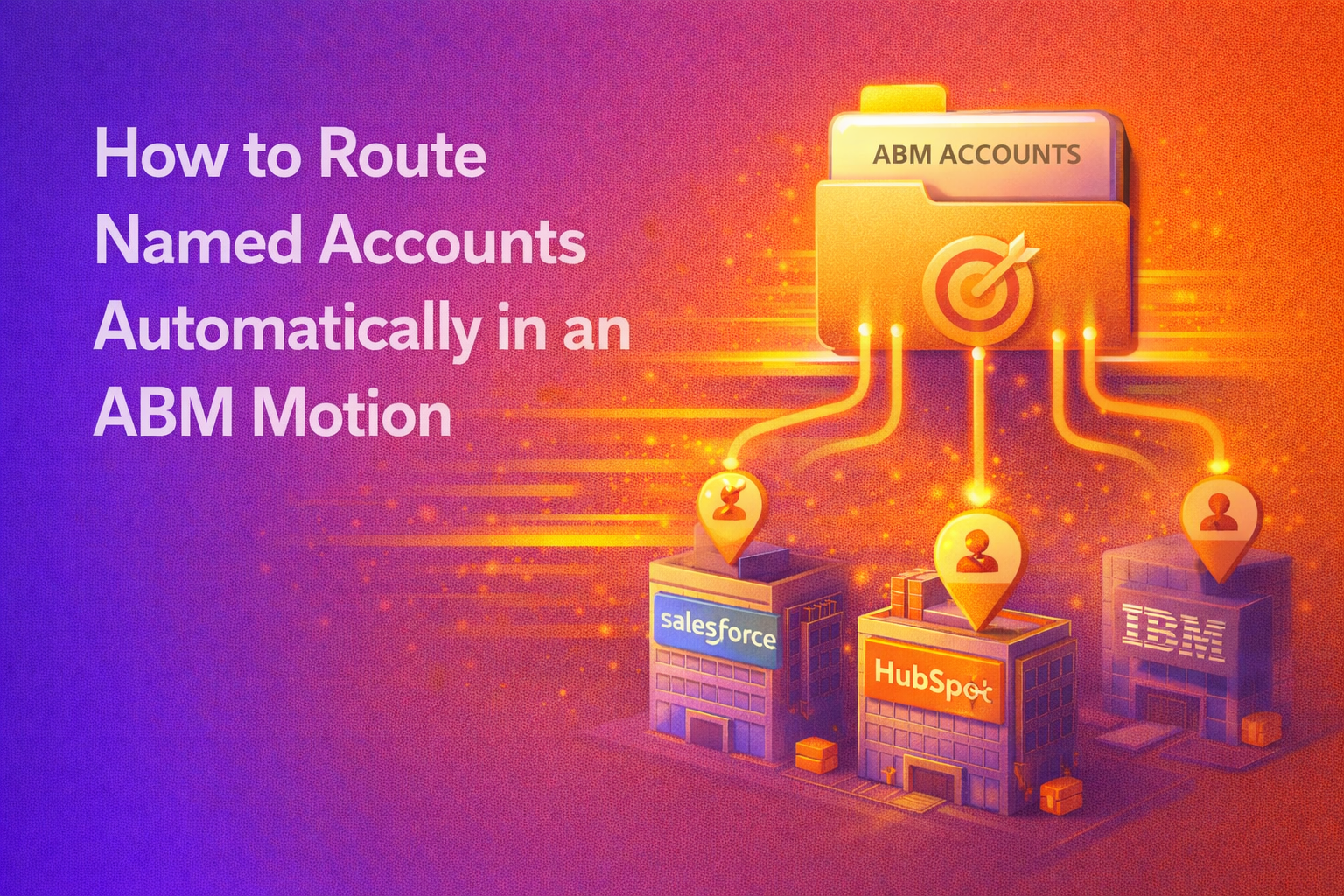
Learning how to route named accounts automatically in an ABM motion solves this fundamental disconnect. When routing logic respects existing CRM relationships, responds to real-time intent data, and triggers immediate notifications to the right owners, your ABM investment starts producing the pipeline it promised. The companies booking 78% of their qualified leads into meetings aren't doing anything magical. They've simply eliminated the friction between signal and action.
The Strategic Importance of Automated Routing in ABM
Account-based motions fail when execution can't keep pace with strategy. Your marketing team identifies ideal accounts, creates personalized campaigns, and generates engagement. Then a contact from a target account fills out a form, and the lead sits in a queue for 24 hours while someone figures out who should own it.
Eliminating Lead Response Latency for High-Value Targets
Speed matters more for named accounts than for general inbound. These prospects have been researched, targeted, and nurtured. They've finally taken action. The median qualified-to-booked rate across B2B SaaS sits at 62%, but top performers hit 78% or higher. The difference comes down to what happens in the thirty seconds after form submission.
For named accounts specifically, response latency creates a compounding problem. These contacts often have existing relationships with your company: past conversations, assigned account owners, or ongoing deals. When a new contact from a strategic account gets routed to the wrong rep or sits unassigned, you're not just losing a lead. You're potentially confusing an account relationship your team has spent months building.
Aligning Sales and Marketing Through Precision Logic
Automated routing creates accountability between teams. Marketing can track exactly which accounts engaged and whether those accounts received immediate follow-up. Sales knows that named account signals will reach them instantly, not after manual review. This shared visibility eliminates the finger-pointing that plagues many ABM programs.
The routing logic itself becomes a documented agreement between teams. When rules specify that Tier 1 accounts go to dedicated owners while Tier 2 accounts enter a round-robin among specialists, both teams understand the prioritization. There's no ambiguity about who handles what.
Establishing Your Named Account Data Foundation
Automated routing only works when your data foundation supports it. Garbage in, garbage out applies directly here. If account ownership is inconsistent in your CRM, or if you can't reliably match incoming leads to existing accounts, your routing will misfire.
Defining Account Ownership in the CRM
Start with a clean ownership model. Every named account needs a clear owner field that your routing logic can reference. This sounds obvious, but many CRM instances have conflicting ownership: one rep owns the account record while another owns the primary contact. Decide which field governs routing and enforce consistency.
For accounts without assigned owners, define fallback logic. Perhaps unowned Tier 1 accounts route to a specific team lead for immediate assignment. Maybe Tier 2 accounts without owners enter a round-robin among territory reps. The key is having explicit rules rather than letting these leads fall into a generic queue.
Implementing Lead-to-Account Matching Algorithms
Incoming leads rarely arrive with perfect account identification. Someone fills out a form with their email, and your system needs to determine whether that email domain belongs to a named account. Simple domain matching works for most cases, but edge cases require more sophisticated logic.
Consider contacts using personal email addresses, subsidiary domains, or recently acquired company domains. Your matching algorithm should handle these variations. Enrichment data helps here: appending company information to incoming leads before routing enables more accurate account matching than relying solely on email domains.
Building the Automated Routing Workflow
With clean data in place, the actual workflow construction becomes straightforward. The complexity lies in handling the various scenarios your ABM motion will encounter.
Tier-Based Routing Rules for Strategic Accounts
Not all named accounts deserve identical treatment. Tier 1 accounts generating millions in potential revenue warrant different routing than Tier 2 accounts in earlier qualification stages. Build this hierarchy into your routing logic.
Tier 1 accounts should route to their dedicated owners with immediate high-priority alerts. Tier 2 accounts might route to a specialized ABM team rather than general sales. Tier 3 accounts could receive automated nurture sequences before human engagement. The tiers you define should match your actual sales motion and resource allocation.
Handling Round-Robin vs. Dedicated Account Manager Assignment
The routing decision between round-robin and dedicated assignment depends on your coverage model. For accounts with assigned owners, the logic is simple: route to the owner. The complexity emerges with unowned accounts or accounts in territories without dedicated reps.
Round-robin distribution works well when you want equal opportunity across a team. Weighted distribution makes sense when you want to favor certain reps based on performance or capacity. Some teams use hybrid approaches: round-robin for initial assignment, but the assigned rep then owns all future contacts from that account. Document your chosen approach and build it into the workflow.
Triggering Actions Based on Intent and Engagement
Routing shouldn't wait for form fills. Named accounts generate signals across multiple channels, and your routing should respond to high-intent behaviors wherever they occur.
Routing Based on High-Intent Website Behavior
When a contact from a named account visits your pricing page three times in a week, that signal deserves action even without a form submission. Website behavior tracking, combined with account identification, enables proactive routing.
Define which behaviors warrant alerts: pricing page visits, case study downloads, comparison page views, or return visits after periods of inactivity. Each behavior type might trigger different actions. A pricing page visit from a Tier 1 account could generate an immediate Slack alert to the account owner. A content download might trigger an automated email sequence.
Prioritizing Alerts for 'Dark Social' and Third-Party Intent
Not all buying signals happen on your website. Third-party intent data from review sites, competitor comparisons, and industry research provides visibility into accounts actively evaluating solutions. When a named account shows intent signals through these channels, your routing should capture and act on that information.
The challenge is signal quality. Third-party intent data varies in accuracy and timeliness. Build routing rules that weight these signals appropriately: perhaps third-party intent alone triggers a lower-priority alert, while third-party intent combined with website activity triggers immediate outreach.
Optimizing Post-Routing Sales Notifications
Getting the lead to the right rep means nothing if the rep doesn't see the notification. Alert fatigue kills response times. Your notification strategy needs to cut through the noise.
Leveraging Slack and Microsoft Teams for Real-Time Alerts
Email notifications get buried. Reps checking email hourly will miss the speed-to-lead window that determines conversion. Real-time messaging platforms solve this problem when configured correctly.
Create dedicated channels for named account alerts. Use formatting that communicates urgency and context at a glance: account tier, contact role, engagement history, and recommended action. Include direct links to the CRM record and calendar booking so reps can act immediately without searching for information.
Automating Personalized Outreach Sequences
Not every alert requires manual action. For certain scenarios, automated sequences can begin while waiting for rep engagement. A contact from a named account who books a meeting should receive immediate confirmation. A contact who doesn't book might receive a personalized follow-up email referencing their company and engagement history.
The key is ensuring automation complements rather than replaces human engagement. Automated sequences handle the immediate response while reps prepare for meaningful conversations. RevenueHero customers using this approach book meetings with 75% or more of qualified inbounds the same day, compared to around 40% with manual processes.
Measuring and Refining Your Routing Performance
Routing logic isn't set-and-forget. Your ABM program evolves, your named account list changes, and your sales team structure shifts. Regular measurement identifies where routing breaks down.
Track metrics that reveal routing effectiveness: time from signal to rep notification, time from notification to rep action, conversion rates by account tier, and routing accuracy (did leads reach the correct owner?). Compare these metrics across segments to identify where rules need adjustment.
Review routing exceptions monthly. When leads require manual rerouting, understand why. Perhaps a new subsidiary domain isn't matching correctly. Maybe a recently hired rep isn't included in the round-robin. Each exception reveals a gap in your logic.
The companies that route named accounts automatically in their ABM motion don't achieve perfect routing on day one. They build measurement into their process and refine continuously. Start with rules that handle 80% of scenarios correctly, then iterate based on what the data reveals. The goal isn't perfection but rather systematic improvement that compounds over time, turning your named account list into the pipeline source your ABM strategy promised.
Let RevenueHero help your team turn high-intent users into booked meeting without slowing down your funnel.