Most B2B sales teams treat qualification as a binary gate: does this lead pass or fail? But the real question isn't whether someone qualifies. It's whether your qualification criteria are doing actual work or just adding steps between a buyer's intent and a booked meeting. The gap between a 40% qualified-to-booked rate and a 78% rate isn't explained by better leads or bigger budgets. It's explained by what happens in the 30 seconds after a form fill: how you qualify, how fast you route, and whether a calendar appears before intent decays. Getting your lead qualification criteria right for B2B sales teams means building rules that filter with precision without introducing unnecessary friction. That balance is what separates teams that convert efficiently from those bleeding pipeline they already paid for.
The Friction vs. Quality Paradox in Modern B2B Sales
Every qualification step you add creates a tradeoff. More filtering improves conversation quality but risks losing buyers who were ready to commit. Less filtering fills calendars but burns rep time on poor fits. The paradox is real, and most teams default to one extreme without measuring the cost of the other.
Data from over one million B2B SaaS form submissions shows that companies with higher disqualification rates actually convert better downstream. Being selective doesn't shrink your pipeline: it concentrates it. Reps stop wasting hours on leads that were never going to close. The leads that do get through show up more often, engage more deeply, and move faster through the funnel.
The key is building qualification rules that are intentional, not arbitrary. If you're disqualifying fewer than 20% of inbound leads and your meeting rate is struggling, you're likely letting through prospects that waste rep time. The fix isn't more leads: it's sharper criteria.
Why Manual Review Queues Are Killing Inbound Intent
A lead fills out a form. It lands in a queue. Someone reviews it, maybe routes it, maybe emails the lead back. Days pass. Intent decays. The meeting that should have happened doesn't. This is the default workflow at most companies, and it's destroying conversion rates.
Buyer intent has a steep decay curve. The probability of booking a meeting drops from roughly 80% in the first minute to around 40% by the next day. Manual review queues introduce exactly the kind of delay that kills this window. The old "five-minute rule" is already obsolete: modern buyers evaluating multiple solutions expect sub-minute engagement.
The Cost of Poor Qualification on Sales Rep Productivity
When qualification criteria are too loose, reps spend their time on calls that go nowhere. When criteria are too tight, marketing gets blamed for low volume. Neither outcome is acceptable. The real cost of poor qualification shows up in three places: wasted rep hours, inflated pipeline that never closes, and a feedback loop where sales and marketing blame each other instead of fixing the process.
Top-performing teams treat qualification as a conversion event, not an administrative task. They use real-time enrichment and form data to make instant decisions, putting a calendar in front of qualified buyers immediately rather than routing them into a follow-up sequence.
Defining Core Qualification Criteria for Your Sales Motion
Your qualification criteria should mirror your sales motion, not some generic framework borrowed from a company with a completely different deal size and sales cycle. A company selling six-figure enterprise contracts needs different filters than one running high-velocity SMB demos.
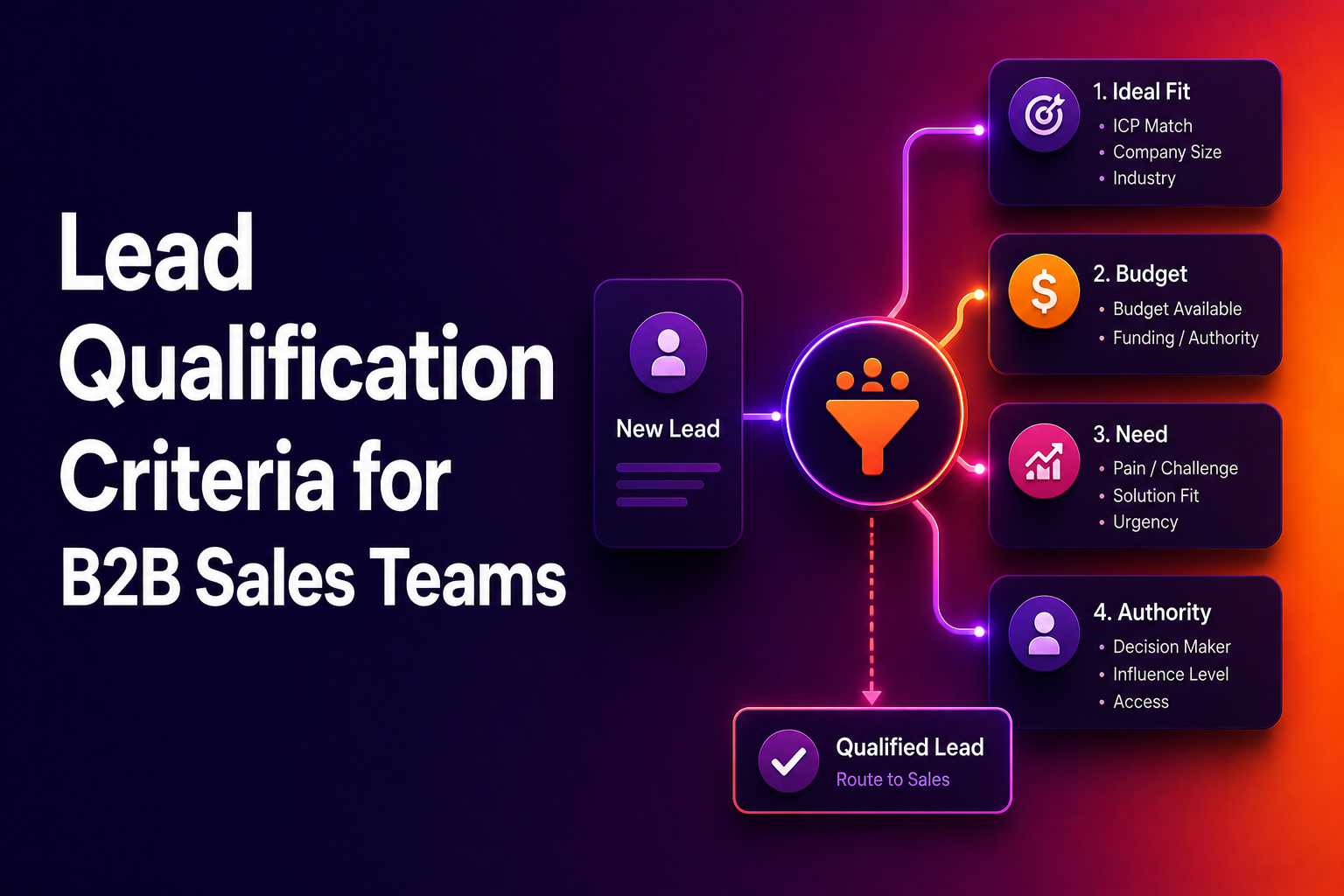
The criteria that matter most are the ones that predict whether a meeting will be productive. Company size, industry fit, use case alignment, and budget authority are the usual suspects, but the specific thresholds depend on your ICP and your capacity to handle volume.
Balancing Selectivity: Enterprise vs. High-Velocity SMB Models
If you're selling enterprise deals where a single bad meeting costs hours of expensive AE time, a higher disqualification rate makes sense. Tighter filters on company size, industry, and decision-maker title protect your most valuable resource: rep attention.
For high-velocity SMB motions where demos are fast and low-cost, you can afford to be more inclusive. The cost of a 15-minute call with a marginal lead is low compared to the risk of filtering out a buyer who would have converted. Match your selectivity to your deal economics, not to a universal standard.
Leveraging Form Data and CRM History for Real-Time Filtering
The strongest qualification systems combine three data sources: what the lead tells you on the form, what enrichment tools reveal about their company, and what your CRM already knows about the account. Layering these inputs creates qualification decisions that are both fast and accurate.
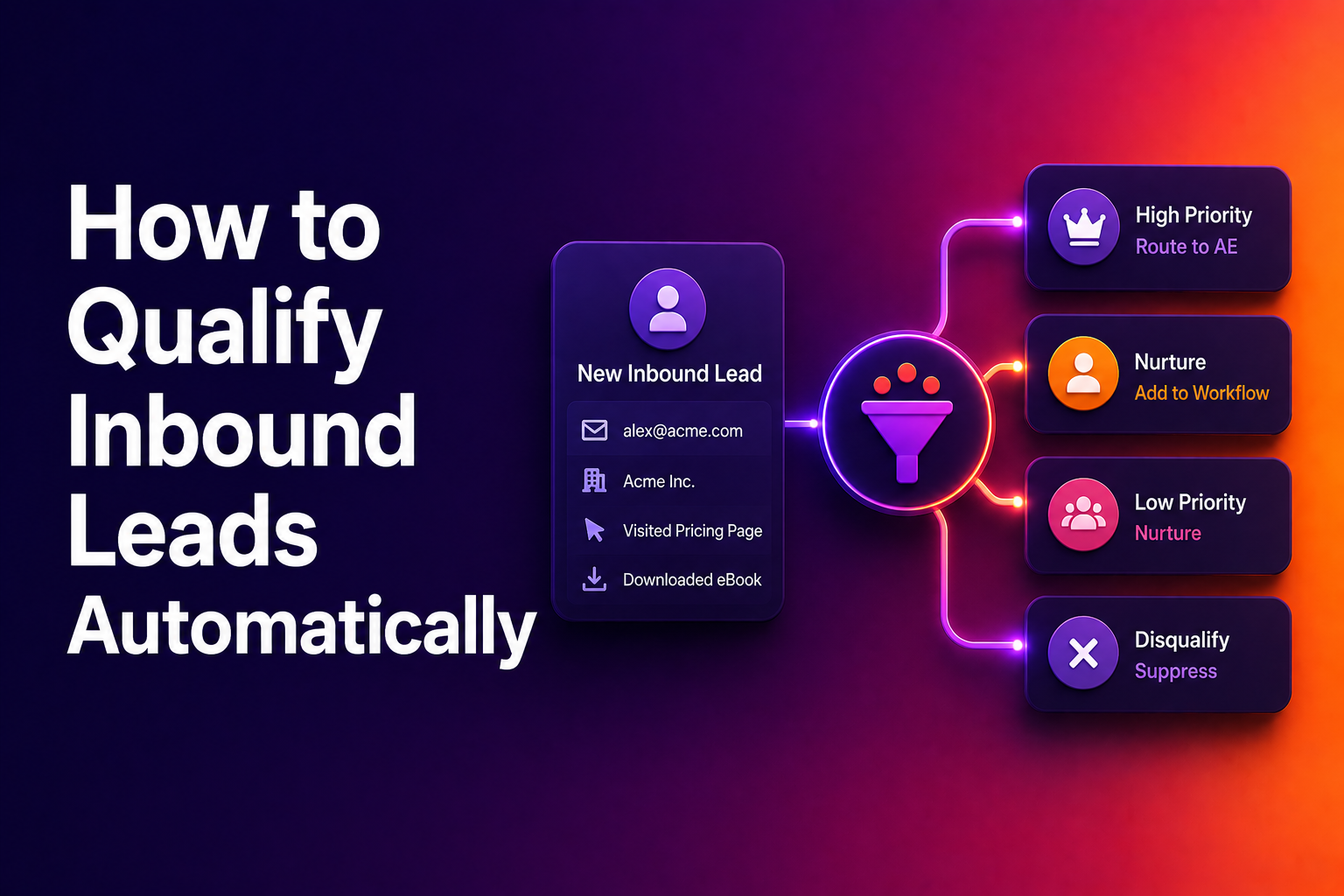
For example, if a lead submits a form and your CRM shows an existing account owner, routing should respect that relationship. If enrichment data reveals the company has 12 employees and your minimum threshold is 50, the disqualification happens instantly: no manual review needed. RevenueHero handles this by qualifying leads using form responses, enrichment data, and CRM history in real time, so the routing decision is made before the page even finishes loading.
Industry-Specific Qualification and Vertical Positioning
Benchmark data tells a clear story: vertical positioning wins. Construction Tech converts at 69.1%. Ecommerce at 68.8%. Travel Tech at 68.3%. Generic Sales Tech sits at 62.8%. The pattern holds across segments.
If you're a horizontal product, consider building industry-specific qualification paths. A "Marketing software for e-commerce" landing page converts better than a generic "Marketing software" page, even if the underlying product is identical. The specificity signals fit, builds confidence, and drives conversion. Your qualification criteria should reflect this: asking "How many retail locations do you manage?" tells you more about fit than a generic "company size" dropdown.
Optimizing Form Fields for Actionable Insights
Top performers convert at 77% with 2 form fields and at 76% with 13 fields. The number of fields doesn't determine conversion. What matters is whether each field does something useful for routing, qualification, or demo personalization.
Every field on your form should answer one question: does this data point change what happens next? If a field doesn't influence routing, personalization, or disqualification, it's adding friction without value. Cut it.
Identifying Useful Data Points vs. Friction-Heavy Fields
Useful fields are ones that directly enable a better experience. Company size helps with routing. Region determines territory assignment. Use case or product interest lets the rep tailor the demo. These fields earn their place on the form because they change the outcome.
Friction-heavy fields are the ones that get collected but never actioned. "How did you hear about us?" is a classic example: it satisfies marketing's attribution curiosity but does nothing for the buyer. Job title can go either way. If you use it for routing or qualification, keep it. If it just sits in a CRM field, drop it.
The Role of Enrichment Data in Instant Qualification
Enrichment data fills the gaps your form can't cover without turning the submission into an interrogation. Firmographic data like employee count, industry, revenue range, and tech stack can be appended in real time, letting you qualify on criteria the lead never had to manually provide.
This is where the friction-versus-quality paradox gets resolved. You keep the form short to protect conversion rates while still gathering the data you need for accurate qualification. The enrichment layer does the heavy lifting behind the scenes, and the lead sees a calendar instead of a "thanks, we'll be in touch" message.
Driving Commitment Through Strategic Language
Language on your forms and CTAs directly affects conversion. This isn't theory: the data is unambiguous. Among top-performing B2B SaaS companies, 29% use "Book a Demo," 21% use "Get a Demo," and 12% use "Schedule a Demo." Only 12% use "Request a Demo."
The difference is psychological. "Request" implies uncertainty: you're asking for permission. "Book" implies commitment: you're taking action. The visitor mentally crosses the threshold from considering to doing while they're still on your page.
Replacing Permission Language with Commitment Language
This is a five-minute fix with measurable impact. Search your site for every instance of "Request," "Submit," "Contact Sales," and "Get in Touch." Replace them with "Book," "Schedule," "Reserve Your Spot," or "Pick a Time."
Check your buttons, headers, meta descriptions, and email templates. Permission language creates uncertainty. Commitment language creates momentum. The companies converting at 78% aren't using fundamentally different technology: they're using different words, and those words shape buyer behavior at the exact moment it matters most.
Benchmarking Success: From Lead Submission to Booked Meeting
The top 10% of B2B SaaS companies book nearly 8 out of 10 qualified leads into meetings. The median across all customers sits at 62%. The best performers hit 88%. These aren't cherry-picked case studies: this is aggregate data from over a million form submissions across a full calendar year.
If your team is converting at 30-40% and assuming that's normal, it isn't. The gap between 40% and 78% on the same traffic, the same spend, and the same leads is determined by what happens in the half-minute after the form fill.
Closing the Gap Between Median and Top-Tier Conversion Rates
The companies that close this gap aren't doing anything complicated. They use commitment language instead of permission language. They cut form fields that don't help routing or personalization. They're pickier about who gets through to sales. And when someone qualifies, they put a calendar in front of them immediately: not tomorrow, not after an SDR reviews the lead, but right then.
Getting from 40% to 62% means 22 more meetings for every 100 qualified leads. Getting to 78% nearly doubles your pipeline from the same traffic. No budget increase required. The qualification criteria for your B2B sales team aren't just a filter: they're a conversion mechanism.
Maintaining and Iterating Your Qualification Rules
Qualification criteria aren't a set-and-forget configuration. Markets shift, ICPs evolve, and what constituted a good fit six months ago might be generating wasted meetings today. The teams that maintain high conversion rates treat their qualification rules as living logic, not static filters.
Seasonal patterns also matter. Q2 consistently outperforms other quarters, with April through June all exceeding 60% meeting rates. Q3 drags, driven almost entirely by August (53.4%) and September (53.7%). Knowing these patterns helps you plan campaigns and set realistic benchmarks.
Quarterly Reviews to Prevent Pipeline Leakage
Review your disqualification criteria every quarter. Ask one question for each rule: "Is this filtering out genuinely poor fits, or just adding friction?" If a criterion isn't improving meeting quality, it's costing you pipeline.
Track your DQ rate alongside your qualified-to-booked rate. If your DQ rate is climbing but your meeting quality isn't improving, your criteria have drifted from filtering to blocking. If your DQ rate is low and reps are complaining about lead quality, tighten up. The data should drive these decisions, not gut feel or last quarter's assumptions. Build a quarterly cadence, review the numbers, adjust the rules, and measure the impact over the next 90 days. That's how you keep your funnel honest and your pipeline clean.
Let RevenueHero help your team turn high-intent users into booked meeting without slowing down your funnel.