Every inbound lead carries a shelf life measured in seconds, not hours. The moment a prospect fills out your demo form, their intent starts decaying. They're comparing vendors, juggling tabs, and moving through their own evaluation process at speed. Your response time isn't just a metric: it's a conversion event. Yet most SaaS teams still treat the post-form-fill experience as an operational afterthought, routing leads through queues, manual reviews, and delayed email sequences. The result? Pipeline that should exist simply doesn't. Understanding speed-to-lead benchmarks for SaaS isn't about chasing a vanity number. It's about knowing exactly where your funnel leaks and how the top performers plug those gaps. Based on data from over one million inbound form submissions across B2B SaaS companies, the gap between median and top-decile performers is enormous: and it's almost entirely determined by what happens in the 30 seconds after someone clicks "submit." This piece breaks down where those benchmarks actually stand in 2026, what separates the best from the rest, and how you can close the gap without increasing your ad spend by a dollar.
The Inbound Conversion Gap: Why Good Leads Die in the Queue
The biggest threat to your inbound pipeline isn't bad traffic or weak messaging. It's the gap between a qualified form fill and a booked meeting. Most B2B SaaS companies convert somewhere between 30% and 40% of their qualified leads into meetings and assume that's normal. The data says otherwise: the median qualified-to-booked rate across RevenueHero's customer base sits at 62%, and the 90th percentile hits 78% or higher. If you're at 35%, you're not dealing with a lead quality problem. You're dealing with a process problem.
The Decay of Intent After the Form Fill
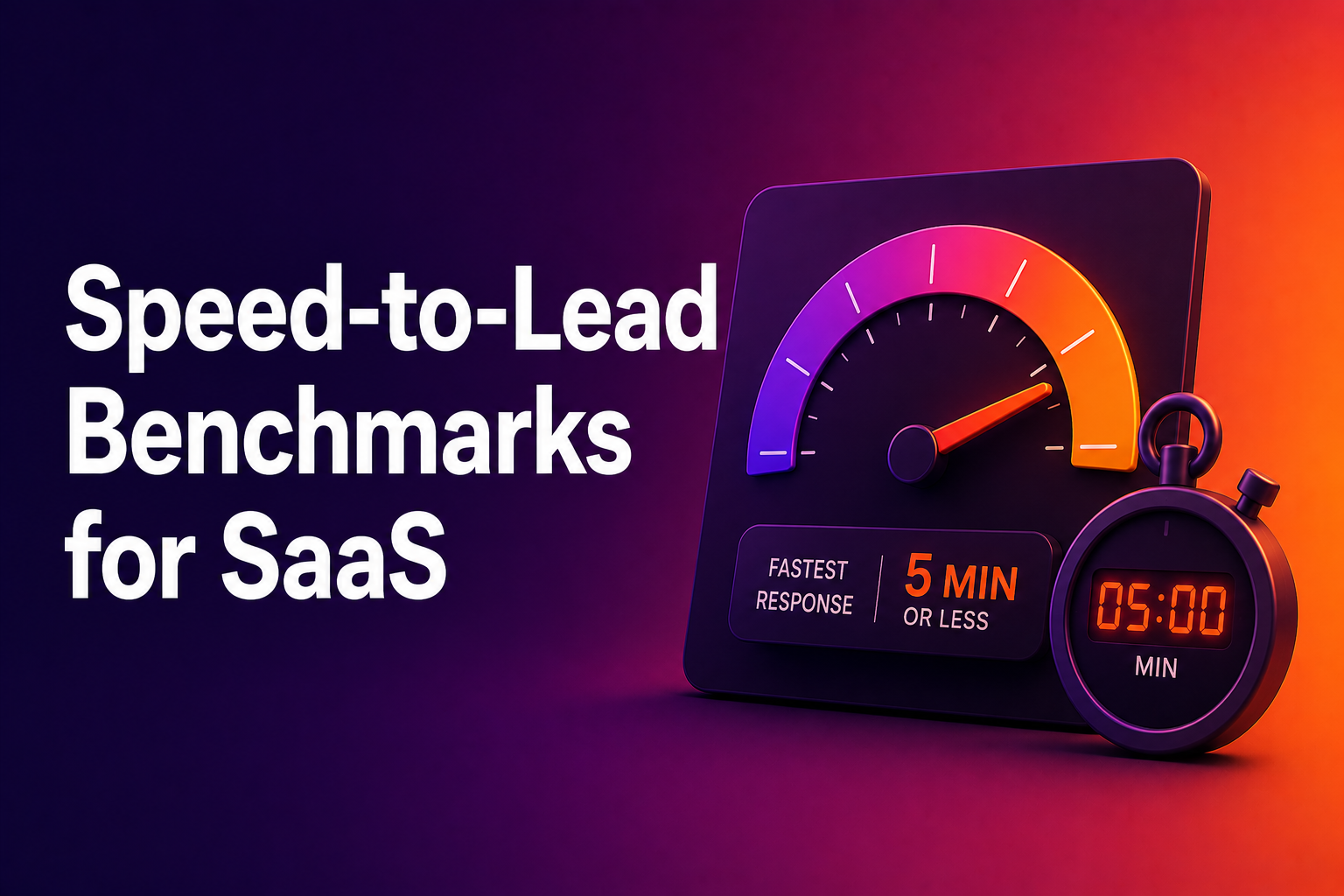
A prospect who fills out a demo form is at peak buying intent at the exact moment they click submit. Research consistently shows that conversion probability drops from roughly 80% within the first minute to around 40% by the next day. That's not a gradual decline: it's a cliff. The old "five-minute rule" that sales teams used to reference is already outdated. Modern buyers are evaluating three to five vendors simultaneously. If your competitor puts a calendar in front of them instantly and you send a "thanks, we'll be in touch" confirmation email, you've already lost. The decay curve is steepest in the first 60 seconds, and every minute of delay compounds the damage.
Why Manual Review is the Silent Pipeline Killer
Here's the pattern baked into most inbound funnels: a lead fills out a form, the submission lands in a queue, someone manually reviews it, maybe they route it, maybe they email the lead back. Days pass. Intent decays. The meeting that should have happened never does. Manual review introduces latency at the worst possible moment. Even well-staffed SDR teams can't match the speed of an automated qualification and scheduling flow. The bottleneck isn't effort or headcount: it's architecture. Teams that rely on human triage as the first step after form submission are structurally disadvantaged against those that automate qualification and put a calendar in front of the prospect immediately.
B2B SaaS Benchmarks: What 'Good' Looks Like in 2025
The benchmarks below are drawn from 12 months of aggregate inbound conversion data across B2B SaaS companies, weighted by volume. These aren't theoretical or cherry-picked. They represent real qualified-to-booked rates across a full calendar year of over one million form submissions.
The 78% Rule: Analyzing the 90th Percentile Performers
The top 10% of companies in this dataset book nearly 8 out of 10 qualified leads into meetings. The best individual performers hit 88%. What separates them isn't better leads or bigger budgets. It's a specific set of operational choices. They use commitment language in their CTAs: "Book a Demo" instead of "Request a Demo." Among top performers, 29% use "Book a Demo," 21% use "Get a Demo," and only 12% use "Request a Demo." They present a calendar immediately after qualification. They don't route leads through manual review. The gap between 40% and 78% on identical traffic and spend comes down to what happens in the 30 seconds after the form fill.
Median Meeting Rates Across SMB, Mid-Market, and Enterprise
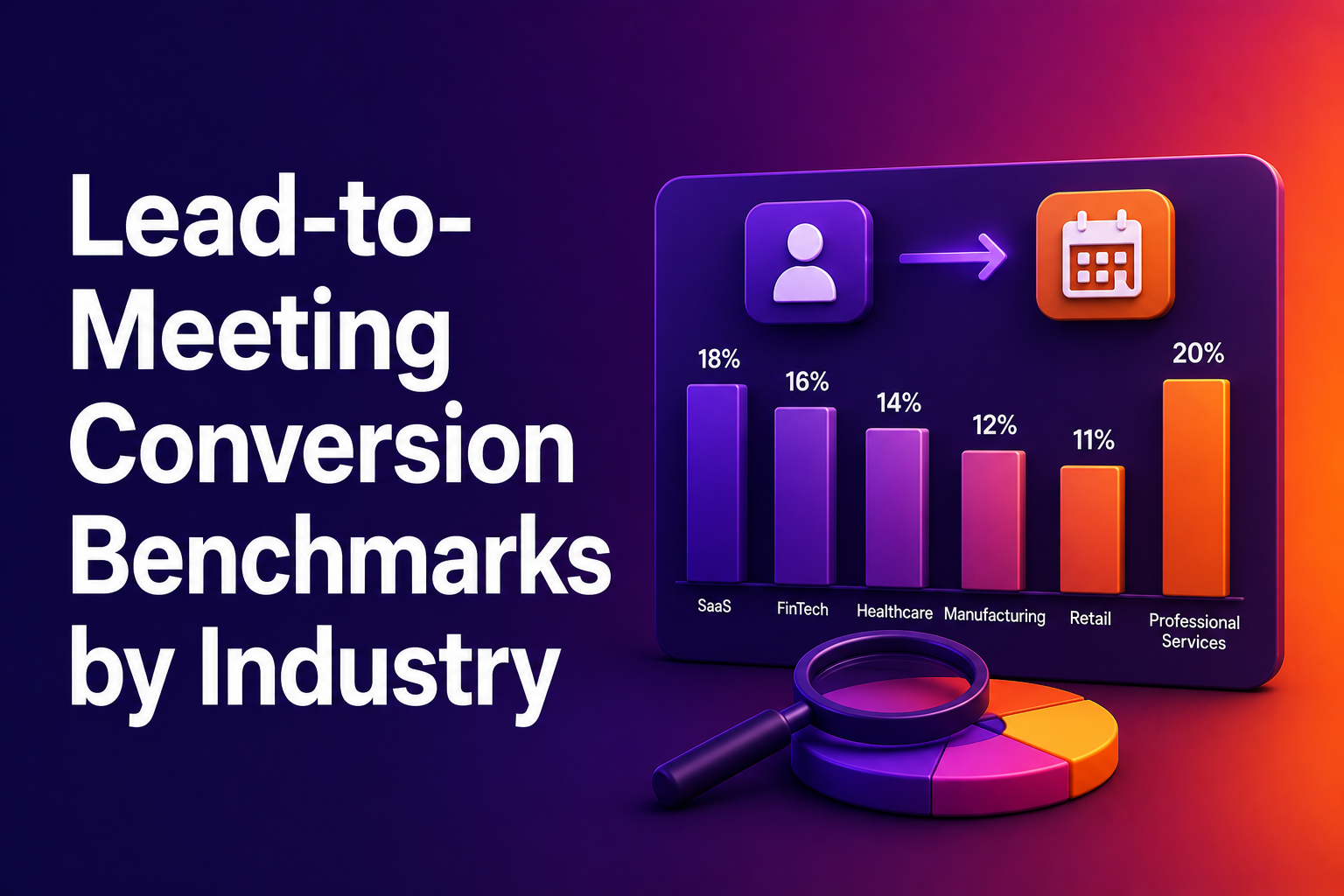
Conversion rates vary meaningfully by segment. SMB-focused companies convert at 63.2% with a 21.8% disqualification rate. Mid-market sits at 61.2% with a 28.1% DQ rate. Enterprise, perhaps surprisingly, leads at 70.1% with a 71.2% DQ rate. Enterprise teams are far more aggressive about filtering out bad fits, which means the leads that do qualify convert at a much higher rate. The takeaway for RevOps leaders: a high DQ rate isn't inherently bad. If your DQ rate is under 20% and your meeting rate is struggling, you're likely letting through leads that waste rep time. Tightening qualification criteria on company size, industry, or use case fit can actually improve your conversion rate.
The 30-Second Window: Converting Leads into Booked Meetings
The conversion event isn't the form fill. It's the moment a qualified lead sees a calendar and picks a time. Everything between the form submission and that calendar is friction, and friction kills meetings.
Instant Qualification vs. Delayed Routing
Companies in the top decile qualify leads in real time using form responses, enrichment data, and CRM history. There's no manual review queue. No delays. The moment someone submits, they know whether they qualify. Contrast this with the typical flow: form goes to a queue, an SDR reviews it within a few hours (if you're lucky), then sends a follow-up email. By then, the prospect has moved on. Instant qualification doesn't mean lowering your bar. It means encoding your qualification criteria into your routing logic so the decision happens programmatically, in milliseconds, rather than manually over hours.
The Impact of 'Commitment Language' on CTA Conversion
CTA copy matters more than most teams realize. The data is clear: commitment language outperforms permission language. "Book a Demo" and "Schedule a Demo" consistently beat "Request a Demo," "Contact Sales," or "Get in Touch." The psychological mechanism is straightforward. "Book" implies the prospect is in control and will get a confirmed time. "Request" implies they're asking for permission, introducing uncertainty about whether they'll actually get what they want. Search your site for every instance of "Request," "Submit," or "Contact Sales." Replace them with "Book" or "Schedule." It's one of the lowest-effort, highest-impact changes you can make.
Variables Influencing Speed-to-Lead Performance
Conversion rates don't exist in a vacuum. Several structural factors influence where your team lands relative to these SaaS lead response benchmarks.
Vertical vs. Horizontal SaaS Conversion Trends
One of the clearest patterns across the entire dataset: vertical SaaS outperforms horizontal SaaS. Construction Tech leads at 69.1%. Ecommerce Tech hits 68.8%. Travel Tech comes in at 68.3%. Generic Sales Tech sits at 62.8%. The advantage comes from clarity. When you sell to contractors, "are you a contractor?" is a simple, effective qualification question. When you sell to "any company that does marketing," qualification gets fuzzy. Visitors aren't sure if they're the right fit. Reps aren't sure how to personalize the demo. If you're a horizontal product, consider vertical positioning on your landing pages. A "Marketing software for e-commerce" page will convert better than a generic "Marketing software" page, even if the product is identical.
Seasonality and the Q3 August-September Drag
Q2 is the strongest quarter for inbound conversion, with April, May, and June all exceeding 60%. Q3 drops to 55.9%, dragged down almost entirely by August at 53.4% and September at 53.7%. July actually performs well at 61.1%. If your late-summer numbers dip, you're not alone: the pattern is consistent across the broader market. Plan your biggest inbound pushes for Q2 and early Q1. Don't panic when August numbers soften: but do account for seasonality in your forecasting rather than treating it as a process failure.
Funding Stages and Meeting Rate Fluctuations
An interesting U-curve appears in the data: both early-stage and late-stage companies outperform the middle. Unfunded and seed-stage companies convert at 63.6%. Series D and PE-backed companies convert at 66.8%. Series A drops to 53.6%, and Series B sits at 55.3%. Early-stage companies tend to have tight, focused ICPs and founders who respond instantly. Late-stage companies have invested in infrastructure and routing automation. The middle stages are where teams are scaling fast, adding complexity, and often introducing manual processes that slow everything down. If you're Series A or B and your conversion rate is lagging, the problem is likely operational, not strategic.
Optimizing Your Inbound Infrastructure for Maximum Velocity
Knowing the benchmarks is only useful if you act on them. The changes that move the needle aren't expensive or complex: they're architectural.
Balancing Form Friction and Disqualification (DQ) Rates
Top performers in the dataset convert at 77% with 2 form fields and at 76% with 13 fields. The number of fields doesn't matter nearly as much as whether each field does something useful. Every field should either help with qualification, routing, or demo personalization. If it doesn't serve one of those purposes, cut it. Review your DQ rate quarterly. If it's under 20% and your meeting rate is below 60%, you're probably not filtering aggressively enough. If it's above 50% and your pipeline is thin, you may be over-qualifying and turning away viable prospects.
Implementing Real-Time Scheduling and Automated Workflows
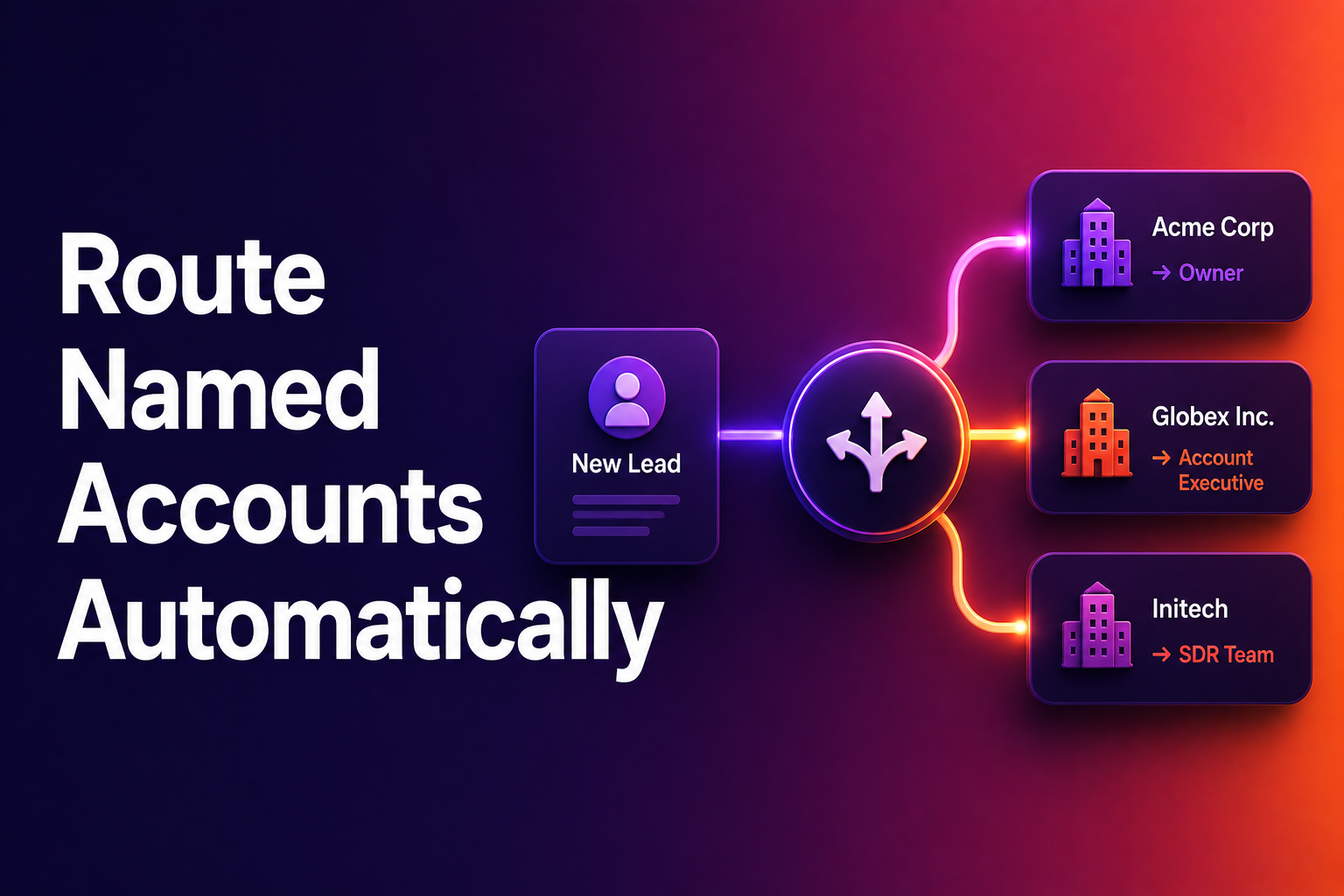
The single highest-impact change is removing the gap between form submission and calendar presentation. When a qualified lead submits a form, they should see available times from the right rep immediately: not a thank-you page, not a promise of follow-up. This requires real-time enrichment, automated qualification logic, and routing that respects CRM relationships like territory ownership and existing account assignments. Tools like RevenueHero handle this by qualifying, routing, and scheduling in a single step, syncing everything back to the CRM without manual intervention. The result is fewer drop-offs, cleaner data, and a fundamentally faster path from intent to meeting.
Where You Go From Here
The data from over one million form submissions tells a consistent story. The companies that book 78% or more of their qualified leads aren't doing anything exotic. They use commitment language in their CTAs. They cut form fields that don't serve routing or personalization. They're selective about who qualifies. And when someone does qualify, they put a calendar in front of them right then: not after an SDR reviews the lead, not the next business day.
None of this requires more budget or better leads. You already have the traffic. You already have people raising their hands. The only question is how many of them actually end up talking to your team. If you're at 40% today and you get to 62%, that's 22 more meetings per 100 qualified leads. Get to 78%, and you've nearly doubled your pipeline from the same spend. Start by auditing your post-form-fill experience this week. Time it. Count the steps. Then eliminate every one that doesn't directly lead to a booked meeting.
Let RevenueHero help your team turn high-intent users into booked meeting without slowing down your funnel.