Every enterprise deal starts with a moment of intent: someone from a named account fills out a form, clicks a CTA, or requests time with your team. What happens in the next 30 seconds determines whether that intent becomes a meeting or evaporates into a follow-up queue. The gap between a 35% qualified-to-booked rate and a 78% rate isn't about lead quality or brand awareness. It's about the mechanics of what fires after that click. For enterprise teams managing hundreds of named accounts across territories, products, and rep assignments, routing those accounts automatically and accurately is the difference between a healthy pipeline and a leaking one. The old model of manual triage, where an SDR reviews a submission, checks the CRM, and emails the lead back, simply can't keep up with how buyers behave in 2026. They're evaluating three or four vendors simultaneously. If your response takes hours, you've already lost positioning. This piece breaks down why manual routing fails, what automated named account routing actually looks like under the hood, and how the best enterprise teams are converting more inbound interest into booked meetings without adding headcount.
The Decay of Intent: Why Manual Lead Routing Fails Modern Enterprise Teams
Intent isn't static. It peaks at the moment someone fills out your form and declines sharply with every passing minute. The old "five-minute rule" for lead response is already obsolete. Enterprise buyers in 2026 expect sub-minute engagement, and the data backs this up: conversion probability sits around 80% in the first minute after submission and drops to roughly 40% by the next day. For named accounts, where deal sizes are large and buying committees are complex, that decay hits even harder because the stakeholder who raised their hand may not be available or interested tomorrow.
The Gap Between Inbound Submission and Sales Connection
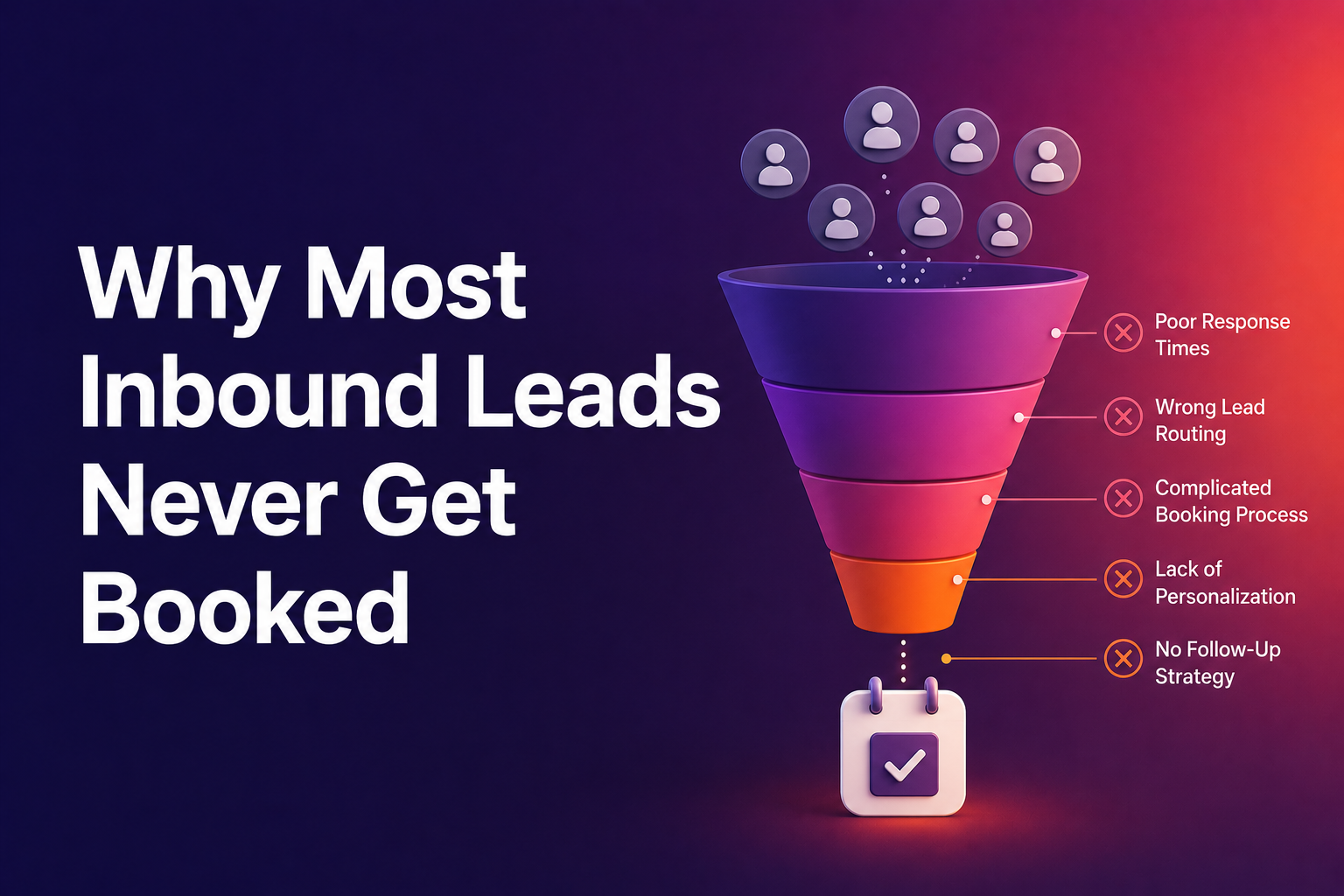
Most enterprise go-to-market teams have a structural problem baked into their process. A lead fills out a form. That form goes to a queue. Someone manually reviews it, checks the CRM for existing ownership, maybe cross-references territory assignments, and then routes it. By the time a rep sends a follow-up email, the lead has moved on. The median time between form submission and first human contact in manually routed organizations often stretches to hours, not minutes. That gap is where pipeline dies.
Why Manual Review Queues Kill Conversion Rates
Manual queues introduce two killers: latency and inconsistency. Latency is obvious. Inconsistency is subtler but just as damaging. Different SDRs apply different judgment to the same data. One might prioritize by company size, another by territory, another by gut feel. Named accounts get misrouted, ownership in Salesforce or HubSpot gets ignored, and reps end up stepping on each other's toes. The result isn't just slow response times. It's a fundamentally unreliable system that erodes trust between marketing and sales.
Defining High-Stakes Qualification for Named Accounts
Enterprise qualification isn't the same as SMB qualification. A bad meeting at the SMB level costs 20 minutes. A bad meeting at the enterprise level costs hours of senior rep time, potential confusion within the account, and sometimes a damaged relationship with a named account that your team has been nurturing for months. The stakes demand precision, and precision requires intentional qualification criteria that filter for fit without creating unnecessary friction.
The Cost of Poorly Qualified Meetings in Enterprise Sales
Data from RevenueHero's 2025 benchmark report shows that enterprise segments carry a 71.2% disqualification rate, far higher than the 21.8% DQ rate in SMB. That's not a bug. It's a feature. Companies that are selective about who gets through to sales end up with higher-quality conversations. Reps aren't burning cycles on poor fits. The leads who do make it through are more engaged, more likely to show up, and more likely to convert. If you're selling enterprise deals, a higher DQ rate is a sign your qualification logic is working, not failing.
Balancing Friction and Value in Named Account Forms
There's a persistent myth that fewer form fields always means higher conversion. The data tells a different story. Top performers convert at 77% with 2 fields and at 76% with 13 fields. The number of fields doesn't matter nearly as much as whether each field serves a purpose. Every field should either help route the lead to the right rep or help the rep tailor the conversation. Company size, region, and use case all enable routing. Job title, when not used for routing or personalization, just adds friction without value. Audit your forms quarterly and ask one question about each field: does this help us route or personalize?
The Mechanics of Automated Named Account Routing
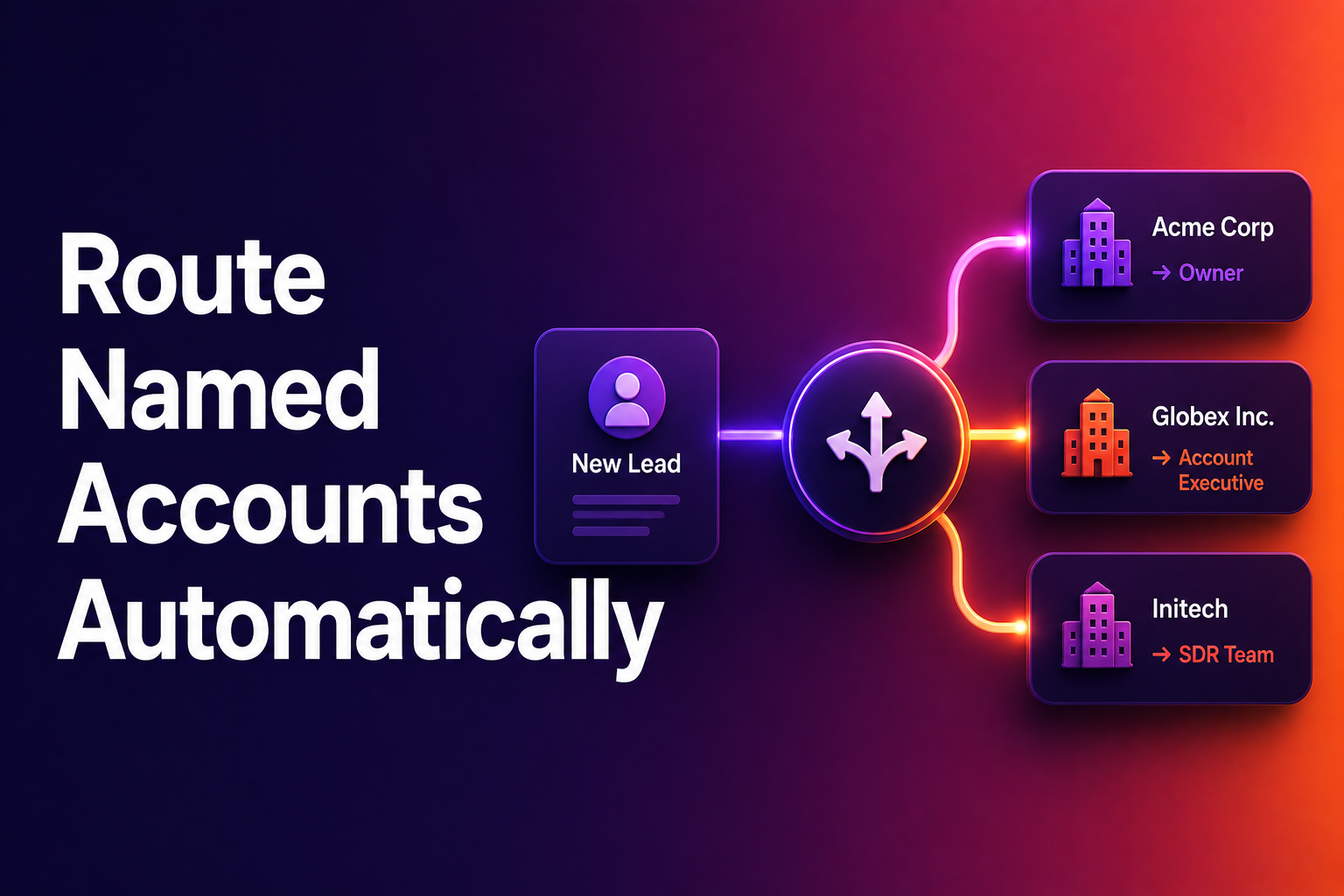
So how do enterprise teams actually route named accounts automatically? The mechanics involve three layers working together: CRM data, real-time enrichment, and routing logic that respects existing ownership. When these layers are connected, every form submission triggers an instant decision tree that matches the lead to the right rep without any human in the loop.
Leveraging CRM Ownership and Enrichment Data
The foundation of any named account routing system is your CRM. If an account already has an owner in Salesforce, the routing engine needs to respect that ownership. This sounds simple, but it requires a bidirectional sync between your scheduling tool and your CRM that checks ownership in real time, not on a cached list from last night's batch sync. Enrichment data fills in the gaps. When a lead submits a form, firmographic data like company size, industry, and revenue can be appended instantly, giving the routing engine enough context to make smart decisions even when the form itself is short. RevenueHero's routing engine, for example, uses form responses, enrichment data, and CRM ownership together to get every lead to the right rep instantly, handling edge cases like rep PTO, territory mismatches, and multi-product routing without manual intervention.
Instant Qualification vs. Manual Triage
The difference between top-performing teams and everyone else comes down to this: do you qualify and route in real time, or do you queue and triage manually? Instant qualification means the moment someone submits a form, the system checks their data against your criteria, enriches what's missing, and either routes them to a calendar or disqualifies them. There's no SDR reviewing the lead. No delay. The companies in the top 10% of inbound conversion made a deliberate choice to stop treating scheduling as an afterthought and start treating it as a conversion event.
Optimizing the Conversion Event for Enterprise Buyers
Routing is only half the equation. The other half is what happens at the moment of conversion. The language you use, the experience you present, and the speed at which you put a calendar in front of a qualified buyer all have measurable impact on whether that lead becomes a meeting.
Replacing 'Request' Language with Commitment Language
Among top-performing teams, 29% use "Book a Demo," 21% use "Get a Demo," and 12% use "Schedule a Demo." Only 12% use "Request a Demo." The pattern is clear: commitment language outperforms permission language. "Request" implies uncertainty. It tells the visitor they're entering a queue, not making a decision. "Book" tells them they're about to do something concrete. This is a five-minute fix. Search your site for every instance of "Request" and "Submit." Replace them with "Book," "Schedule," or "Reserve Your Spot." Watch what happens to your numbers.
Presenting the Calendar Immediately Upon Qualification
The moment a named account lead qualifies, they should see a calendar. Not a "thanks, we'll be in touch" message. Not a promise that someone will email them. A calendar, loaded with the available times of the rep who owns that account or territory. This is where the entire automated routing system pays off. If your routing is accurate and instant, the calendar that appears will belong to the right person. The lead picks a time, the meeting syncs back to the CRM, and the rep gets a fully enriched meeting on their schedule. No handoff. No lag. No lost intent.
Measuring Success: Benchmarking Inbound Conversion Performance
You can't improve what you don't measure. For enterprise teams routing named accounts, the primary metric is the qualified-to-booked rate: of the leads your system qualifies, how many actually book a meeting?
Tracking the Qualified-to-Booked Rate
The median qualified-to-booked rate across all segments sits at 62%. If you're below 58%, you're in the bottom quartile. At 76% or above, you're outperforming most of your peers. Enterprise segments tend to perform well here because the higher DQ rate filters out noise before it reaches the booking step. Track this metric monthly, segment it by source and account tier, and use it as your north star for inbound performance. If you're at 40% today and you get to 62%, that's 22 more meetings for every 100 qualified leads with zero additional spend on traffic.
Vertical Specificity and Its Impact on Conversion
One of the clearest patterns in 2025 and 2026 benchmark data is that vertical SaaS outperforms horizontal SaaS on conversion. Construction Tech leads at 69.1%, Ecommerce at 68.8%, and Travel Tech at 68.3%, while generic Sales Tech sits at 62.8%. The takeaway for enterprise teams is straightforward: if you're selling into specific verticals, build dedicated landing pages with industry-specific headlines, logos, testimonials, and form fields. "How many locations do you operate?" is a better qualifying question for a multi-site buyer than a generic "tell us about your needs" text box. Run traffic to a vertical-specific page for 30 days and compare against your generic page. The lift is real and repeatable.
What Separates the Top 10% from Everyone Else
The companies booking 78% or more of their qualified leads aren't doing anything exotic. They use commitment language on their CTAs. They cut form fields that don't serve routing or personalization. They're intentionally selective about who qualifies. And when someone does qualify, they put a calendar in front of them immediately. Not after an SDR reviews the lead. Not tomorrow. Right then.
None of this requires a bigger budget or better leads. You already have the traffic. You already have people from named accounts raising their hands. The only question is how many of them actually end up talking to your team. If your enterprise routing is still manual, if there's a queue between form submission and calendar, you're leaving pipeline on the table every single day. The fix isn't complicated. It's operational. And the teams that treat inbound scheduling as a real conversion event, not an administrative task, are the ones building pipeline that holds up through the quarter.
Let RevenueHero help your team turn high-intent users into booked meeting without slowing down your funnel.