


Welcome to the nineteenth edition of Breaking Inbound, your weekly deep-dive into inbound numbers and form-to-demo conversion rates across industries.
One of the most common disqualification (DQ) criteria is: “Gmail leads are junk.”
Someone from RevOps pulls up the DQ report and asks: “Why are we still accepting Gmail IDs on the demo form?” So they pull up the blocklist. Marketing seconds the notion, because sales has been complaining about junk leads for weeks.
It’s a five-minute change for cleaner data and better pipeline hygiene. Everyone walks out feeling productive.
But this isn’t the case for healthcare SaaS companies.

Two weeks after you block Gmail IDs, your pipeline is a ghost town. Demo requests from doctors, clinic managers, practice administrators: all gone.
And you end up disqualifying valid prospects instead of purging your pipeline of junk ☹️
So how do our customers convert 71%+, while allowing Gmail addresses in their demo forms? Read below ⬇️
How healthcare SaaS converts 71%+ without blocking Gmail 📧
Nearly half of U.S. physicians work in practices with 10 or fewer doctors. Many of these small practices don’t have corporate email domains. The buyer's personal inbox is often the only email they can use to request a demo.
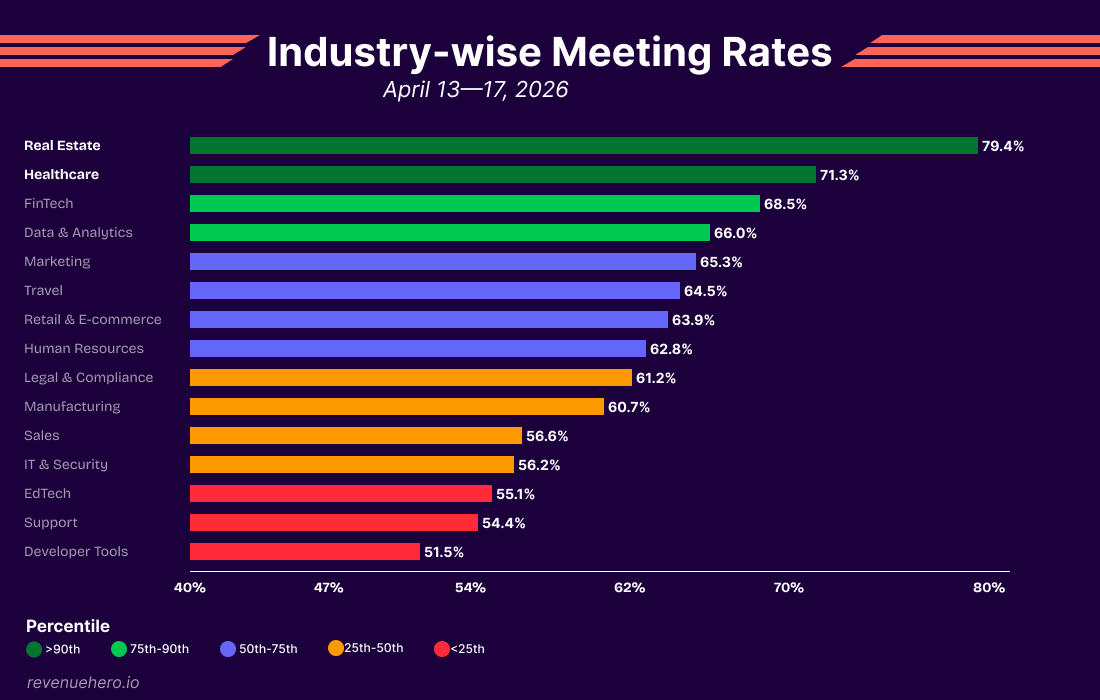
Across RevenueHero’s healthcare software companies, the average DQ rate last week was 26.6%, and the average form-to-demo conversion rate was 71.3%, the only other industry aside from real estate last week to go beyond 70% conversion rate.
The difference in their approach is qualifying on clinical criteria: number of providers, specialty, practice size, etc. These are the signals that separate a 20-provider orthopedic group from a med student who was just browsing.
Based on our research on high-converting demo pages, field quality matters more than field count. Especially in healthcare SaaS, a single dropdown does more qualifying work than blocking an entire email domain.
The companies that filter hardest convert best ✨
Our healthcare SaaS customers who run DQ rates above 30% averaged a 77.4% form-to-demo conversion rate last week, but the ones with below 30% averaged 66.5%, nearly an 11% difference. More aggressive the clinical filtering, higher the conversion rates.
One of our customers, a Series B mid-market healthcare SaaS company with 500+ weekly demo requests, DQs 55% of its traffic and still books meetings at 67%. Another customer of the same profile DQs 60% and converts 78.3% of the qualified inbounds.
The commonality is neither of them blocks Gmail. Both use clinical qualifiers, like:
- Buyer authority: Job role dropdown (practice owner, dentist, etc.), yes/no toggle answers
- Practice size/scale: Type of organization (Solo practice, multi-location, etc.), number of clinical providers
- Technical fit: Imaging software used, current software used
Accepting Gmail doesn’t mean accepting everything. These companies still block temporary, disposable, and invalid email addresses at the point of form using RevenueHero’s ZeroBounce integration. Every submission gets validated in real time, and if the email is fake, disposable or undeliverable, the lead never sees the booking scheduler.
What happens when you flip the vertical?
On a recent implementation call, an automotive software company reviewed their DQ rules with our team. When asked “Do you guys accept Gmail?”, they answered immediately: “We should just do work email. It’s better data hygiene, and frankly, we know they’re serious.”
They blocked all the free email providers on the spot. Similarly, an e-commerce fulfilment company made the same choice on a separate call: block personal email, keep only work domains. In their pipeline, a Gmail address signals a window-shopper. A company domain signals a buyer with purchase authority.
Both decisions were correct, for their verticals.
A Gmail block makes sense in industries like:
- Automotive: Every dealership has a domain
- E-commerce: Every D2C brand has a domain
- Enterprise IT: Procurement uses work email exclusively
It makes zero sense in industries like healthcare (doctors use personal email) or edtech (teachers use personal email), or SMB verticals where the buyer is the founder’s Gmail account.
Most companies run one set of DQ rules across everything: one email blocklist, one minimum company-size threshold, or one set of geographic filters. The rule that protects an enterprise IT company’s pipeline will shred a healthcare SaaS company’s pipeline.
And you won’t notice until someone pulls the report and asks why your meeting rates fell off a cliff.
The solution to take back to your team
Pull your DQ rate by lead source and buyer type. If qualified leads are getting blocked at the form, check what’s blocking them:
- Is it an email domain rule that doesn’t fit your buyer?
- Is it a company size threshold that filters out solo practitioners that are your actual ICP?
Converting at 71%+ in healthcare requires you to run smarter inbound funnels, with filters that make sense for your industry.
Onto the regular weekly numbers now ⬇️
Weekly Highlights ✨
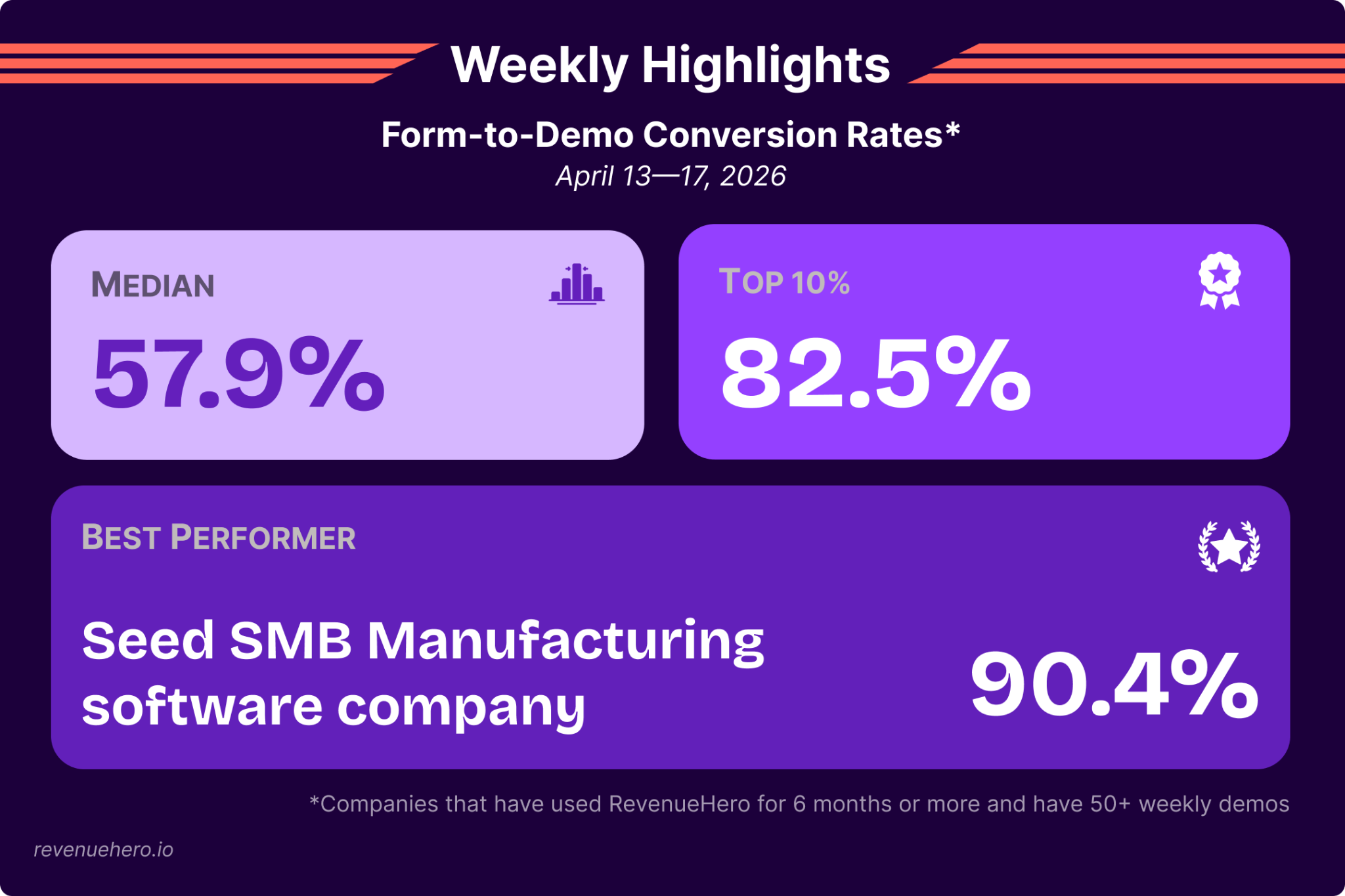
The best performer last week was a seed-funded SMB manufacturing software company. Here’s what we learnt from their demo page:
- The homepage offers a free trial with “Start Free Trial” as their primary CTA
- Homepage also has a “15,000+ businesses trust” claim, along with four customer logos
- For a customized plan, their pricing page offers a “Talk to Sales” CTA, which lands at their demo page
- Their demo form has 6 fields, 2 of which are used as qualifying questions
- They also display four G2 badges on their demo page.
Inbound Snapshot
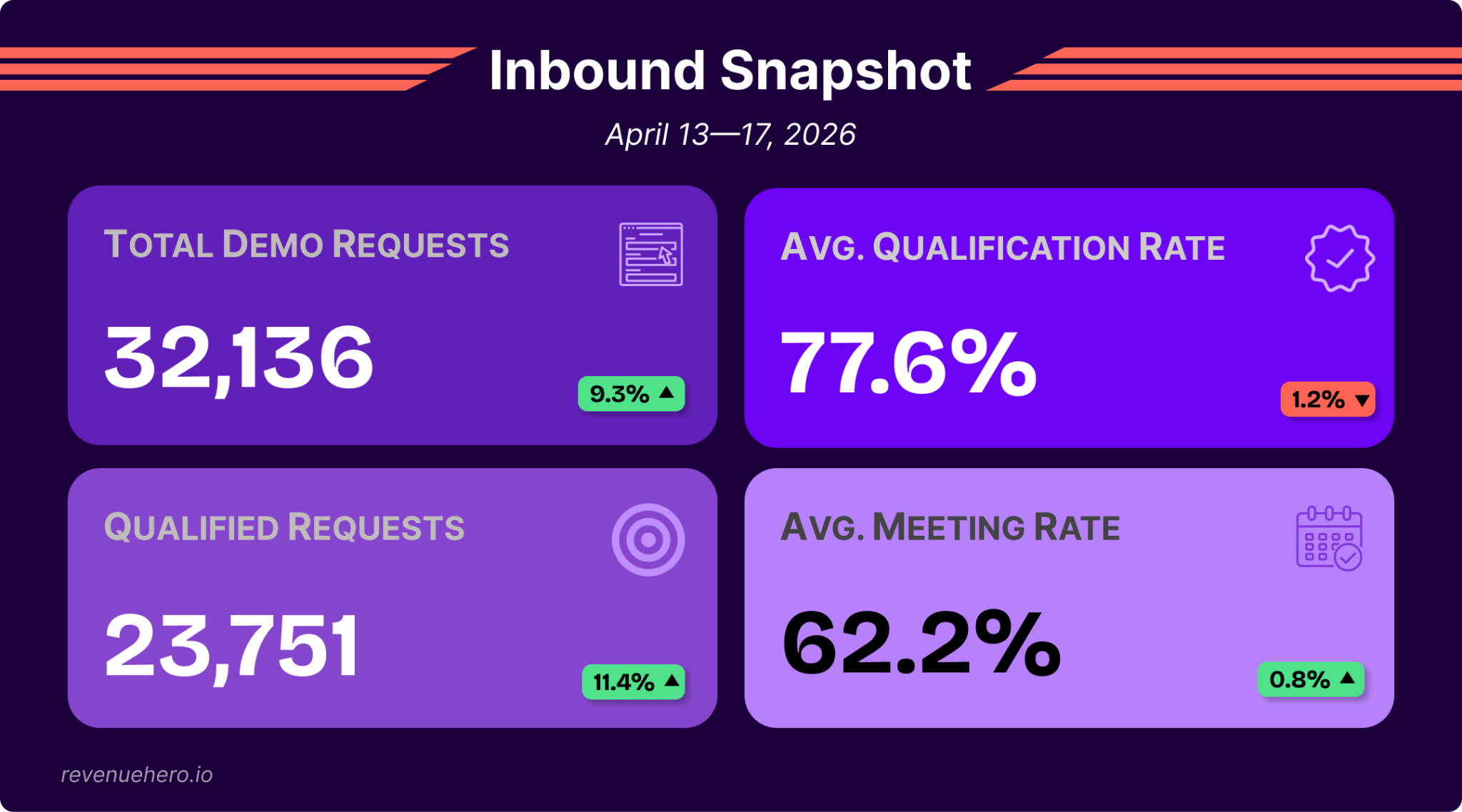
The funnel expanded in both directions this week: more people showed up, and more of them booked meetings. Demo requests jumped 9.3% to 32,136, while qualified requests soared 11.4% to 23,751.
Qualification rates saw a 1.2% downtick as volume climbed, while the average form-to-demo conversion rates saw a 0.8% increment, rising from 61.4% to 62.2%.
Segment Snapshot
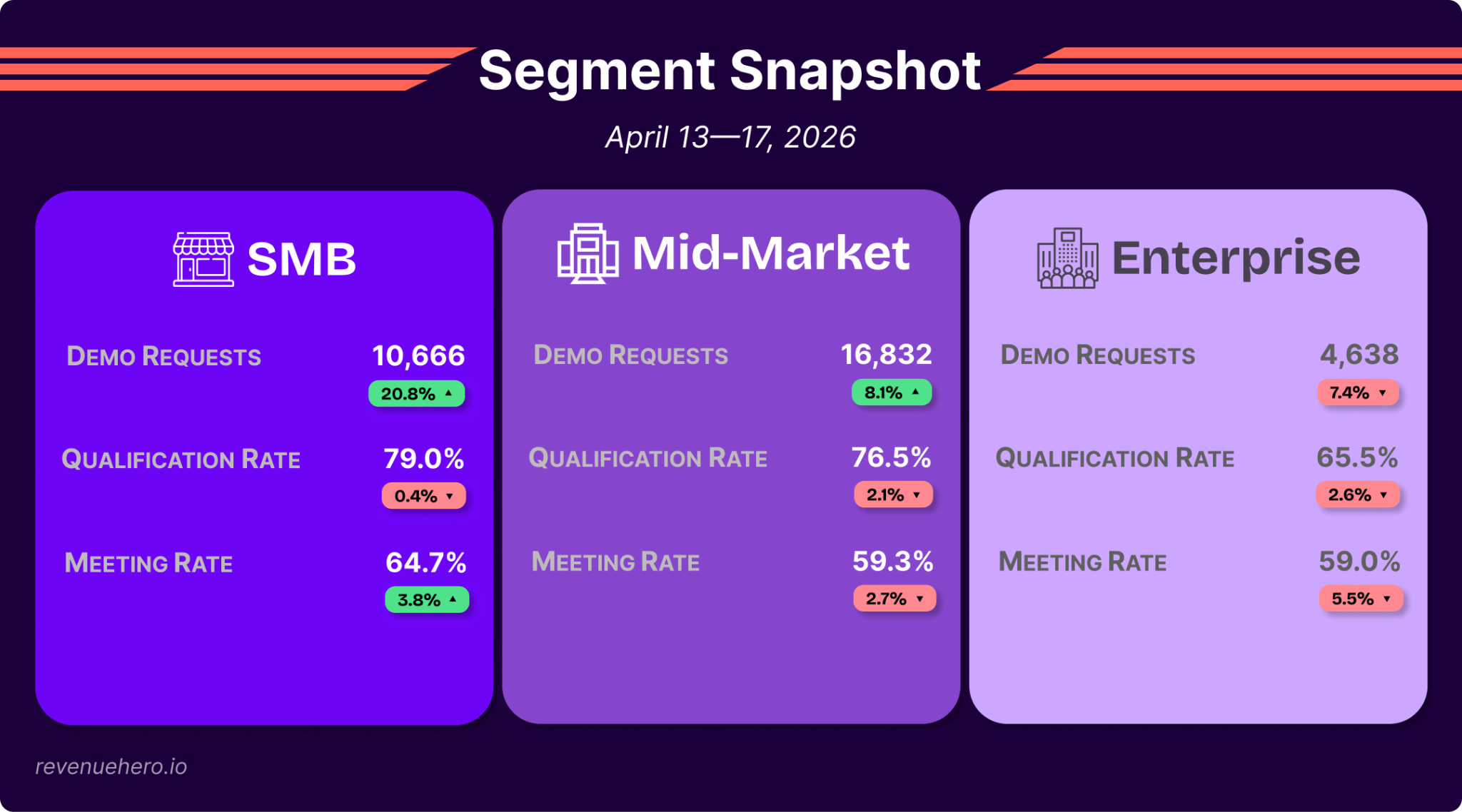
SMB was the breakout segment last week: with 20.8% more demo requests flowing in. Their meeting conversion rates rose 3.8% last week, with qualification rates remaining steady at 79%.
Mid market added volume as well: demo request volumes jumped 8.1%. But the extra traffic didn’t convert. While qualification rates slipped 2.1%, meeting conversion rates slipped 2.7%. If you’re a mid market company that hasn’t revisited your demo page since March, time to do an audit.
Enterprise lost all of the previous week’s gains. Demo requests dropped 7.4%, while qualification rates slipped 2.6% and form-to-demo conversion rates dropped 5.5%.
Funding Stage Analysis
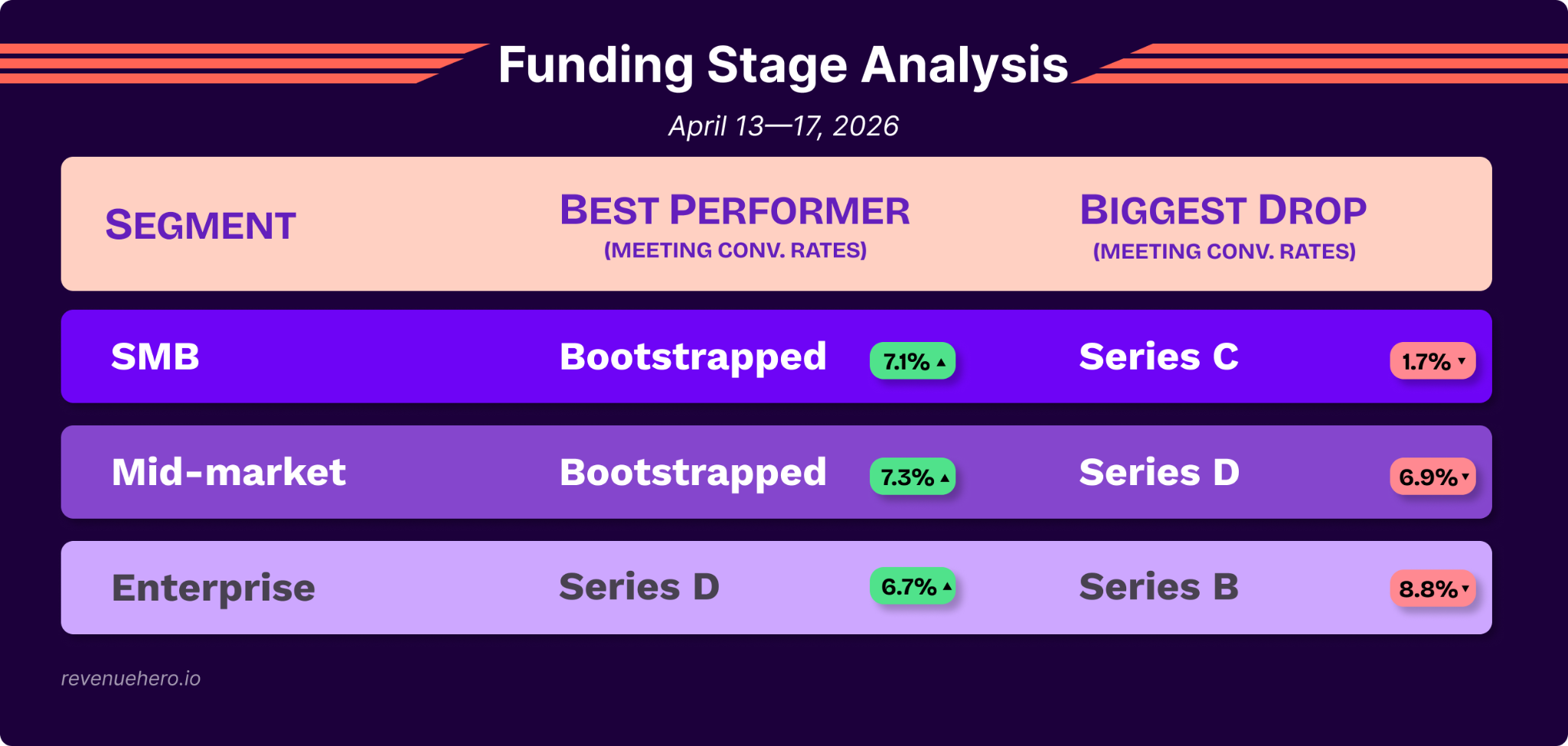
Bootstrapped companies bounced hard: SMB bootstrapped companies saw a 7% jump in form-to-demo conversion rates, while their mid-market counterparts saw a 7.3% leap. Both became the biggest single-week gainers in their cohorts last week. Enterprise Series D saw a 6.7% spike in meeting conversion rates.
On the other end, mid-market Series D dropped 6.9%, the lowest reading in the mid-market cohort. Enterprise Series B plunged 8.8%, reversing last week’s massive spike.
Industry-wise Meeting Rates
Real estate soared 11.9% to 79.4%, the highest single-industry weekly reading in Breaking Inbound history. No other industry has ever crossed 79%.
Legal & compliance jumped 8.5%, bouncing back from the previous week’s below 25th percentile reading. Data & analytics saw a 6.1% surge, taking the fourth spot in last week’s leaderboard.
Support saw the biggest drop of 5.8%, falling below the 25th percentile last week. Human resources dipped 4.2%, while manufacturing saw a 4.1% slide in form-to-demo conversion rates.
All industries converted 50%+ of their qualified inbounds into booked meetings, with 53% of industries witnessing steady or better form-to-demo conversion rates.
The Leaderboard
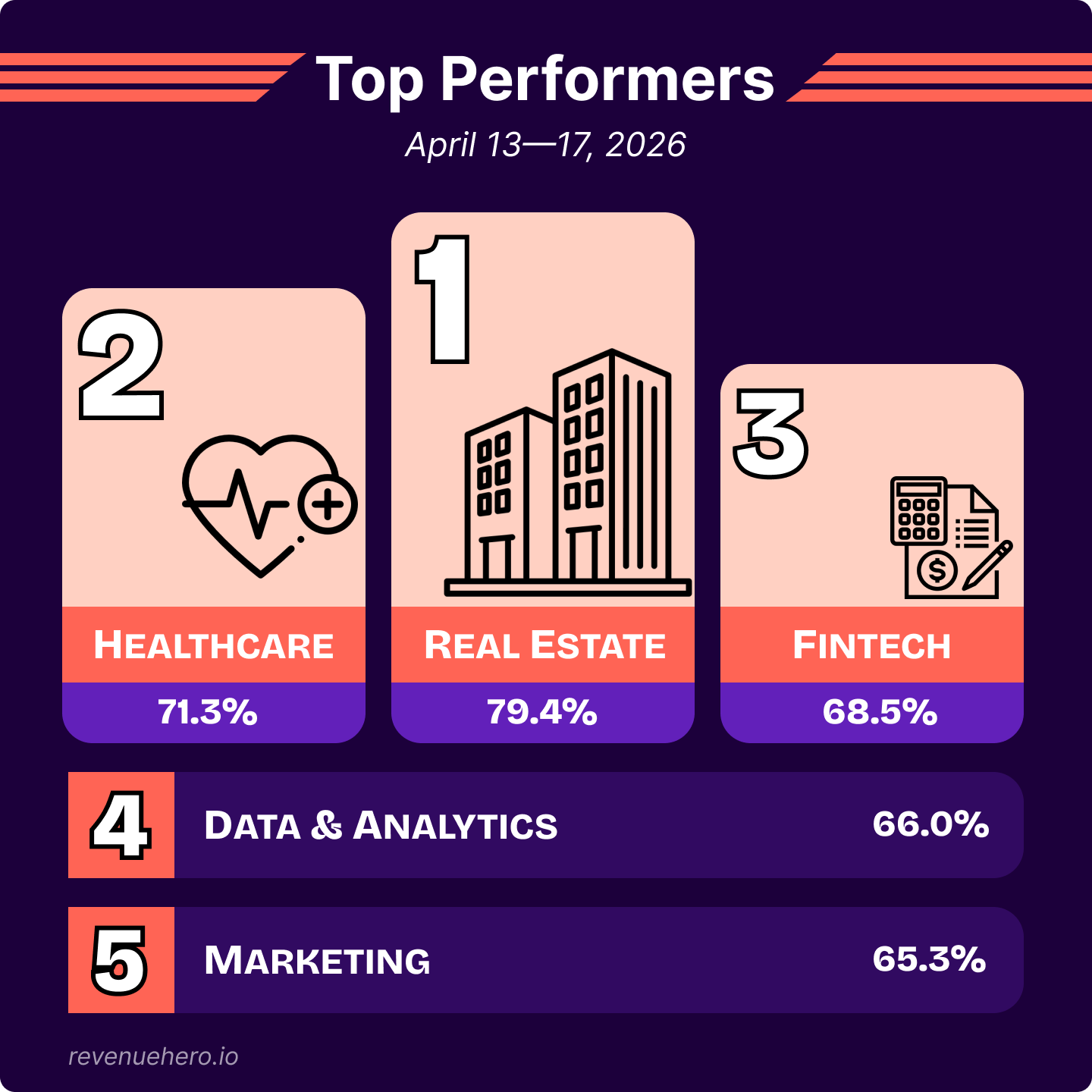
Real estate widened the gap between the #1 and #2 spots by 8.1%, taking the crown last week. Healthcare came in second with 71.3%, while Fintech managed to grab the third place with 68.5%, completing the podium.
Key Observations
- The funnel surged on both sides: Demo requests jumped +9.3% to 32,136 and qualified requests soared +11.4% to 23,751, the highest readings in five weeks. Meeting conversion rates remained steady at 62.2% (+0.8%).
- SMB was the breakout: Volume soared +20.8% to 10,666 and MR rose +3.8% to 64.7%, the only segment where both metrics climbed together. SMB's strongest conversion reading in eight weeks.
- Mid-Market added volume (+8.1%): Though it received more demo requests, form-to-demo conversion rates slipped -2.7% to 59.3%. Mid-Market Series A dropped -5.9% and Series D dropped -6.9%, the two steepest funding-stage declines in the segment.
- Enterprise reversed: Demo requests dropped -7.4% to 4,638 and MR dropped -5.5% to 59.0%, giving back last week's entire +5.5% gain.
- Real estate soared +11.9% to 79.4%, the highest single-industry reading in 19 weeks. The 8.1-point gap to #2 Healthcare is the widest #1-to-#2 spread in the dataset.
- Support dropped -5.8% to 54.4%, Human Resources dipped -4.2% to 62.8%. On the rebound side, Legal & Compliance jumped +8.5% to 62.1% and Data & Analytics jumped +6.1% to 66.0%.
- Bootstrapped companies bounced: SMB Bootstrapped jumped +7.0% and Mid-Market Bootstrapped jumped +7.3%. A Seed SMB Manufacturing company hit 90.4% MR on 73 demo requests, and the 90th percentile ticked up to 82.7%.
We'll be back next week with a fresh batch ✨
Until then, keep those meetings flowing 📈


