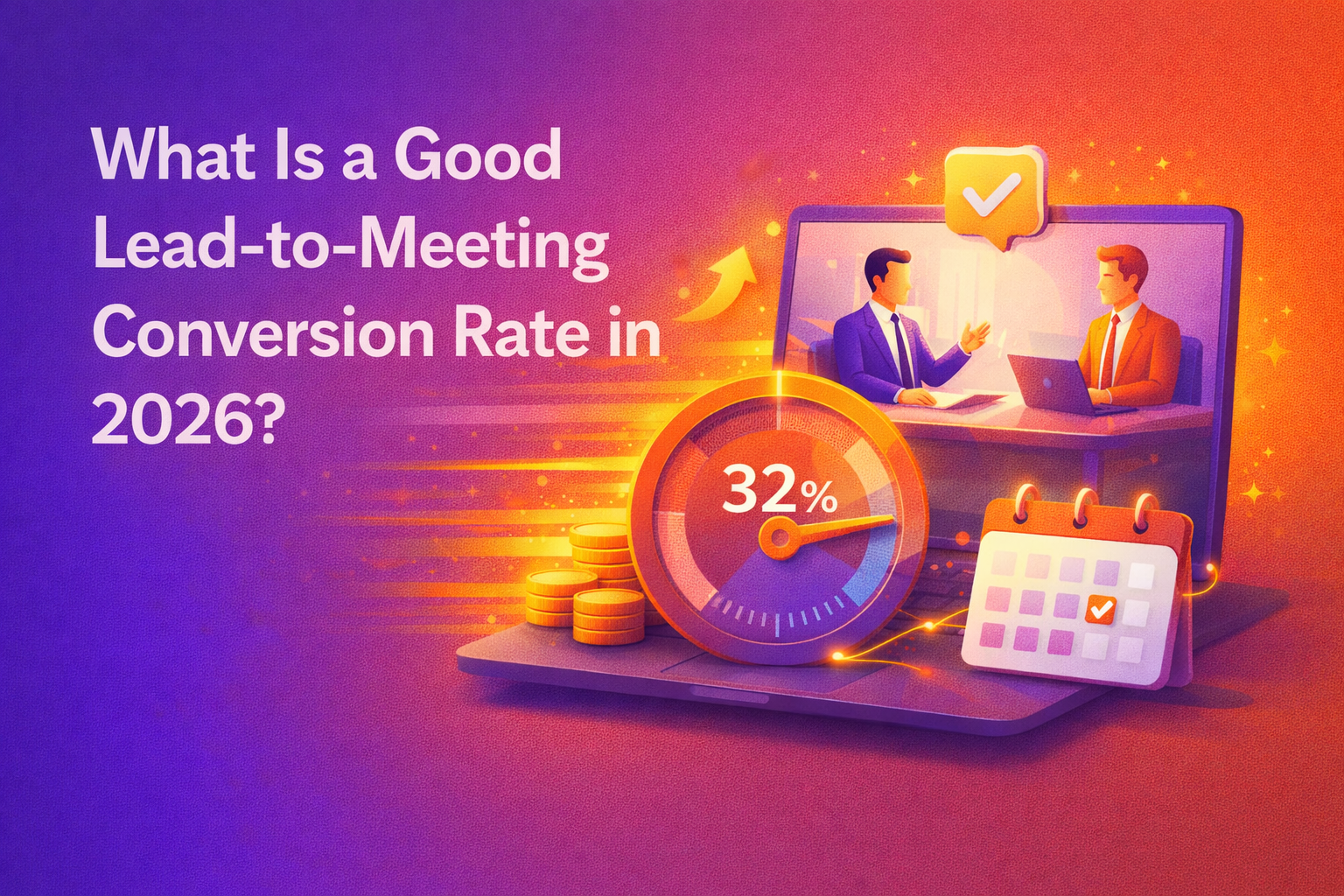
A 35% lead-to-meeting conversion rate used to be considered acceptable. Sales teams would celebrate hitting that number, assuming it represented the ceiling of what's possible when converting qualified inbound leads into actual booked meetings. That assumption is now outdated.
Data from over one million B2B SaaS form submissions tells a different story. The median qualified-to-booked meeting rate sits at 62%, with top performers consistently hitting 78% or higher. The best in class reach 88%. If your team operates in the 30-40% range and considers that normal, you're leaving significant pipeline on the table. The gap between average and excellent isn't about lead quality or product-market fit. It's determined by what happens in the 30 seconds after someone clicks your demo request button.
Understanding what constitutes a good lead-to-meeting conversion rate in 2026 requires looking at actual performance data, not outdated assumptions. Your conversion ceiling is likely much higher than you think.
Defining the Lead-to-Meeting Standard in 2026
The old benchmark of 35% qualified-to-booked came from a world of manual review queues, back-and-forth email scheduling, and 48-hour response times. That world no longer exists for high-performing teams. Companies that treat inbound scheduling as their conversion event, rather than just the form fill, are proving that 60%, 70%, and even 80%+ rates are achievable.
What separates the median from the top isn't complicated. It's operational. Top performers put a calendar in front of qualified leads immediately. Not tomorrow. Not after an SDR reviews the submission. Right then. The gap between 40% and 78% on identical traffic, spend, and lead quality comes down to eliminating the delay between intent expression and meeting confirmation.
Current Industry Benchmarks by Sector
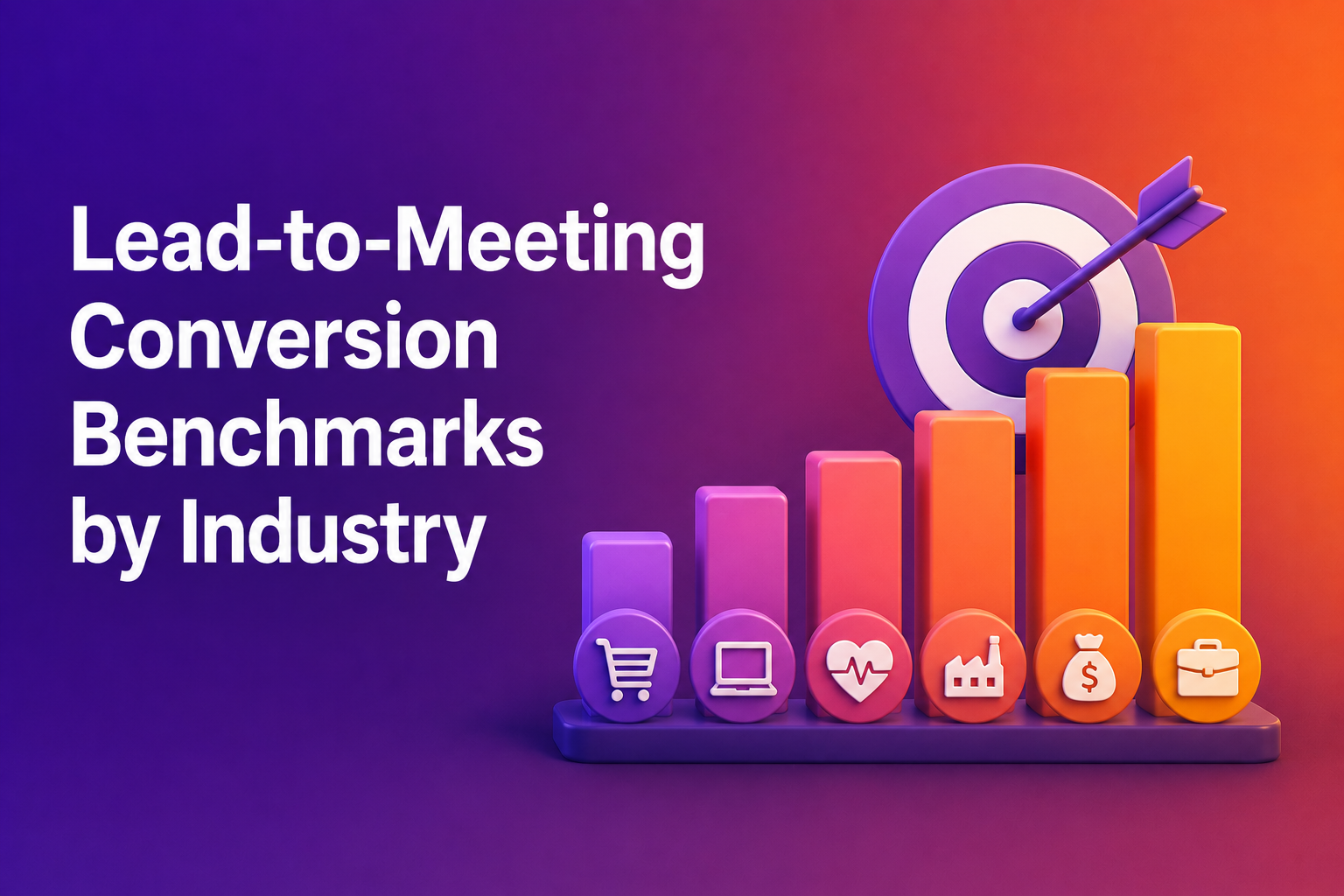
Performance varies meaningfully across categories. Construction Tech leads at 70% median conversion, followed by Real Estate Tech at 66% and IT Services at 66%. EdTech converts at 65%, while Supply Chain and Logistics hit 64%. Sales Tech, HR Tech, and MarTech all cluster around 62-63%.
The pattern reveals something important: vertical SaaS consistently outperforms horizontal SaaS. When you sell to contractors, qualification is straightforward. When you sell to "any company that does marketing," qualification becomes fuzzy. Visitors aren't sure if they're the right fit. Reps struggle to personalize demos. Everything downstream suffers.
Inbound vs. Outbound Conversion Expectations
Inbound leads carry fundamentally different intent signals than outbound prospects. Someone who fills out your demo form has already researched alternatives, identified a problem, and decided your solution might address it. This self-qualification means inbound conversion rates should significantly exceed outbound.
For outbound, a 5-15% meeting rate from qualified prospects represents strong performance. For inbound, anything below 50% suggests friction in your booking process. The difference reflects buyer psychology: inbound leads have momentum you need to capture, while outbound requires creating momentum from scratch.
Technological Drivers Influencing Today's Rates
The 25-point gap between legacy benchmarks and current top performers didn't happen by accident. Specific technological shifts made higher conversion rates possible for teams willing to adopt them.
The Role of AI-Driven Personalization
Real-time enrichment changes what's possible at the moment of form submission. Instead of asking prospects for company size, industry, and tech stack, modern systems pull this data automatically. This reduces form friction while simultaneously improving qualification accuracy.
Enriched data enables instant routing decisions. A prospect from a target account gets routed to their assigned AE. Someone from a non-ICP company gets filtered appropriately. This happens in seconds, not hours, which means qualified leads see calendars while their intent remains high.
Automated Scheduling and Frictionless Booking
The traditional flow involved a form submission, a queue, manual review, an email response, and then maybe a meeting. Each step introduced delay and drop-off. Modern scheduling collapses this into a single interaction: qualify, route, and book in one motion.
RevenueHero customers demonstrate this principle in action. Every CTA, form, or campaign link becomes a 24/7 meeting setter. Leads are qualified using form responses, enrichment data, and CRM history with no manual review queue. The moment someone submits, they know if they qualify and can book immediately.
Factors That Impact Your Meeting Success Rate
Beyond technology, several controllable factors determine whether you convert at 50% or 75%.
Lead Source Quality and Intent Signals
Not all inbound leads carry equal intent. A visitor who read three blog posts, viewed your pricing page, and then requested a demo demonstrates stronger buying signals than someone who clicked a social ad and submitted a form impulsively.
Enterprise-focused companies convert at 70.1% with a 71.2% disqualification rate. They're pickier about who gets through, which means the leads that do qualify are genuinely ready to buy. SMB-focused companies convert at 63.2% with only a 21.8% DQ rate. If your DQ rate sits under 20% and your meeting rate struggles, you might be letting through leads that waste rep time.
Speed to Lead and Response Time Optimization
Intent decays rapidly. A lead who fills out your form at 10 AM and receives a response at 2 PM has already moved on mentally, even if they eventually book a meeting. The data consistently shows that instant response, meaning calendar access within seconds of form submission, dramatically outperforms even 5-minute delays.
This isn't about working faster. It's about removing human latency from the booking process entirely. When qualification and scheduling happen programmatically, speed becomes a non-issue. The meeting gets booked before the prospect closes their browser tab.
Strategies to Improve Conversion Performance
Moving from 40% to 62% doesn't require better leads or bigger budgets. It requires operational changes to your booking process.
Omnichannel Follow-Up Cadences
For leads who don't book immediately, multi-channel follow-up increases recovery rates. Email alone converts a fraction of what email plus SMS plus LinkedIn touches achieve. The key is speed and relevance: your first follow-up should happen within minutes, not hours.
Personalization matters here. A generic "Thanks for your interest" email performs worse than one referencing the specific page they visited or the use case they selected. Use the data you collected during form submission to make follow-up feel like a continuation of their research, not a cold pitch.
Leveraging Social Proof in Initial Outreach
Top performers feature specific, quantified testimonials near their booking forms. "We saw a 57% increase in bookings within 90 days" gives prospects a concrete expectation. It also implies you have customers willing to share real numbers, which builds credibility.
Generic testimonials without metrics perform poorly by comparison. One testimonial with a specific number outweighs ten vague endorsements. Call your best customers this week. Ask for one sentence with a metric. Put the best response on your demo page, above the fold, near the form.
Measuring Beyond the Initial Meeting
A booked meeting isn't the finish line. It's a checkpoint.
The Meeting-to-Qualified-Opportunity Ratio
If 70% of your meetings don't convert to qualified opportunities, your qualification criteria need adjustment. You're booking meetings with the wrong people, which wastes rep time and distorts your funnel metrics.
Track the full journey: form fill to qualified lead to booked meeting to qualified opportunity to closed deal. Each transition point reveals friction. A high meeting rate with low opportunity conversion suggests your qualification is too loose. A low meeting rate with high opportunity conversion suggests you're filtering out good prospects unnecessarily.
Future-Proofing Your Sales Funnel for 2027 and Beyond
The teams converting at 78%+ today made a specific choice: they stopped treating inbound scheduling as an afterthought and started treating it as a conversion event. That mindset shift matters more than any individual tactic.
Review your qualification criteria quarterly. What worked six months ago may filter out good prospects today as your ICP evolves. Test vertical positioning on landing pages. A "Marketing software for e-commerce" page will convert better than a generic "Marketing software" page, even if the product is identical. The specificity signals fit, which builds confidence.
Consider your form fields carefully. Top performers convert at 77% with 2 fields and at 76% with 13 fields. The number doesn't matter. What matters is whether each field serves qualification or personalization. If a field doesn't help you route the lead or customize the demo, cut it.
The gap between 40% and 78% represents real pipeline. On 100 qualified leads, that's 38 additional meetings. With a 25% close rate and $30K average deal size, that's nearly $300K in incremental revenue from the same traffic you already have.
You don't need more leads. You need to convert the ones raising their hands right now.
Let RevenueHero help your team turn high-intent users into booked meeting without slowing down your funnel.