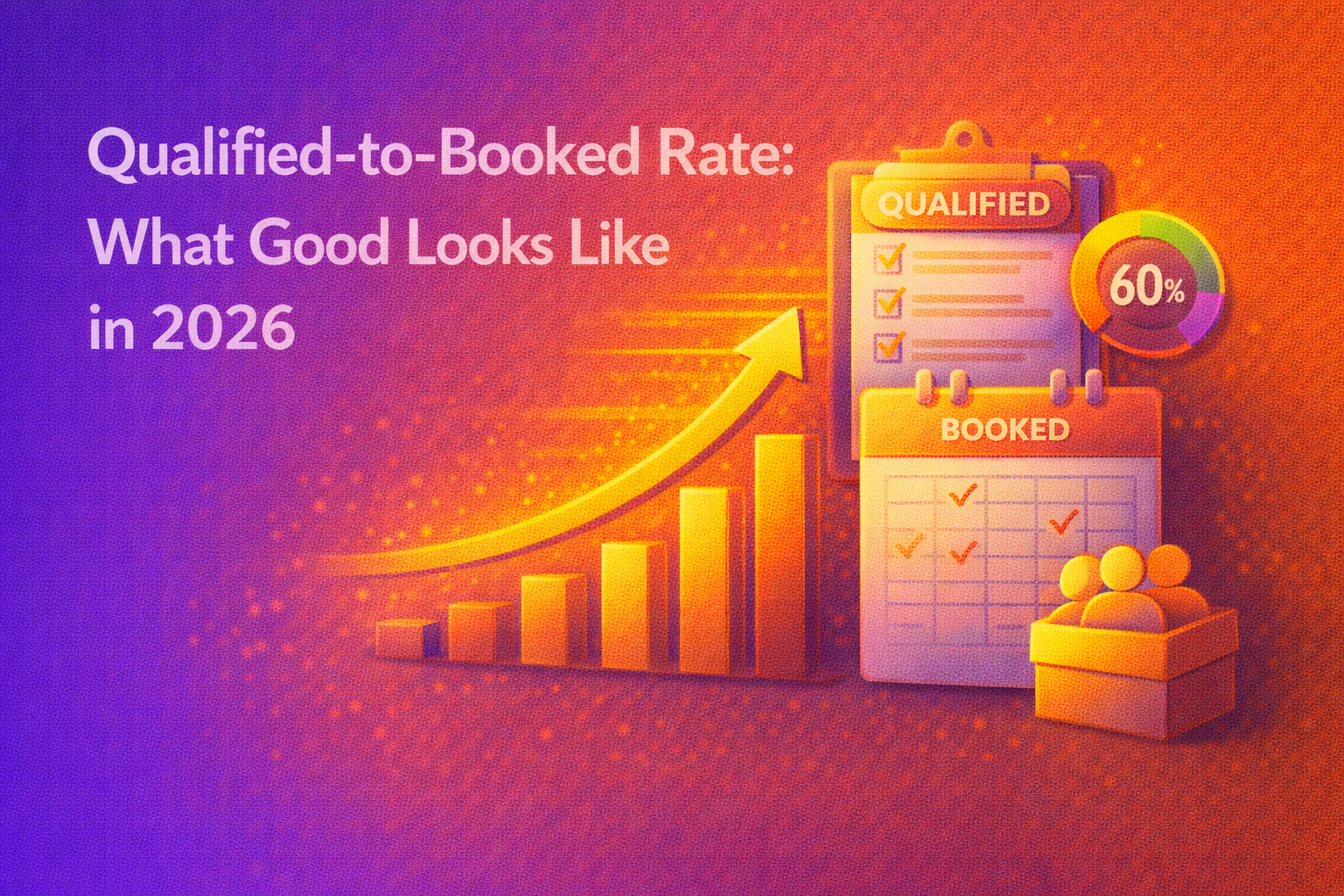
Your marketing team drives qualified leads to your site. Your sales team waits for meetings. Between those two moments sits a metric that determines whether your pipeline grows or stagnates: the qualified-to-booked rate. In 2026, this conversion point has become the clearest indicator of go-to-market efficiency, separating teams that capture demand from those who watch it evaporate.
The old assumption that 30-40% conversion from qualified lead to booked meeting was acceptable no longer holds. Data from over one million B2B SaaS form submissions reveals that the top 10% of companies book 78% or more of their qualified leads into meetings. The median sits at 62%. If your team hovers around 40%, you're not performing at industry standard. You're leaving significant pipeline on the table.
The gap between 40% and 78% isn't determined by lead quality, ad spend, or product strength. It's determined by what happens in the 30 seconds after someone submits a form. Do they see a calendar, or do they see a "thanks, we'll be in touch" message? That single design decision shapes your entire conversion trajectory.
Defining the Qualified-to-Booked Metric in 2026
The qualified-to-booked rate measures the percentage of leads who meet your qualification criteria and successfully schedule a meeting with your sales team. It sounds straightforward, but the definition of "qualified" has shifted dramatically.
The Evolution of 'Qualified' in an AI-Driven Landscape
Qualification in 2026 happens in real time, not in a manual review queue. The moment someone submits a form, enrichment data pulls company size, funding stage, tech stack, and intent signals. Form responses combine with CRM history to determine fit instantly. This shift means qualification decisions that once took hours now happen in milliseconds.
The implication for your qualified-to-booked rate is significant. When qualification happens faster, the leads entering your "qualified" bucket are fresher. Their intent hasn't decayed. They're still sitting at their computer, ready to book. Teams using real-time qualification see higher conversion rates not because their leads are better, but because they're capturing intent at its peak.
Why Qualified-to-Booked is the Ultimate Revenue Predictor
Pipeline metrics upstream, like MQLs or form fills, measure activity. Downstream metrics like closed-won revenue lag by months. The qualified-to-booked rate sits at the critical inflection point where marketing investment converts to sales opportunity.
A 22-point improvement in this metric, moving from 40% to 62%, means 22 additional meetings per 100 qualified leads. Same traffic, same spend, same team. The math compounds quickly. If your average deal size is $50,000 and your close rate is 25%, those 22 extra meetings represent $275,000 in potential pipeline from the same lead volume.
Current Industry Benchmarks and Performance Tiers
Understanding where you stand requires context. A 60% rate might be excellent in one category and mediocre in another.
SaaS and B2B Enterprise Averages
Across the full dataset of B2B SaaS companies, the median qualified-to-booked rate is 62%. The bottom 25% convert at 58% or below. The top 25% hit 76% or higher. These numbers come from companies using instant scheduling, so the baseline is already elevated compared to teams relying on email-based booking.
Category-specific benchmarks reveal significant variation. Construction Tech leads at 70% median, followed by Real Estate Tech at 66%. IT Services and EdTech both sit at 66%. Dev Tools and Data Analytics trail at 55%. Vertical SaaS consistently outperforms horizontal SaaS because buyers in specific industries encounter more relevant messaging and faster qualification logic.
The 'Gold Standard' for High-Growth Scale-ups
The top 10% of performers book 78% or more of qualified leads. The absolute best hit 88%. These aren't outliers with unusually high-intent traffic. They're companies that eliminated friction between qualification and scheduling.
Enterprise-focused teams actually show higher conversion rates than SMB-focused teams: 70.1% versus 63.2%. The assumption that enterprise sales requires more manual touchpoints doesn't hold when qualification criteria are tight and routing is accurate. When you're selective about who qualifies, those who do qualify are ready to book.
Technological Drivers Influencing Conversion Rates
The gap between median and top performers isn't explained by luck or market conditions. It's explained by infrastructure decisions.
Autonomous Scheduling and Frictionless Handoffs
The companies in the top 10% made a specific choice: they stopped treating inbound scheduling as an afterthought and started treating it as a conversion event. When a qualified lead submits a form, they see a calendar immediately. Not a thank-you page with a promise of follow-up. A calendar.
This requires routing logic that works in real time. The system must know which rep owns the account, which territory applies, and which calendar to surface, all within the page load. RevenueHero customers achieve this by connecting qualification, routing, and scheduling into a single step, eliminating the handoff points where leads traditionally drop.
Real-Time Intent Scoring and Lead Prioritization
Speed matters, but speed without accuracy wastes sales capacity. Real-time intent scoring combines form responses with enrichment data to determine not just whether someone qualifies, but how urgently they should be engaged.
High-intent signals include visiting pricing pages, viewing case studies in their industry, or returning multiple times within a short window. When these signals combine with strong firmographic fit, the lead should see calendar availability immediately. Lower-intent but qualified leads might receive a slightly different experience, perhaps a short video before the calendar appears, to warm them up before booking.
Strategies to Optimize the Booking Funnel
Moving from the bottom quartile to the median, or from the median to the top 10%, requires specific changes to your funnel design.
Personalization at Scale: Beyond the Standard Calendar Link
Top performers use "Book a Demo" language, not "Request a Demo." The data shows 29% of high performers use "Book," while only 12% use "Request." Commitment language outperforms permission language because it sets an expectation of immediate action.
Beyond button copy, personalization extends to the scheduling experience itself. When a lead from a specific industry books, they should see a rep who knows that industry. When an existing customer's colleague fills out a form, they should route to the account owner, not a random SDR. These routing decisions happen automatically when CRM relationships are respected and custom logic is configured properly.
Reducing Speed-to-Lead with Automated Qualification
The traditional funnel has delay baked in. A lead fills out a form. The form goes to a queue. Someone manually reviews it. Maybe they route it. Maybe they email the lead back. Maybe the lead responds. Days pass. Intent decays.
Automated qualification eliminates this sequence. Leads are qualified using form responses, enrichment data, and CRM history the moment they submit. No manual review queue. No delays. The companies hitting 78% conversion rates aren't working harder. They're eliminating the steps that cause leads to disappear.
Common Pitfalls and Why Rates Stagnate
Teams often plateau at 50-55% and assume they've hit their ceiling. Three patterns explain most stagnation.
First, disqualification rates are either too high or too low. If your DQ rate is under 20% and your meeting rate is struggling, you might be letting through leads that waste rep time. If your DQ rate exceeds 35%, you might be filtering out viable prospects with overly aggressive criteria. Review your qualification logic quarterly.
Second, form fields create friction without providing value. Top performers convert at 77% with 2 fields and at 76% with 13 fields. The number doesn't matter. What matters is whether each field contributes to routing, personalization, or qualification. If a field doesn't do something useful, remove it.
Third, seasonality catches teams off guard. August and September drag conversion rates down to 53-54%. Q2 consistently outperforms other quarters, with April through June all exceeding 60%. Plan your biggest inbound campaigns accordingly, and don't panic when late-summer numbers dip.
Future-Proofing Your Pipeline for 2027 and Beyond
The companies that win aren't doing anything complicated. They use commitment language. They cut form fields that don't help routing or personalization. They're selective about who qualifies. And when someone does qualify, they put a calendar in front of them immediately.
The benchmark for "good" will continue rising. As more teams adopt instant scheduling and real-time qualification, the median will climb. What's top-quartile performance today becomes table stakes tomorrow. The teams that invest now in eliminating friction between form fill and meeting will maintain their advantage.
Your qualified-to-booked rate tells you exactly how much pipeline you're capturing versus losing. If you're at 40% today and you reach 62%, that's 22 more meetings for every 100 qualified leads. Reach 78%, and it's 38 more meetings. Same traffic, same spend, same leads. The only difference is what happens in the 30 seconds after someone raises their hand.
Let RevenueHero help your team turn high-intent users into booked meeting without slowing down your funnel.